News Broadcasting
Zee 24 Taas makes noise with Ganpati coverage that wins viewer devotion

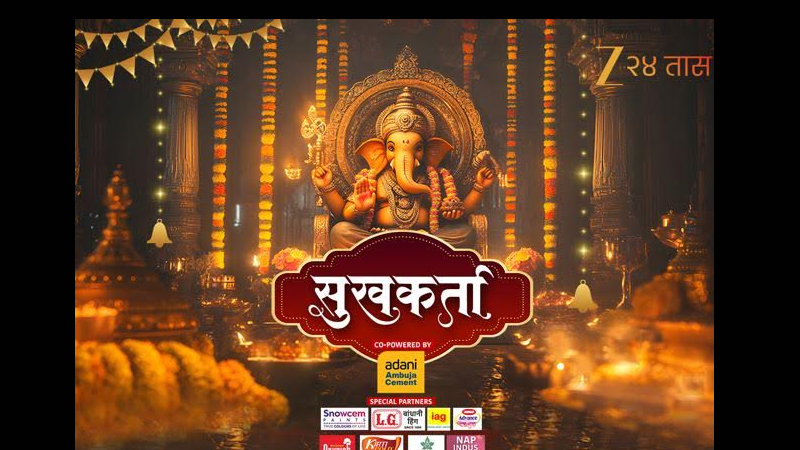
MUMBAI: When Maharashtra welcomed its favourite elephant-headed god this year, Zee 24 Taas ensured no modak went unshared and no mandap went unseen. The channel rolled out wall-to-wall coverage of Ganesh Utsav 2025, blending ritual, revelry and reportage into a festival broadcast that stretched from the narrowest lanes of Pune to the furthest corners of the world.
The scale was nothing short of spectacular. With live, on-ground reporting from major mandals across urban centres and rural outposts, Zee 24 Taas captured the devotion, colour and cultural vibrancy of the state’s most celebrated festival. Viewers not only saw the grandeur of Mumbai’s Lalbaugcha Raja and Pune’s Dagdusheth Halwai mandal but also felt the pulse of smaller towns, where local communities brought their own flair to the festivities.
And it wasn’t just Maharashtra tuning in. Through robust digital-first initiatives, including live streaming, interactive updates, mobile feeds and social media engagement, the coverage reached audiences across six continents, making it a truly global Ganesh Utsav. Diaspora viewers joined in real time, watching rituals, immersions and mandal visits unfold alongside political developments and community stories.

Zee 24 Taas also went beyond just visuals, curating special programming that delved into the history, traditions and evolving practices of Ganesh Chaturthi. From exploring how eco-friendly celebrations are reshaping idol-making to telling stories from rural Maharashtra, the shows added depth, giving the festival both cultural context and contemporary relevance. Citizen voices, community stories and ground-level experiences further enriched the mix, ensuring the coverage felt participatory rather than just observational.
Brands, too, took note. Leading advertisers partnered with the channel to tap into millions of festive viewers, leveraging Zee 24 Taas’ reputation as Maharashtra’s most trusted news destination. Even amid major political events dominating headlines, the channel balanced hard news with devotional fervour keeping audiences informed without diluting the festival spirit.
The channel’s leadership called it a defining moment. managing editor Kamlesh Sutar described Ganesh Utsav as “a reflection of Maharashtra’s culture, traditions and collective spirit” and praised the team for capturing both the energy of the celebrations and the news pulse of the state. Meanwhile ZMCL CEO Karan Abhishek Singh pointed out how the coverage underscored the network’s commitment to immersive, accurate and engaging journalism extending from television to mobile screens.
By uniting festival storytelling with timely reportage and global digital integration, Zee 24 Taas has set a new benchmark for what festival journalism can look like. This year’s Ganpati wasn’t just covered, it was celebrated, streamed and shared across the globe. And in the process, Zee 24 Taas showed why, in Maharashtra, it remains the channel where devotion meets credible journalism.




News Broadcasting
UDF poised to return to power in Kerala, says Manorama-CVoter survey
Massive opinion poll projects shift in Kerala politics ahead of 2026 Assembly elections.
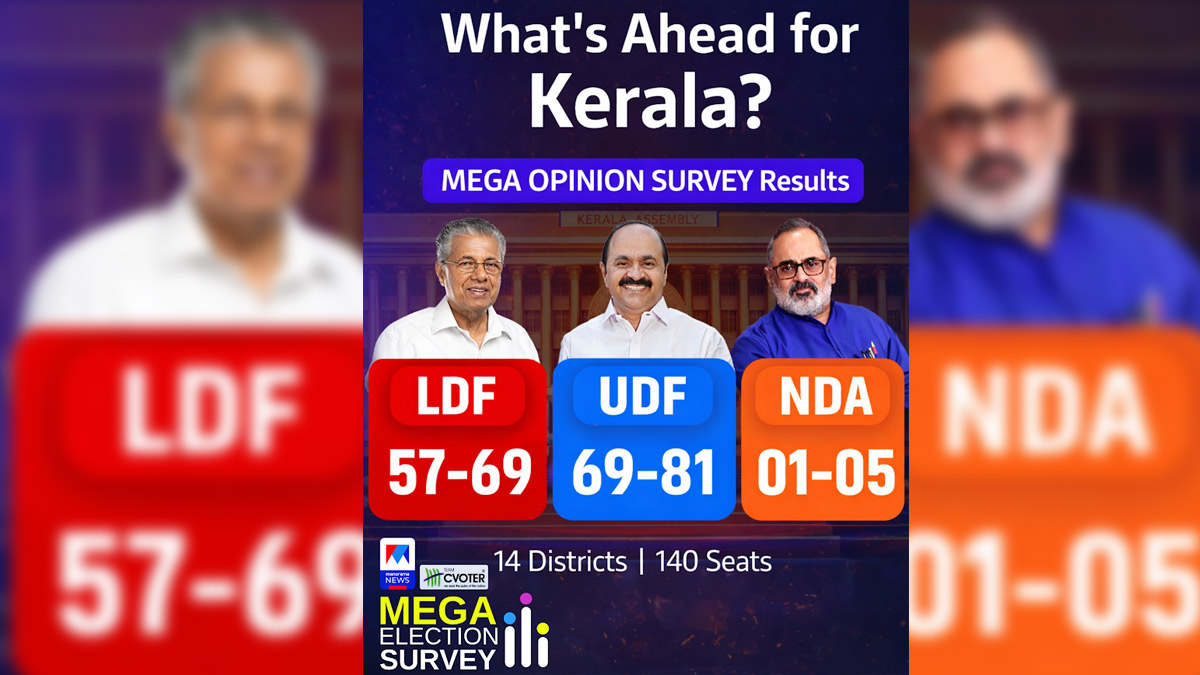
MUMBAI: The winds of change appear to be blowing through Kerala’s political landscape and this time, they seem to favour the United Democratic Front. A comprehensive mega opinion survey conducted by Manorama News in partnership with CVoter projects a potential comeback for the UDF in the upcoming Kerala Legislative Assembly Elections 2026. The survey, covering all 140 constituencies with a massive sample size of nearly 90,000 respondents, predicts the UDF could win between 69 and 81 seats.
The ruling Left Democratic Front (LDF) is expected to secure 57 to 69 seats, a significant drop from the 99 seats it won in the 2021 elections. This would mean the LDF losing 30 to 42 of its sitting seats. Meanwhile, the National Democratic Alliance (NDA), which drew a blank in 2021, is projected to open its account with 1 to 5 seats.
Region-wise, the UDF is expected to make strong gains in Malabar, winning 25 to 34 out of 48 seats, and in Central Kerala, where it could bag 29 to 33 out of 53 seats. In South Kerala, the LDF is likely to retain an edge with 21 to 25 seats, while the UDF may improve to 12 to 16 seats. The NDA could pick up 1 to 3 seats in the southern region.
The survey was conducted between 14 and 26 March 2026, with additional tracker and snap polls carried out from December 2025 to March 2026. A total of 89,693 respondents participated, ensuring representation across all demographics and social segments.
Manorama News has a strong track record of accuracy, with its previous projections closely matching the actual results of the 2019 and 2024 Lok Sabha elections as well as the 2021 Kerala Assembly polls.
In Kerala’s famously fierce political battles, this survey suggests the pendulum may be swinging back. Whether the final verdict matches these numbers or throws up another surprise, one thing is clear, the 2026 Assembly elections are shaping up to be one of the most keenly watched contests in the state’s history.






