News Headline
Weekly TV viewing mins up by 8%, smartphone time spent up by 6.2% during Covid-19: BARC India & Nielsen

MUMBAI: As India goes through an unprecedented lock-down in living memory due to the Covid-19 crisis, people are increasingly consuming more content on TV and smartphones, according to a report. BARC India and Nielsen have jointly put together a report to understand the changes in consumption behaviours of TV and smartphones, respectively, given the extraordinary situation surrounding the Covid pandemic and its fallout.
Key highlights: –
1. Expectedly the COVID disruption period has seen an increase in television viewership – 6% increase in TV reach and 8 per cent increase in TV viewing minutes /week. The time spent on TV / viewer has seen a jump by 2 per cent.
The PM’s address to the nation on complete lockdown garnered unprecedented viewership of 197 million watching it across the country.
2. When we look at smartphone behaviour the time spent on smartphones per user has gone up by 6.2 per cent. The time spent/user/week on VOD apps has also seen an increase of 3 per cent. If we look at the increase in the time spent/user/week over that of the previous week (to take away the impact of cricket viewing in the PRE COVID period considered), we can see a jump of 5 per cent.
3. Kids’ schools being shut down and the stress of exams off their shoulders; this increase in Television viewing is driven by Kids (+20 per cent). With corporate India getting into work from home mode, we are seeing NCCS A showing an 11 per cent increase in viewership. Even on smartphone usage, the increase in driven NCCS A (+7.7 per cent) and 35-44 year olds (+10.7 per cent).
4. People staying at home means watching TV throughout the day and hence the growth in TV viewing is coming during non-prime time slots (8am – 5 pm).
5. The need for continuous updates expectedly has led to a huge increase in news consumption on television (57 per cent increase in Impressions), while spending more time as a family together could be leading to the movies genre and the kids genre also showing significant increases.
6. This behaviour is seen in digital consumption as well with news and gaming showing huge increases. News apps saw 8 per cent more users per week with an increase of 17 per cent in time spent/user/week. This growth was led by non-English News apps (+87 per cent). Gaming apps saw an increase of 2 per cent in users/week and with a 11 per cent increase in time spent/user/week.
7. With a lot of uncertainty around what is happening, people have increased their time spent on chatting (+23 per cent) and social networking (+25 per cent) apps. Almost all social networking apps – Facebook, Instagram and TikTok have seen significant increases not only in time spent /user/week but also in the sessions/ user/ week.
8. Expectedly shopping apps, travel apps and food apps have seen a huge drop in both users/ week and time spent/user/week.
9. It’s not just TV viewership that has seen an increase – we can advertising FCT on TV has increased by 13 per cent.


Sharing her views on the current surge in smartphone usage, Nielsen Global Media, South Asia country leader Dolly Jha said, “We are living through unprecedented times! physical social distancing seems to have led to a phenomenal growth in virtual social togetherness with an almost 20 per cent increase in time spent per user on chats, social media and news in the last one week. And we anticipate this to grow further.”
Elaborating on the topic BARC India CEO Sunil Lulla said, “These are unfortunate and unprecedented times. Working closely with Nielsen, we bring for our customers and stake-holders, this very significant and important update, on change in content and advertising consumption behaviour, with a significant population at home. We will report soon enough, the impact of total lockdown. Our respective brave teams are working (WFH) round the clock to ensure the TV measurement currency, continues uninterrupted.”
On 24 March 2020, with the prime minister announcing a total lockdown in the country, peo ple are slowly coming to terms with the new normal. It started with many states enforcing the lock-down, partially and fully, and many places of work enforcing work from home (WFH). Faced with the predicament of not being able to move out of their homes, people are creating new ways of spending time productively.
It is a well known fact that Television Viewing is an integral part of the Indian ethos. An average Indian is known to spend a considerable number of hours with 3 hours, 51 minutes every day on TV. So, it is obvious that forced confinement will lead to changes in TV consumption behaviour.
Today if there is one device besides the TV which is an integral part of the Indian consumers’ lives, it is the smartphone. People today depend on their smartphones not just for communication and social interactions, but also for entertainment, banking and financial transactions, purchase of daily need goods like groceries, personal care to durables. It is but natural that this period of forced confinement would also engender some change in the way people interact with their smartphones.
As the situation continues to evolve in the coming weeks, BARC and Nielsen will also continue to track shifts in TV and Smartphone audience behaviour. Future reports will be released on a weekly basis to keep the ecosystem abreast of how audiences in India are adjusting their TV and Smartphones consumption around the new normal.
BARC is the official currency on Television Measurement in India and Nielsen runs a 12000 strong smartphone panel passively capturing smartphone behaviour.






NEW DELHI: Hamdard Laboratories gathered a cross-section of India’s achievers in New Delhi on Friday, handing out the Hakeem Abdul Hameed Excellence Awards to figures who have left their mark across healthcare, education, sport, public service and the arts.
The ceremony, attended by minister of state for defence Sanjay Seth and senior officials from the ministry of Ayush, celebrated individuals whose work blends professional success with a sense of public purpose. It was as much a roll call of achievement as it was a reminder that influence is not measured only in profits or podiums, but in people reached and lives improved.
Among the headline awardees was Alakh Pandey, founder and chief executive of PhysicsWallah, recognised for turning affordable digital learning into a mass movement. On the sporting front, Arjuna Awardee and kabaddi player Sakshi Puniya was honoured for her contribution to the game and for pushing women’s participation onto bigger stages.
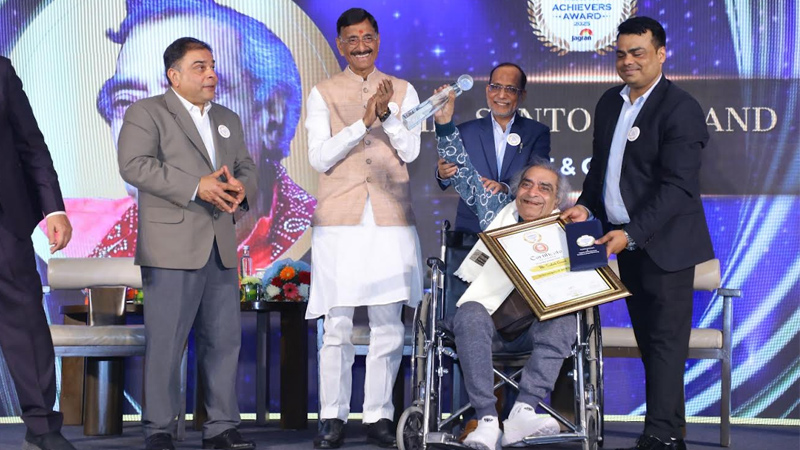
The cultural spotlight fell on veteran lyricist and poet Santosh Anand, whose songs have echoed across generations of Hindi cinema. At 97, Anand accepted the honour with characteristic humility, reflecting on a life shaped by perseverance and hope.
Healthcare honours spanned both modern and traditional systems. Manoj N. Nesari was recognised for strengthening Ayurveda’s place in national and global health frameworks. Padma shri Mohammed Abdul Waheed was honoured for his research-backed work in Unani medicine, while padma shri Mohsin Wali received recognition for his long-standing contribution to patient-centred care.
Education and social development also featured prominently. Padma shri Zahir Ishaq Kazi was honoured for decades of work in education, while former Meghalaya superintendent of Police T. C. Chacko was recognised for public service. Goonj founder Anshu Gupta received an award for his dignity-centred rural development initiatives, and the Hunar Shakti Foundation was honoured for empowering women and young girls through skill development.
The Lifetime Achievement Award went to former IAS officer Shailaja Chandra for her long career in public healthcare and governance, particularly in the traditional systems under Ayush.
Speaking at the event, Hamdard chairman Abdul Majeed said the awards were a tribute to those who combine excellence with empathy. “These awardees reflect Hakeem Sahib’s belief that healthcare, education and public service must ultimately serve humanity,” he said.
Minister Seth struck a forward-looking note, saying India’s young population gives the country a unique opportunity to become a global destination for learning, health and wellness by 2047.
The ceremony also featured the trailer launch of Unani Ki Kahaani, an upcoming documentary starring actor Jim Sarbh, set to premiere on Discovery on 11 February.
Instituted in memory of Unani scholar and educationist Hakeem Abdul Hameed, the awards have grown into a national platform that celebrates those building a more inclusive and resilient India. For one evening at least, the spotlight was not just on success, but on service with substance.