GECs
‘We have enough high quality relevant content to provide for each of the three channels’ : RC Venkateishi- ESPN Software India managing director

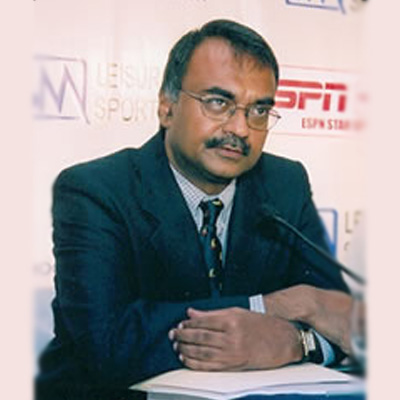
Just when everyone was thinking that sports broadcasters might look to “de-risk” the cricket story, ESPN Star Sports has announced the launch of a dedicated cricket channel for Indian audiences. The new channel, christened Star Cricket, will commence transmission in June.
Star Cricket will be making its bow with a big bang property to showcase because its launch coincides with the India tour of England that involves four Tests and seven One Day Internationals.

Indiantelevision.com caught up with ESPN Software India managing director RC Venkateish in an attempt to get a feel of what was guiding this decision.
Excerpts:
|
Is this the right time to launch another cricket centric sports channel, particularly considering the disillusionment of the general public with the game in the country?
What is more important is the longer term picture and going forward we continue to believe that cricket will continue to hold its own and in fact strengthen as there is a lot of new talent coming in. |
|
|
Nobody’s is arguing that India will not continue to remain cricket-centric. But the fact of the matter is that for something like this to work, it has to be underpinned by high levels of interest in the domestic game as well, which is not the case in India. In fact, this is a problem that Neo Sports seems to be confronting as well. |
|
|
Exactly, and isn’t that what Nimbus is hoping to leverage on Neo Sports. And you don’t have local Indian cricket to showcase, so what is the USP of your channel?
In many ways we will be doing a parallel to things like English Premier League. Where it was four or five years ago to where it is today, it is really a result of the investments that we have done in promoting that property and making it interesting for the viewer.
If you just pick up something and put it on the channel, it is not going to work. That is the job of marketing to popularize a particular sport. It has to be exploited and executed properly. Even the domestic Indian tournament, it needs to be put across properly to the viewer. It is not something that will happen automatically. |
|
|
There are two strands to the communication that you sent out on your upcoming channel. One is that you will showcase live India and non India cricket. You will also showcase feature programming, including reality reality shows? |
|
|
Fair enough but the point is that now you have three platforms through which you have to transmute content. Is there enough content to go around?
So, if you look at each and every sport and the key properties, they are all residing on our channel. Along with this, we have other smaller content also which has come on the network.
As for cricket, for the next 14-16 months I have India’s tour of England, the Twenty20 World Cup, India’s tour of Australia, the Asia Cup and the Champion’s Trophy. That is five major cricketing events.
So I don’t believe that we are in anyway falling short of providing high quality relevant content in each of these three channels. |
|
|
What about distribution? Right now we are in a very uncertain distribution market, both on analog as well as on digital cable, with Cas only in the beginnings of being rolled out. And in such a time you are launching a 3rd channel? |
|
|
Let us accept that you have great content, but today the reality of placement fees cannot be wished away. And it means that slots are booked on tunable bandwidths for one year, two years… |
|
|
There is the recent example of Neo Sports, which had great content but still faced distribution problems? |
|
|
Well they had Star distributing them, which is as good as it can get? |
|
|
|
|
That still doesn’t explain how you’re going to find place in a tunable bandwidth if all the slots are already locked in. |
|
|
There is the option of DD, where the matches are being shown because of must carry.
Even then, we have always managed to be there in prime band even when we didn’t have cricket running. And you must understand that in regards to sports channels there has been a certain amount of consolidation. So the other channels which don’t have relevant content tend to be pushed onto the hyper band.
There will be a little bit of juggling and we will have to manage that. But as a company policy, we will certainly not pay any carriage fee or any placement fee. We are a pay channel and we will get our price. |
|
|
What rates have you fixed for the new channel? |
|
|
Let’s talk about the ICC cricket rights. I take you back to a comment you’d made earlier to Indiantelevision.com that the crazy escalation in rights prices will start cooling down a bit. And yet you went and plonked $ 1.1 billion for those rights?
Now take the ICC, the last ICC went for $ 550 million. So that’s basically a 100 per cent increase. And the last ICC did not have events like the Twenty20 World Cup, which have been added on this property.
What we have paid over eight years, is basically a 9 per cent per annum escalation in rights fee, as opposed to some of the other properties, which in recent times have gone absolutely berserk. The BCCI, as well as the BCCI offshore cricket rights package sold to Zee for over $ 215 million ($ 219.15 million).
Even if you look at things like the Sri Lanka board for $ 50 million, or the Bangladesh board, which went for $ 56 million after going for $ 6-7-8 million last time.
So what we have paid for are not just the World Cups and Champions Trophies, but also what is going to develop into a real cracker of a property – the Twenty20 World Cup. Not once, but thrice. |
|
|
From an average per day cost perspective, and if we compare the three properties that went for big bucks, how does such a payout work? |
|
|
There are also the cricket rights that are coming up over the next 12 months for many big territories over the next year and a half. You have already committed $ 1.1 billion for the ICC rights as well as all the other rights you’ve mopped up recently, so where do you stand on that?
But having the ICC rights provides us a very strong backbone of cricket over the next eight years. Whatever else we add on would be accretive to what we already have so it won’t be necessary to go out and buy everything under the sun. |
|
|
What of the territories that ESS currently own – England, Australia, New Zealand, South Africa? Will you be making aggressive bids to retain them? |
|
|
I again come back to the disaster that was the World Cup. Everyone was expecting 2007 to be cricket’s year as far as advertising is concerned due to the sheer volumes of A list properties that are coming up throughout the year. Now will all the calculations have to be reworked? |
|
| But this is an argument that Star’s Paritosh Joshi has raised, as too Zee’s Joy Chakraborty. Today we are faced with a situation where HLL has pulled out its advertising from Star. And the broadcasting community does not seem to have any unity on this issue so what are we talking here? There is unity developing on this issue and you will see a more forceful exposition of the point in the days to come. Certainly at IBF we are all seized of it in terms of a consolidation of our position. We have been delivering higher and higher reach and we haven’t seen the proper monies for that as yet. |
|
| Coming back to the development of local sport, you’ve earlier stated that Sports federations need to get their act together. One of the biggest culprits in that sense is the IHF run by KPS Gill with whom you’re a partner. One could say that it is because of the mess the IHF is in that the PHL is not taking off. So doesn’t it make sense to encourage the IHF to get itself sorted out? Our experience with the PHL has been very positive. There wasn’t anything in PHL that we needed to do and have not been able to do because of lack of support from IHF. Suffice to say that we are quite happy, both with the way the PHL has performed and with the kind of partnership we have with the IHF. |
|
|
But you yourself have said one reason why PHL is not taking of is because they are not performing well internationally. I think it is interlinked. If the federation was being run properly, the teams would be doing better internationally. A follows B, one could argue. |





GECs
Sahara One reports financial results, notes director exit and business realignment
Muted revenues, steady expenses and strategic adjustments shape company’s current phase

MUMBAI: In a tale where the sands seem to be slipping faster than they can be gathered, Sahara One Media and Entertainment Limited has reported another quarter of wafer-thin income and widening losses, even as a boardroom exit adds to the unease.
The company informed the Bombay Stock Exchange that its board, in a meeting held on April 4, approved its unaudited financial results for the quarter ended September 30, 2025. The numbers paint a stark picture. Total income for the quarter stood at just Rs 0.13 lakh, unchanged sequentially and sharply down from Rs 0.26 lakh a year earlier.
Losses, meanwhile, deepened. The company posted a net loss of Rs 24.16 lakh for the quarter, compared to Rs 18.81 lakh in the June quarter and Rs 39.69 lakh in the same period last year. For the six months ended September 2025, the cumulative loss stood at Rs 39.69 lakh, while the full-year loss for FY25 was reported at Rs 60.72 lakh.
Expenses continued to outweigh income by a wide margin. Total expenses for the quarter came in at Rs 24.30 lakh, led by employee benefit costs of Rs 6.51 lakh and other expenses of Rs 17.78 lakh. Earnings per share remained in the red at Rs (0.11) for the quarter.
The balance sheet reflects a company with significant assets on paper but limited operational momentum. Total assets stood at Rs 23,065.57 lakh as of September 30, 2025, broadly unchanged from March 2025. Equity share capital remained steady at Rs 2,152.50 lakh, while total equity was reported at Rs 18,004.85 lakh.
Cash and cash equivalents saw a modest uptick to Rs 6.75 lakh from Rs 4.68 lakh earlier, supported by a positive operating cash flow of Rs 180.01 lakh for the period.
Yet, beneath these numbers lies a more complex narrative. The company’s auditors flagged their inability to obtain sufficient evidence to form a conclusion on the financial statements, citing lack of access to records. They also raised concerns over the company’s ability to continue as a going concern, pointing to insufficient funds, delayed recoveries, and stalled content investments.
Adding to the governance overhang, the company disclosed that Rana Zia has resigned as whole-time director, effective October 16, 2025, citing other professional commitments. The resignation, noted and accepted by the board, also brings an end to her role across company committees.
Regulatory pressures continue to loom large. The Securities and Exchange Board of India has already initiated penal actions for non-compliance with listing norms, with trading in the company’s shares remaining suspended. There is also a risk of promoter demat accounts being frozen.
Legacy legal issues remain unresolved. A substantial deposit of Rs 694,027.88 thousand linked to the long-running OFCD dispute involving Sahara group entities is still under the purview of the Supreme Court of India. Restrictions on asset disposal continue to weigh on the company’s financial flexibility.
Operationally, challenges persist across multiple fronts. Advances worth Rs 1,92,916 thousand given for film content remain stuck, with delays in project completion and uncertain recoverability. The company’s YouTube channel, despite being operational, has generated no revenue for over three years due to compliance lapses. In a further twist, management has indicated that revenues may have been fraudulently diverted through unauthorised changes to its AdSense account, with a police complaint in the works.
There are also missed revenue opportunities. Television content rights continue to be used by a related party despite the expiry of the licence agreement, with fresh negotiations still underway.
For now, Sahara One Media and Entertainment Limited appears caught between legacy disputes and present-day operational hurdles. As losses linger and governance questions mount, the road to recovery looks less like a sprint and more like a slow trudge through shifting sands.






