News Broadcasting
Wanted to name my book ‘TsuNaMo’, says Rajdeep Sardesai

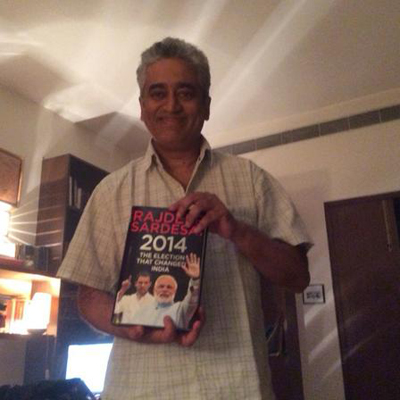
MUMBAI: “I had initially thought of naming it ‘TsuNaMo: The Election That Changed India’,” says one of India’s most recognised journalistic faces on television.
Rajdeep Sardesai, who quit Network18 as IBN18 editor in chief in July this year and later on joined the India Today Group as consulting editor, recently launched his book ‘2014 : The Election That Changed India’. The book tracks the story of the 16th Lok Sabha elections with a media insider’s view.
The man with over 26 years of experience in the field first thought of writing a book last year but it was only in July, this year that he thought of penning his expertise. Sardesai was initially approached by Penguin Publishers to write a biography on Prime Minister Narendra Modi but he says he felt that he was more qualified as a journalist to write about the elections than just a biography.

When asked why he chose 2014 elections to write the book on, he informs “I have been covering elections since 1989, but this was a historic election. For the first time, we had a non-Congress single political party winning by a huge and thumping majority. It was an election that saw the emergence of a larger than life Modi image, extensive media coverage along with new styles of campaigning that were very different from the past. The book while focuses on the 2014 elections has slices of elections from the previous years as well,” says the veteran.
He provides three reasons why journalists and media students should pick up the book. “First, this was the biggest election we have seen so far. It documents a slice of history that people would want to be a part of. Secondly, people love to read good stories. With my 26 years of journalism experience, I have compiled interesting anecdotes of many years that bring to life many personalities from the political field. Thirdly, TV programmes today are like fast food while a book is like good wine that people will enjoy indulging in,” he says.
Sardesai who singlehandedly wrote the book of 135,000 words without a team, informs that he was helped by Centre For The Study of Developing Societies (CSDS) for valuable statistics and insights. CSDS along with CNN-IBN together kept audiences abreast about election trends. He mentions that his wife Sagarika Ghose was the one who helped boost his confidence and pushed him to write the book. “She really energised me. She, in fact, is the book writer in the family. My daughter helped me out on the computer and printouts while my son set the deadline for me that was before his holidays began,” adds Sardesai.
He is extremely happy with the response that the book has garnered, so far, as audiences have already termed it as a page turner. “One does not have to be politically obsessed to read the book. It is accessible for all to read,” he says.
He is glad that even politicians have taken a liking to the book which goes for its second print next week.
Talking about the marketing aspect for the book he says that while films by actors like Shah Rukh Khan need marketing to promote a film, for a book it boils down to the quality of prose and content.
When asked if he plans to write another book on the elections or his autobiography, he chuckles and says “No, not for now. I will take a break of at least one year from book writing,” he concludes.







News Broadcasting
Network18 channels lead YouTube news viewership in March 2026
CNN-News18, News18 India and CNBC channels top categories with record views
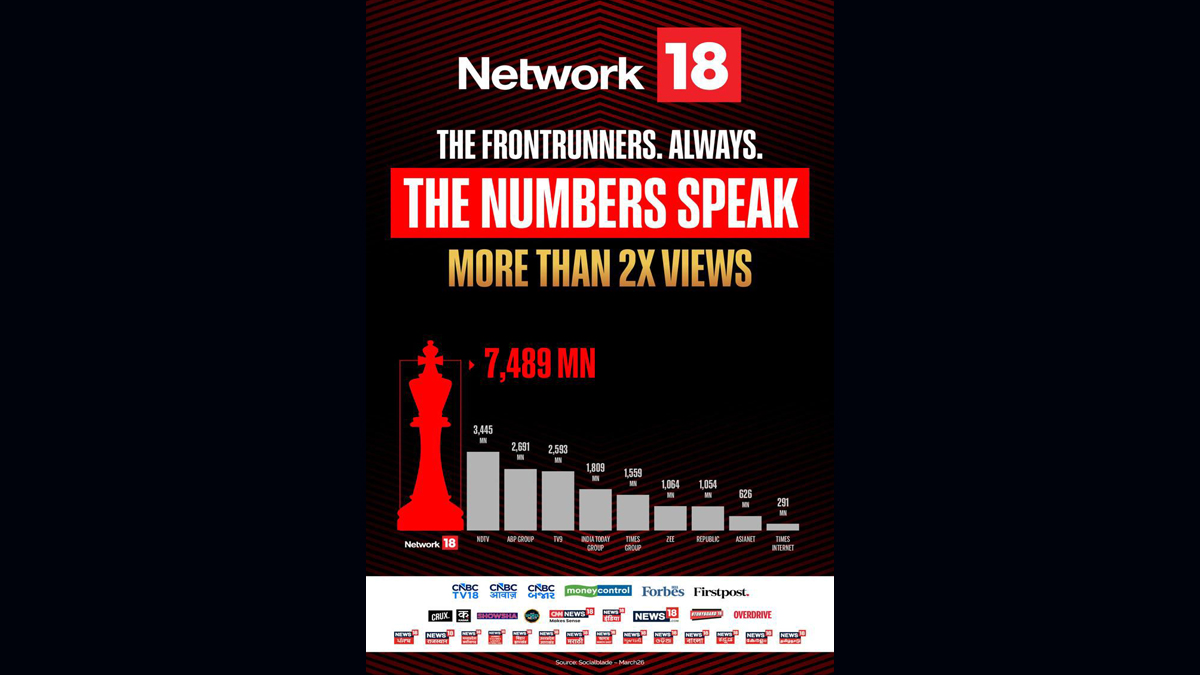
MUMBAI: When the world hit refresh on breaking news, Network18’s channels were already streaming ahead. As geopolitical tensions and war-driven headlines fuelled a surge in global news consumption, the network’s digital playbook delivered big clocking record Youtube viewership across English, Hindi and business news categories in March 2026.
At the forefront was CNN-News18, which emerged as the clear leader in the English news segment with 130 million live and video-on-demand views. The channel edged past competitors such as Times of India (126.5 million), Times Now (101.1 million), India Today (88.2 million) and NDTV (77.5 million), according to Databeings data for March.
In the Hindi news arena, News18 India delivered a commanding performance, racking up a staggering 3,297 million views on YouTube. The channel comfortably outpaced NDTV India, which recorded 3,119 million views, underlining its deep reach and consistent engagement with mass audiences, as per Playboard data.
The network’s dominance wasn’t confined to general news. In the Hindi business segment, CNBC Awaaz topped the charts with 92 million views, narrowly ahead of Zee Business (90 million) and well ahead of ET Now Swadesh (57 million). Meanwhile, its English counterpart CNBC-TV18 posted a strong 58 million views, reinforcing the network’s cross-category strength.
The spike in viewership reflects a broader shift in audience behaviour, with viewers increasingly turning to digital platforms particularly Youtube for real-time updates and in-depth coverage during high-intensity news cycles. For Network18, the numbers signal more than just scale; they underline the effectiveness of a multi-platform strategy that blends speed, credibility and continuous coverage.
In a month where the news never paused, it seems viewers chose to stay tuned where the stream never stopped.






