I&B Ministry
Waiting for Godot


Another year and the industry continues to scan the horizon for the chimera of clarity of purpose from the powers that be in the government.
The long delayed broadcasting bill remains just that – long delayed.
In January there was much debate on the government’s policy on convergence and direct-to-home (DTH) broadcasting. It was “being reworked” by the information and broadcasting ministry. If not in the winter session, at least the monsoon session might see its introduction in Parliament was the hope.

Still no sign of it but now is a good time as any to have a once over of what it is our parliamentarians are trying to do. The bill when (a big when that) introduced will outline a new telecom-IT convergence legislative framework to replace the Indian Telegraph Act 1885. It will also recommend whether there should be separate legislations for telecom, broadcasting, cable TV, Internet and satellite communication. The bill will also outline the broad parameters for DTH broadcasting. Ultimately, the DTH policy will reflect the recommendations of the group of ministers (GoM).
The GoM constituted by the previous government had recommended that Doordarshan be exclusively allowed DTH services for five years but its recommendations were not put on file and the move was scuttled by the election commission.
The Vajpayee government decided to examine the issue afresh on coming to power and set up the Fali S Nariman committee to study the issue. The report is ready but now redrafts have been sought.
The latest on the matter has come from Information and Broadcasting Minister Sushma Swaraj. She said that the bill was very much a priority with the government and it was taking efforts to get it into shape. She added that hardly one per cent of convergence had happened in India, so there was no point in saying that the regulation accompanying it has been delayed.
The GoM had sent the convergence bill ball back at Nariman to clarify the role of the spectrum manager, the name of the bill, and specify which ministry should play the steering role for convergence, among other issues. The IT, telecom and I&B ministry have all been jostling with each other take up that role.
The bottomline of Swaraj’s statements is that the convergence draft will take some more time to see the light of day before being shaped as a bill. Following this it will be posted onto the Net for people’s views. It will be placed before a parliamentary subcommittee before being introduced in parliament for enactment.
 |
The convergence bill remains the bill that the industry is waiting to see enacted. And it may just scrape through in the budget session of Parliament, if things pan out. |
WHAT’S UP ON THE Ku-BAND DTH FRONT? After more than five years of delays, the government on 3 November announced it had cleared all the hurdles in the way of Ku-band DTH television broadcasting. The GoM had thrashed out all modalities of opening up DTH it was declared. CNBC India reported that the government had decided to open up DTH to as many players as possible. All that remained were for details of the clearance to be spelled out.
Two months have gone by and we’re still waiting.
BUDGET BLUES: What of Budget 2000? It held little cheer for the CATV industry. Finance Minister Yashwant Sinha didn’t fulfil expectations of the industry of declaring entertainment (broadcasting) on par with infotech. Large cable networks were however given a sop in that the duty on fibre optic cable was slashed from the earlier 15% to 5%.
VAT POSTPONED TILL 2002: The deadline of 1 April, 2001 for collective introduction of value added tax in states was extended in August provisionally to 1 April, 2002. The decision to extend the deadline was taken by the empowered committee of state finance ministers.
DOOR OPENED FOR PRIVATE PLAYERS TO OPERATE SATELLITE SYSTEMS: It hasn’t all been dither on the part of the government. In May, India opened the door for private firms to own and operate communication satellite systems and offered the local INSAT system for commercial use by private agencies.
“This new policy provides the mechanism for investments by the private sector in the field of communication satellites,” said INSAT programme director S. Rangarajan.
Sun TV and Eenadu TV were the first players to get permission to enter the fray. They set up their own earth stations and were granted uplinking facilities.
The most ambitious project however is Chairman of Zee Telefilms Subhash Chandra’s Agrani satellite project. The Agrani is something very close to Chandra’s heart. But the $800-million price tag, of which Chandra has to pump in $120 million as equity from his end, is going to be something even a high risk player like him is going to find difficult to pull off.
The project has also run into export licence issues under US munitions restrictions imposed after India’s nuclear explosions. The curbs have not been eased yet despite the high hopes that followed Prime Minister AB Vajpayee’s recent visit to the US.
The convergence bill remains the bill that the industry is waiting to see enacted. And it may just scrape through in the budget session of Parliament, if things pan out. Otherwise its rewind to a year back when the hope was that the monsoon session would throw it up.
Any wagers on when parliament sees the bill? The answer my friends is still blowin’ in the wind.






I&B Ministry
India tightens anti-piracy law, blocks sites and Telegram channels
New rules bring jail terms, fines and faster takedowns of illegal content
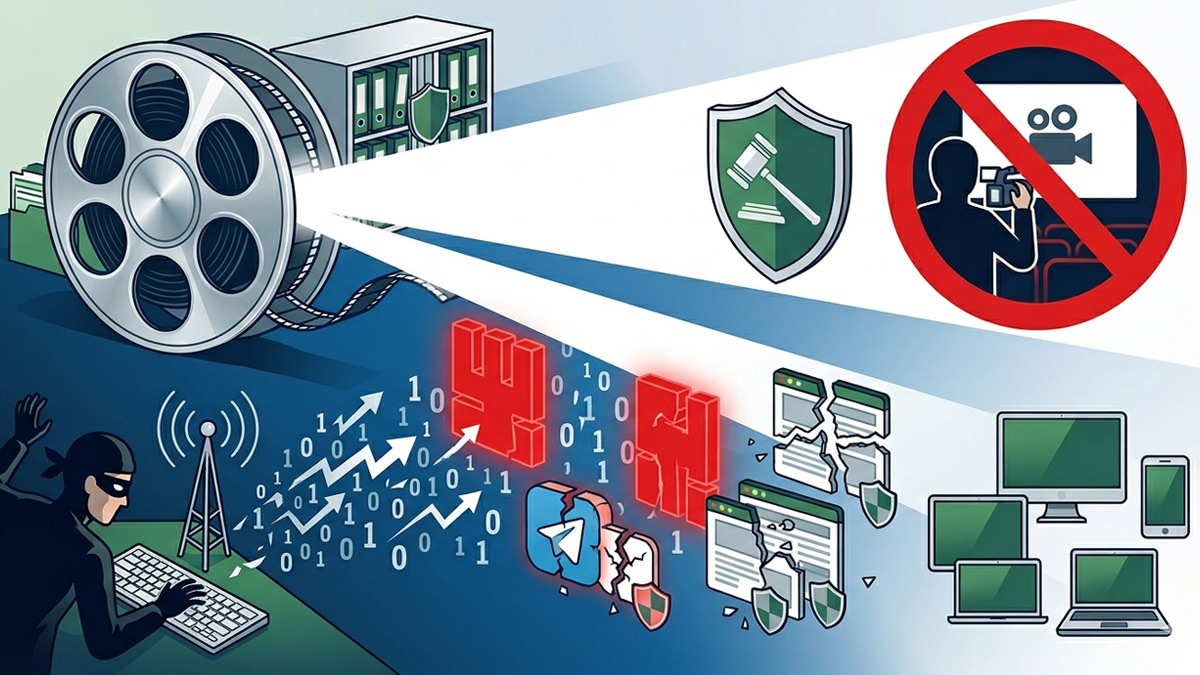
NEW DELHI: The Government of India has stepped up its fight against film piracy, invoking stricter provisions under the Cinematograph Amendment Act 2023 to crack down on unauthorised recording and distribution.
The law now imposes tougher penalties, including jail terms ranging from three months to three years and fines starting at Rs. 3 lakh, which can go up to 5 per cent of a film’s production cost. The provisions target both illegal recording in cinemas and unauthorised online transmission.
In a fresh enforcement push, authorities have notified the Telegram platform to act against piracy, leading to the identification of 3,142 channels allegedly distributing copyrighted content without permission. In parallel, access to around 800 piracy websites has been blocked through internet service providers.
The action has been taken under the Information Technology Act 2000, which empowers the government to direct intermediaries to remove unlawful content. The framework is further reinforced by the Information Technology Rules 2021, requiring platforms to act swiftly when notified of violations.
An institutional mechanism is also in place, allowing copyright holders and authorised representatives to file complaints through designated nodal officers. Once verified, these complaints trigger takedown notices to intermediaries for disabling access to infringing content.
The update was shared in Parliament by Government of India minister of state information and broadcasting l murugan in response to a query from Parimal Nathwani.
The government’s latest move signals a sharper, more coordinated approach to tackling piracy across both physical and digital channels. For the film industry, it is a step towards protecting revenues, while for viewers, it reinforces the shift towards legitimate content consumption.