News Broadcasting
Viewpoint: Us News Networks Failed To Present The Big Picture

The world yesterday entered Act II of America’s “War Against Terrorism” with the launch of cruise missiles against multiple targets in Afghanistan. The terror attacks on the US on 11 September were of course the first act.
Across the world, perceptions about the attacks, and about their aftermath, have almost entirely been shaped by the American news networks led by CNN. If there is one message that has come through loud and clear in the news byte bombardment it is that the leader of the “free world” has a media machine which – either by accident (difficult to believe) or design – in their handling of the whole affair, has lost the right to be called purveyors of free expression.
The talk is of distortion, bias and lack of sensitivity. The US television networks in particular have been singing the same song in such complete synch with the administration in a way I dare say would have been termed controlled and rubber stamp press if replicated in less privileged parts of the world.

If one were to put a positive spin on the post-WTC attack events, it would be to claim that the United States has embraced patriotism in a way not seen since World War II. But where was World War II and where is this on a comparative scale?
That question that begs an answer is – is the role of news anchors and commentators essentially to function as the bugle corps of the Pentagon.
The message is the medium. And the message is that television has failed to adequately address the issues involved except from a unipolar prism.
Programming execs often give the argument that they are providing what the viewers want when questioned about some of the inane stuff on air on the entertainment channels. The US news channels had no such excuse to offer. The viewer had to perforce accept the news processed, presented and packaged the way the networks wanted.
ABC’s Bill Maher discovered the hard way that it is better to do the bugle bit than try any other line. Maher, the host of “Politically Incorrect”, said on his show that “we have been cowards, lobbing cruise missiles from 2,000 miles away. That’s cowardly. Staying in the airplanes when it hits the building. Say what you want about it, that’s not cowardly.” That cost him advertisers Sears and FedEx. along with an affiliate in Washington. Maher’s remarks may be termed insensitive, but the same response has been witnessed in the media to anyone who doesn’t toe the line. Californian Congresswoman Barbara Lee (the lone dissenting vote in the House of Congress against the use of force against Afghanistan unless concrete proof was available) has been pilloried by the media for her decision.
Switch that remote to the Al-Jazeera Satellite Channel. It broadcasts from one of the smallest countries in the world, the oil-rich Persian Gulf sheikhdom of Qatar.
It is not only the only channel which has recent footage of Osama Bin Laden, the most wanted man in the world, but was also the first channel to beam actual shots of Kabul after it was hit. What the American networks offered was Defence Department-provided visuals and White House statements.
Some historical perspective is in order here. Started in 1996 by Qatar’s liberal emir, Sheik Hamad bin-Khalifa al-Thani, Al-Jazeera has revolutionised the media scene in the Arab world with its vibrant and lively debates.
The channel’s political talk shows touch on issues considered by Arab standards to be taboo, such as sex, polygamy, government corruption and Islamic fundamentalism.
The channel has aired interviews with Israeli leaders and allowed its guests and viewers who call in to its programmes to openly criticise Arab regimes.
It has been dubbed the “CNN of the Arab world” for its reportage. Every Arab regime in the region has found something in Al-Jazeera’s programmes to complain about – which is precisely why it is by far the most popular satellite news channel in the Middle East.
Clearly one would expect the leader of the free world to have only good things to say about such a channel. That was the case anyway before the events of 11 September where Al-Jazeera was a channel well received by US officials. “We recognise [Al-Jazeera] as a powerful voice with a wide viewership in the Arab world,” Greg Sullivan, a State Department spokesman, was quoted as saying in June. “It is a media outlet of importance in the Arab world.” He was quoted as saying he tuned into it every day.
That is not quite the situation today. The Bush administration on 3 October was trying to impress upon Qatar the need to restrain the Al-Jazeera because “the United States believes it is unbalanced and encourages anti-American sentiment in the Middle East.”
Secretary of State Colin Powell met the emir of Qatar and pressed upon him the need to use his influence with the cable network. The official complaint was that the station continued to run an old television interview with Bin Laden and has invited anti-American guests who have argued that US foreign policy was to blame for the 11 September terrorist attacks.
The week before Powell met Sheikh Hamad, the US ambassador to Qatar Maureen Quinn delivered a demarche, or formal US protest, to Qatar foreign minister Sheikh Hamad bin Jassim bin Jabor al-Thani about the broadcasts.
Would one be too far off the mark if the “CNN of the Arab world” laid claim to having done a march on its more illustrious counterparts in its handling of this particular conflict? You be the judge.
Every use of media pre-supposes manipulation to some degree or other. It cannot be otherwise. Only one would have expected the world’s most vibrant democracy to have a more vibrant media.
THOMAS ABRAHAM,
MANAGING EDITOR, INDIANTELEVISION.COM





News Broadcasting
CNN-News18 to host Fury in the Gulf conclave on West Asia crisis
Three-hour summit to unpack geopolitical fallout and impact on India
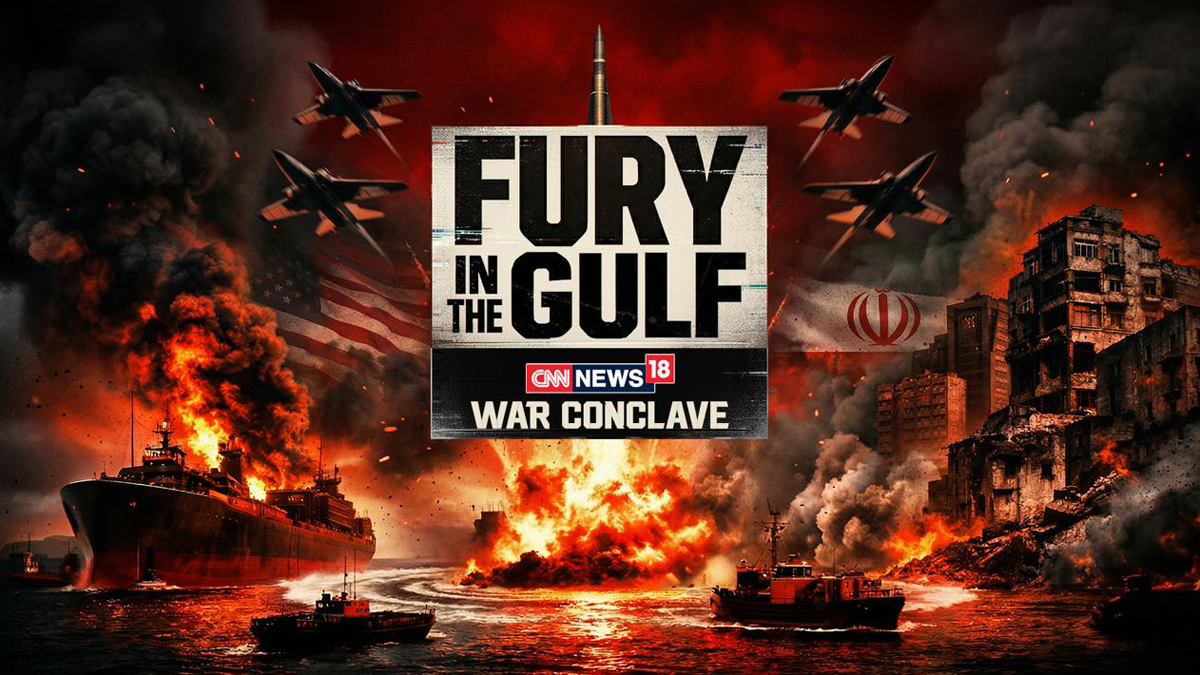
MUMBAI: CNN-News18 is set to host a special three-hour broadcast, Fury in the Gulf – War Conclave, on April 7, aiming to decode the escalating West Asia crisis and its far-reaching implications for India.
Scheduled from 4:00 PM to 7:00 PM, the conclave comes at a time when tensions between Iran and the United States are reshaping global geopolitics and triggering economic uncertainty. With India’s deep energy ties, trade links and large diaspora in the Gulf, the developments carry significant domestic relevance.
Built around the theme ‘Conflict, Consequences, and The Future,’ the programme will feature six curated sessions combining one-on-one interviews and panel discussions. The focus is to cut through the clutter and offer viewers a clearer understanding of the fast-evolving situation.
Key sessions include ‘Diplomacy in Times of War’ featuring Shashi Tharoor, and ‘World After the Iran Conflict’ with voices such as Ram Madhav, Reuven Azar, representatives from the European Union and the Iranian Deputy Envoy. Another session titled ‘Another Dunkirk?’ will bring together K. J. S. Dhillon and Jitin Prasada among others.
CNN-News18 editorial affairs director Rahul Shivshankar said, “In times of war, clarity becomes the most powerful tool. Fury in the Gulf – War Conclave brings together credible voices to address the questions and confusion that arise amid an overwhelming influx of information.”
He added that the initiative is aimed at delivering “facts, perspective, and insight” at a time when misinformation can easily cloud public understanding.
Echoing the sentiment, CNN-News18 CEO– English and business news Smriti Mehra said the conflict marks a defining global moment, with consequences that extend well beyond the region. She noted that the conclave seeks to present the crisis with “depth, nuance and responsibility” so audiences can better grasp its real-world impact.
As geopolitical tensions continue to dominate headlines, the conclave positions itself as an attempt to bring order to the noise, offering viewers a structured, insight-led look at a complex and rapidly shifting global situation.






