iWorld
VidNet 2022: ‘India lags in terms of content distribution security’

Mumbai: The world’s largest streaming service Netflix with 222 million paid subscribers reported that another 100 million subscribers were accessing its services via shared passwords. The OTT platform is effectively losing billions in revenue every year because of password sharing. Similarly, issues like downloadable pirated content, illegal video hosting websites, password sharing and duplication of copyrighted intellectual property (IP) have created a parallel economy on the worldwide web that is hurting the revenues of video-on-demand platforms.
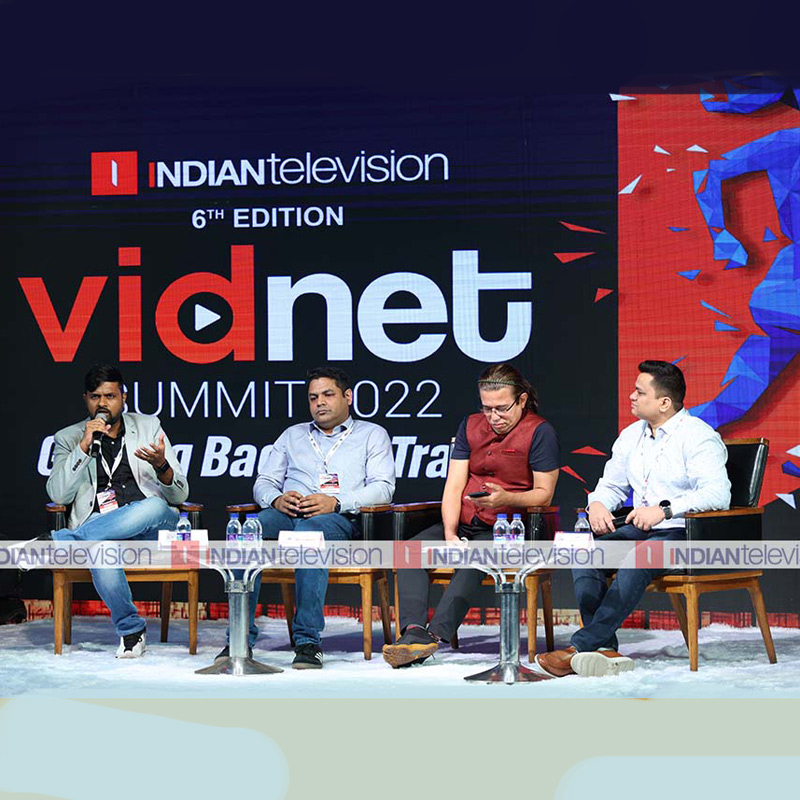
Recently, IndianTelevision.com’s VidNet Summit 2022 organised a panel discussion on the ‘best practices for securing revenue for OTT platforms’ that included Inka Entworks India global business head Govindraj Basatwar, Epic On and Stream-Sens chief operating officer Sourjya Mohanty and Eros Now chief technology officer Lokesh Chauhan. The agenda of the session was to figure out how OTTs can plug the leakages in their revenue pipeline.
The two-day industry event was supported by technology partners Dell Technologies and Synamedia, summit partners Applause Entertainment and Viewlift, industry support partners Gupshup, Lionsgate Play and Pallycon, community partners Screenwriters Association and Indian Film and Television Producers Council and gifting partner The Ayurveda Co.

Epic On’s Sourjya Mohanty started the discussion by explaining that OTT platforms face revenue loss on two fronts. One is the technology front and another is the content front. On the content front, there is the issue of piracy that stems from the fact that certain segment of audiences may not be able to afford the content. “It is important to create protections for the content within the tech stack. This includes an effective digital rights management (DRM) system as well as embedded security features in the video player itself.”
DRM is the use of technology to control and manage access to copyrighted material. It is a mode of encryption and decryption that determines whether the user who’s accessing the content is authentic or not. “Often platforms ignore these basic security measures and that’s the reason why piracy takes place,” remarked Mohanty.
On the technology front, it is not just a content leak that causes revenue to be impacted. A platform may come under a variety of attacks ranging from a potential hijack of the app, a distributed denial of service (DDOS) attack, or something as simple as password sharing. Another issue is consumer awareness and education as many believe that it is fine to share password with friends and family.
Furthermore, Mohanty observed that in the last five years with the proliferation of OTT services the audience is no longer loyal to the platform but rather it chases the content.
Inka Entworks India’s Govindraj Basatwar was of the view that the best practices in terms of content distribution security are not being followed in India. He stated that distribution also means application security and that 50 per cent of the time subscription business models are hacked at the application level. He explained, “There are MOD APKs of apps available on the internet for download that gives consumers access to the platform’s content for free.”
MOD APKs are modified versions of android applications. “When you put your application on the Play Store you effectively lose control of who gets to download it. It may be downloaded by an imposter or a genuine user,” said Basatwar. “Hackers usually reverse engineer the application, remove the subscription wall and upload the MOD APK. The MOD APK may be used by consumers without requiring them to share any credentials.”
Eros Now’s Lokesh Chauhan held the opinion that all platforms are fundamentally prone to attacks and the attacker is constantly evolving. While OTT platforms routinely do jailbreak testing to look for weaknesses in their security but the best way to mitigate attacks is the democratisation of content availability. He said, “The access to content itself should be made readily available at affordable price points. This makes it easier for consumers to access it rather than install something like a MOD APK that is going to infect their system with a virus and make them vulnerable to potential credential hijacks. We have to make people understand that piracy is not worth it.”
Chauhan also stated that technology infrastructure on an OTT platform has to be dynamically scaled up and down to keep control of costs. This is a big challenge currently for platforms, he said. “The structure for computing, caches, databases etc. should start playing a role in service-level agreements (SLAs).”
An SLA is the level of service expected by a customer, i.e., the OTT platform, from a supplier i.e., the technology partner. Chauhan noted that these SLAs should factor in the cost of scaling up and maintaining the performance when a spike in usage happens.



iWorld
Samay Raina returns with Still Alive, confronts 2025 controversy in bold comeback special
Comeback set tackles controversy, blending humour with raw storytelling
MUMBAI: Samay Raina is set to release his new stand-up comedy special, Still Alive, on YouTube on April 7, 2026, marking a high-profile return following a turbulent year.
The trailer for the special dropped on April 5, offering a glimpse into what Raina describes as a raw and unfiltered set that leans as much on honesty as it does on humour.
Positioned as a comeback of sorts, Still Alive draws heavily from the controversy surrounding his show India’s Got Latent in early 2025. The episode led to legal trouble, multiple FIRs, and a lengthy six-hour interrogation by the Maharashtra Cyber Cell, placing the comedian at the centre of intense public scrutiny.
Rather than sidestep the episode, Raina leans into it. The special reflects on the fallout and his personal journey through it, blending observational comedy with moments of emotional candour. Early audience feedback from live performances suggests the tone is less about rapid-fire punchlines and more about storytelling with bite.
The special was filmed during his global Still Alive & Unfiltered tour, which ran from August 2025 to early 2026. The tour saw Raina perform across major international venues, including the Madison Square Garden Theatre in New York, a milestone that places him among the youngest Indian comedians to take that stage.
The title itself signals resilience. “Still Alive” is a nod to navigating both legal and public backlash while choosing to remain unapologetically authentic, a theme that appears to anchor the set.
With the special set to premiere online, all eyes are now on how audiences respond to a performance that promises equal parts reflection and wit. For Raina, the message is clear. He is not just back, he is ready to be heard on his own terms.






