GECs
Viacom18 chief: Indian media sector can create 10 mn jobs over next decade

NEW DELHI: Making a strong case for the Indian media and entertainment (M&E) sector as a major employment generator in the country and which can blunt job automation up to an extent, Viacom18 group CEO Sudhanshu Vats said that it, along with ancillary sectors, has the potential to “create at least 10 million” jobs over the next decade.
“I say this because in other sectors also the skills needed in our sector will be the same ones needed to ensure that the workforce remains competitive. Therefore, in a future where jobs are going to get automated, our sector (M&E) is part of the (employment) solution,” Vats said while delivering a keynote address at the CII-organised Global Exhibition on Services 2017 at Greater Noida, on the outskirts of Delhi.
Pointing out that in a future where jobs are going to get automated and India’s M&E sector can lend a helping hand, Vats exhorted on Tuesday policymakers present from India and abroad at the event that they must do everything in their power to “grow” the M&E sector over the next decade. “For my industry colleagues from different parts of the world, no matter which country or sub-sector of our industry you represent, I’m going to explain to you why the singular stereotype of ‘Indian content’ is a myth and why you need to help our industry shatter this myth as you take our message to the world,” he added.

In an address, given in the presence of Indian and foreign dignitaries, including Minister of State for Information & Broadcasting Rajyavardhan Rathore, Vats went beyond clichés and said, “World over the economic narrative is moving from simply GDP growth and wealth-creation to ‘job creation’. And this is important, because as societies evolve, it is extremely important for the growth to be equitable and productive.”
According to Vats, discussions in India have focused around the importance of India’s services sector in exports, job creation and GDP growth or the need for India to build the M&E sector as the next IT sector given the ‘creativity endowment’ or “slightly more nuanced” themes such as inter-linkages between manufacturing and services policy measures that can unleash the country’s true potential.
“However, I am going to take a different two-pronged approach. An approach that is both critical and interesting. Most of you here will agree with me when I say that in the new world of media where OTT platforms have become mainstream and digital audiences are much sought after, it’s important to tailor-make messages that are relevant to the audience,” Vats said in an address that mixed practical economics with policy-making, adding he had two distinct messages for “two distinct sets of stakeholders” that have gathered at the GES 2017.
“If you look at the pace at which jobs are changing, you’ll be surprised. If my 18-year-old daughter told me 10 years back that she wanted to be an ‘app designer’ I wouldn’t have understood what she meant. Ten years back the first I-phone was launched and Android came much later. India has a workforce that’s anywhere in the 460-480 million range and 10-15 million Indians are being added to the workforce each year. This is likely to continue for another 10 years at least,” Vats said highlighting the USP of India — growing workforce.
And, then he went on to explain his theory why India’s M&E sector was an important clog in the country’s overall economic growth: “Automation won’t make all jobs across a sector or two redundant but certain ‘kinds of jobs’ (especially ‘routine ones’) across several sectors redundant. If you break down jobs performed by us in the M&E sector, a large bulk of them is actually non-routine. This is because of the importance of creativity in everything that we do and the need to create content that will appeal to human beings, making our sector a key creator of high-value-added jobs that will be relatively ‘automation-proof’ in the future.”
Dwelling on the versatile content with universal appeal that India generates annually, which should be taken advantage of globally, Vats told the audience, “The versatility of our content is mind-boggling. We have created a mega-property out of a local sport; we have regional language content on a wide variety of themes (mythological, super natural, comedy, drama, action, mystery, animation, etc.); we have our own non-scripted formats; we have a wide variety of films in different languages – our spectrum of content is endless. All you need to do is to find the right partner and make the right effort in taking these stories to your part of the world.”
Vats message to the audience and Indian policy-makers was simple, yet clear: over the next decade, India’s growth, coupled with the government’s measures, might be able to absorb some of the growing job-seekers, but closer to 2027, it is likely to find itself in a spot where even if the supply of jobs matched the demand, the skill sets needed might not match those available with job-seekers as a “robot can perform those jobs better”. Hence, M&E sector with its vast opportunities could be a savior.






GECs
Asianet Television Awards 2026 celebrates women power in Malayalam TV
“She is the Colour” theme honours icons as ceremony airs on March 14 and 15 at 7 PM.
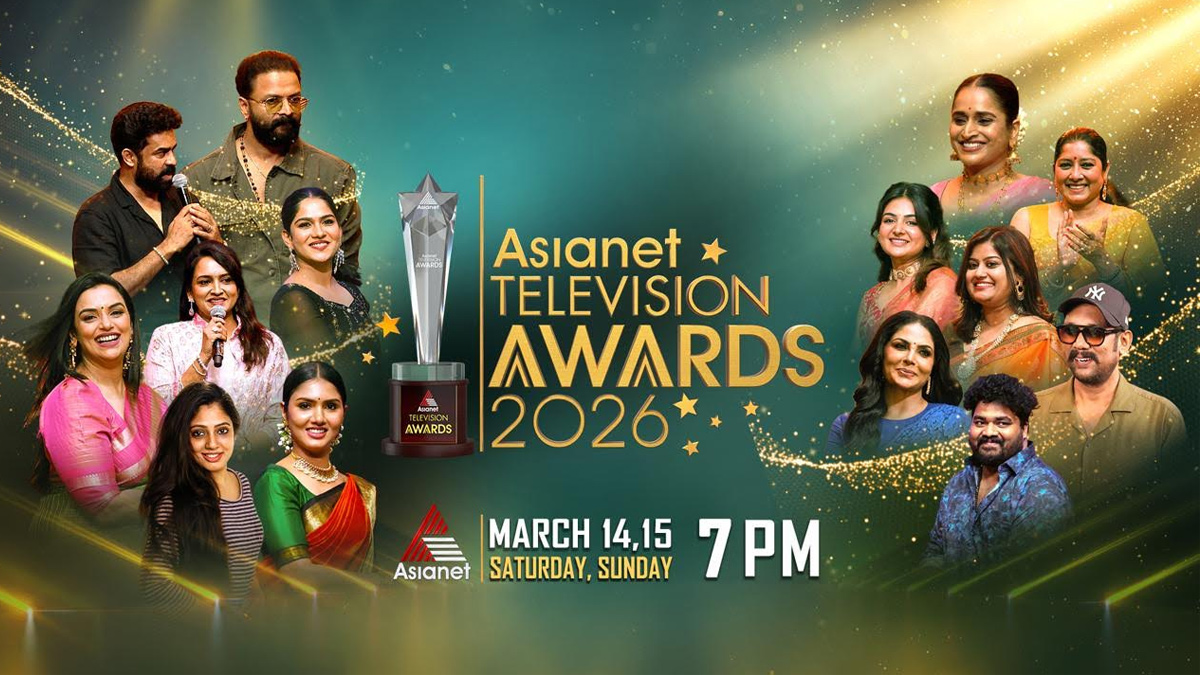
MUMBAI: If television lights up living rooms, this year Asianet decided to let women provide the colour. The Asianet Television Awards 2026 turned the spotlight firmly on women empowerment with the theme “She is the Colour”, celebrating the strength, resilience and achievements of women who continue to shape society and the Malayalam entertainment industry.
The ceremony honoured several distinguished personalities whose journeys have left a lasting cultural imprint. Among them was legendary playback singer Vimala Varma, widely recognised as the first Malayalam playback singer. The evening also paid tribute to Padma Shri awardees Devaki Amma and Vimala Menon for their exceptional contributions in their respective fields.
Leading women from the Malayalam film industry were also recognised during the event, including actor Shweta Menon, who currently serves as president of the Association of Malayalam Movie Artists, and National Award winning actor Surabhi Lakshmi.
The awards ceremony brought together a glittering lineup of actors and industry figures, including Jayasurya, Vijay Babu, Asha Sarath, Lena, Esther Anil, Anumol, Akhila Bhargavan, Sarayu Mohan, Prajod Kalabhavan, Gayathri Suresh, Sabumon Abdusamad, Swasika, Tini Tom, Sijoy Varghese, Kailash, Veena Nandakumar, Sabareesh Varma, Ansiba Hassan and Dinesh Prabhakar. Kishan Kumar, executive vice president Malayalam at JioStar, was also present at the event.
Beyond individual recognitions, the awards celebrated excellence across Malayalam television, acknowledging artists and technicians whose work continues to drive the industry forward.
The evening also offered plenty of spectacle, with elaborate dance performances, stunt acts and comedy skits performed by popular television and film personalities, turning the ceremony into a full fledged entertainment showcase.
Viewers will get to watch the celebrations when the Asianet Television Awards 2026 air on Asianet on March 14 and 15, Saturday and Sunday, from 7 pm onwards, bringing the star studded tribute to homes across Kerala and beyond.