Hardware
VeriSign sets up facility in Bangalore

BANGALORE: US-based VeriSign, a provider of intelligent infrastructure services for the internet and telecommunications networks has set up their Indian Development Center (IDC) at Bangalore.
An investment of $350,000 has already been while another US$650,000 is in the pipeline. And the total investments to an order of $6 billion were announced by VeriSign’s Aristotle Balogh, Sr. VP, Operations and Infrastructure.
The $6 million investments will be utilized towards infrastructure, human resources and R & D in wireline and wireless, e-commerce and other forms of on-line transaction processing (OLTP), security and Oracle 11i development and maintenance areas.

The IDC will undertake end-to-end product engineering, design, development, testing and software cycle management for products and services running over IP and telecommunications network.
The 20000 square feet utility would initially house 50 employees and this number is expected to go up to 125 by the end of 2005.
VeriSign Global Product Engineering VP Manoj Srivastava, who would be in charge of the Bangalore facility said, “The IDC will play a key role in building core mission critical solutions for telecommunications, Internet and Management Information Systems (MIS). We are recruiting highly qualified engineering and software professionals to work with cutting edge product and technologies and aim to significantly increase new product development capacity of VeriSign at the IDC”, while addressing media persons.
Balogh added, “The IDC will help VeriSign develop products and create more releases in shorter spans of time.”
Each day VeriSign enables more than 14 billion Internet transactions, 3 billion telephony signals, US$100 million in transactions, and delivery of over 10 million wireless text and content messages. The company also provides services that secure more than 3000 global enterprises and over 450,000 web sites. VeriSign reported revenues of US$1.2billion or 2004, US$400 million for Q1, 2005 and expect to gross US$1.7billion during 2005.




Hardware
India clears Rs 1.6 lakh crore semiconductor projects under Semicon India
Ten projects cleared as production begins and design ecosystem gathers pace
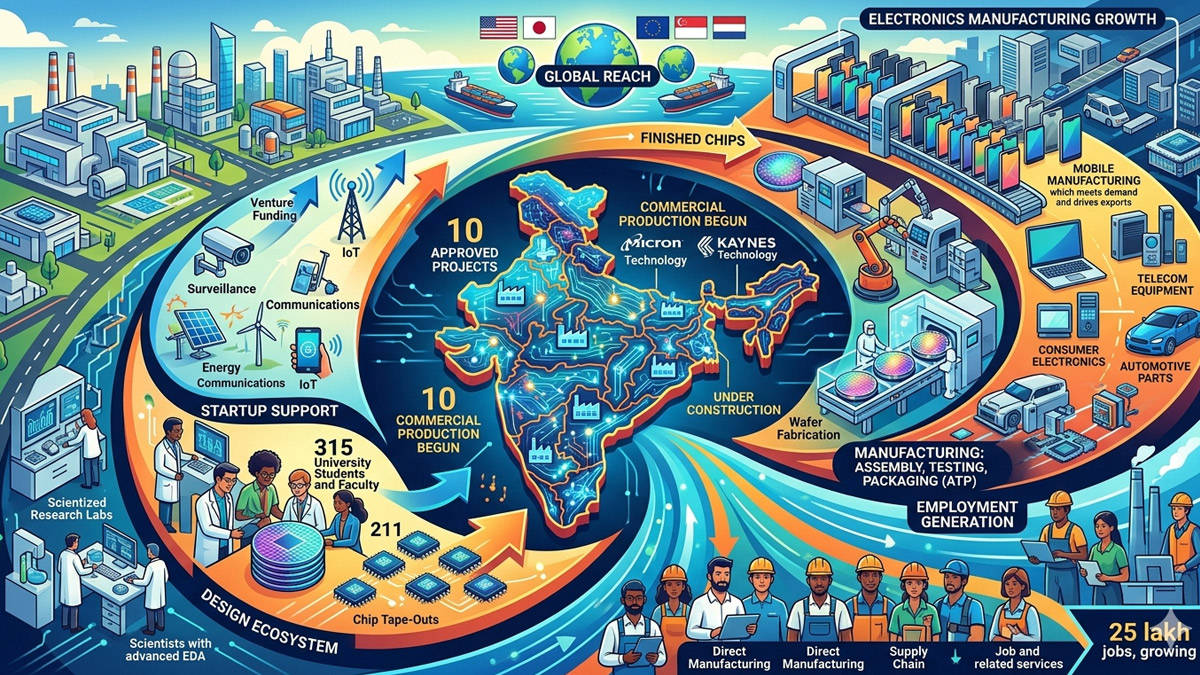
NEW DELHI: India’s push to become a global electronics powerhouse is gaining momentum, with the Semicon India Programme driving the creation of a full-fledged semiconductor ecosystem from design to manufacturing.
Launched in 2022, the programme aims to build capabilities across the entire value chain, including chip design, fabrication, assembly, testing and packaging. In just four years, the government has approved 10 semiconductor projects with a combined investment commitment of around Rs 1.6 lakh crore.
Two of these facilities have already begun commercial production, including units led by Micron Technology Inc. and Kaynes Technology India Limited. Two more plants are expected to go live later this year, signalling that India’s chip ambitions are moving from blueprint to factory floor.
The broader electronics manufacturing story has also seen sharp growth over the past decade. Production has jumped from roughly Rs 1.9 lakh crore in 2014-15 to about Rs 12 lakh crore in 2024-25, while exports have surged nearly eightfold. Mobile phone manufacturing, once heavily import-dependent, now meets almost all domestic demand and has become a major export driver.
Alongside manufacturing, the government is investing heavily in design capabilities. Through access to advanced chip design tools provided free to 315 universities, students and researchers have clocked over 200 lakh hours of usage. This effort has already resulted in 211 chip tape-outs from 75 institutions.
Support for startups is also picking up pace. Twenty-four chip design projects have been approved, targeting sectors such as surveillance, energy, communications and IoT. Of these, 14 companies have collectively raised over Rs 650 crore in venture funding, while several designs have progressed to fabrication, including at advanced nodes.
To strengthen supply chains, India has also signed semiconductor cooperation agreements with countries including the United States, Japan, the European Union, Singapore and the Netherlands. These partnerships aim to reduce global dependencies while boosting domestic capabilities.
The employment impact is equally significant. The electronics sector now supports an estimated 25 lakh jobs, with mobile manufacturing alone accounting for nearly half. As more semiconductor units come online under the India Semiconductor Mission, indirect job creation across supply chains is expected to rise further.
Sharing these updates in Parliament, Ministry of Electronics and Information Technology minister of state Jitin Prasada underscored the government’s focus on building a resilient, end-to-end semiconductor ecosystem.
With factories taking shape, designs moving to silicon and investments flowing in, India’s semiconductor story is steadily shifting gears from ambition to execution.






