News Broadcasting
UK’s ITC for ’16-QAM’ in DTT transmission


LONDON: Britain’s Independent Television Commission (ITC) yesterday amended its technical standards to authorise those digital broadcasters who wish to broadcast in ’16-QAM’ transmission mode to press ahead. This follows the readvertising of licences for three digital terrestrial multiplexes and the success of tenders based on the ’16-QAM’ transmission mode.
In the light of technical assessments, including laboratory trials, and following the licence awards the ITC has said it is minded to mandate ’16-QAM’ as the transmission mode for all DTT services. A consultation on this proposition closed on 12 September.
Proponents of a change to ’16-QAM’ argued strongly that the benefits in terms of coverage and signal robustness justifies making ’16-QAM’ the mandatory transmission standard. Other respondents argued strongly that the research evidence for this was not strong enough to outweigh the disbenefit of reducing the number of services available.

The ITC has decided to commission an independent study to undertake tests in dual mode, ’64-QAM’ and ’16-QAM’ transmission in October when both modes will be in use.
The ITC will shortly be announcing field trials and research to provide practical in-home evidence of the performance of the two transmission modes. The most critical issue to assess will be the potential for differential performance between the public service channels carried at ’64-QAM’, and those at ’16-QAM’, in poor reception areas and in the presence of impulse interference (e.g. from thermostats, car ignitions, refrigerators etc).
This research will allow the Freeview service to launch with its preferred mode and the industry to assess the impact of transmission mode change based on real evidence. The ITC is minded to choose the ’16-QAM’ transmission mode but intends to make a final decision on this issue for the New Year based on the outcome of this research.
BBC and Crown Castle, who between them operate four of the six digital terrestrial television multiplexes, plan to move to a ’16-QAM’ transmission mode from the launch of their new service, known as ‘Freeview’. The remaining two multiplex operators, Digital 3 and 4 and SDN, will be permitted to continue transmission at ’64-QAM’ during this interim period.






News Broadcasting
Network18 channels lead YouTube news viewership in March 2026
CNN-News18, News18 India and CNBC channels top categories with record views
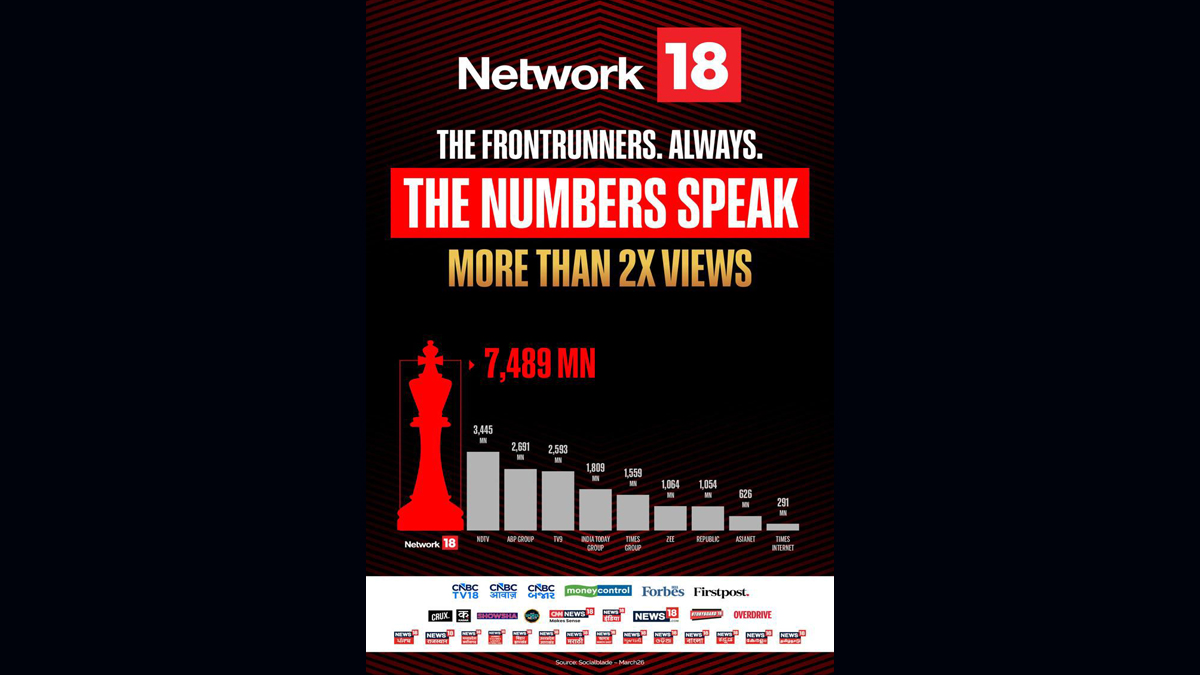
MUMBAI: When the world hit refresh on breaking news, Network18’s channels were already streaming ahead. As geopolitical tensions and war-driven headlines fuelled a surge in global news consumption, the network’s digital playbook delivered big clocking record Youtube viewership across English, Hindi and business news categories in March 2026.
At the forefront was CNN-News18, which emerged as the clear leader in the English news segment with 130 million live and video-on-demand views. The channel edged past competitors such as Times of India (126.5 million), Times Now (101.1 million), India Today (88.2 million) and NDTV (77.5 million), according to Databeings data for March.
In the Hindi news arena, News18 India delivered a commanding performance, racking up a staggering 3,297 million views on YouTube. The channel comfortably outpaced NDTV India, which recorded 3,119 million views, underlining its deep reach and consistent engagement with mass audiences, as per Playboard data.
The network’s dominance wasn’t confined to general news. In the Hindi business segment, CNBC Awaaz topped the charts with 92 million views, narrowly ahead of Zee Business (90 million) and well ahead of ET Now Swadesh (57 million). Meanwhile, its English counterpart CNBC-TV18 posted a strong 58 million views, reinforcing the network’s cross-category strength.
The spike in viewership reflects a broader shift in audience behaviour, with viewers increasingly turning to digital platforms particularly Youtube for real-time updates and in-depth coverage during high-intensity news cycles. For Network18, the numbers signal more than just scale; they underline the effectiveness of a multi-platform strategy that blends speed, credibility and continuous coverage.
In a month where the news never paused, it seems viewers chose to stay tuned where the stream never stopped.






