News Headline
Two Intelsat satellites with C and Ku-Band transponders set for launch tomorrow

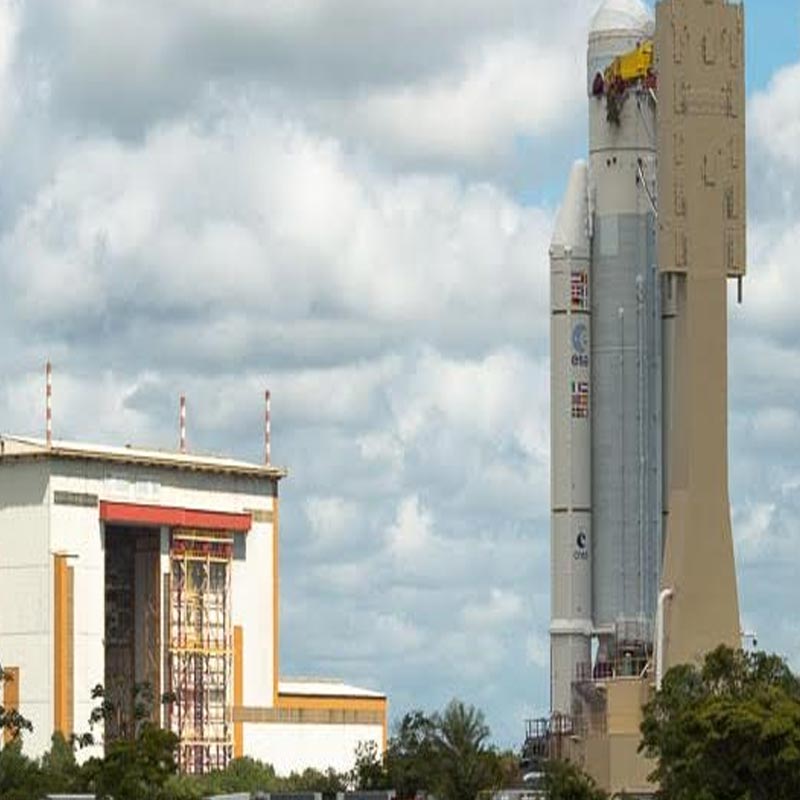
NEW DELHI: Two Intelsat communications satellites – Intelsat 33e and Intelsat 36 – are being launched into orbit on 24 August, with Arianespace in the final stage of preparations.
This sixth mission of the year will be launched from the Ariane Launch Complex No. 3 (ELA 3) in Kourou, French Guiana, atop an Ariane 5 booster. The launch window starts at 5:55 p.m. EDT (21:55 GMT) and extends for 45 minutes.
The work on the launch started in mid-July with the arrival of the satellites in French Guiana. Intelsat 33e and Intelsat 36 were shipped to the Guiana Space Centre in late July. Both spacecraft were put through a series of tests including electrical checks verifying command and telemetry systems, as well as electrical propulsion tests, validating the Xenon propulsion system. The engineers also performed bi-propellant tests to make sure that each thruster responds correctly to activation commands, and to prove there were no leaks.

With a lifetime of fifteen years, the Intelsat 33e has been built by Boeing and is based on its 702 MP platform. The satellite weighs 6.6 metric tons and measures 7.9 by 3.8 by 3.2 meters. It features two deployable solar wings, each with four panels of ultra-triple-junction gallium arsenide solar cells, capable of generating up to 13 kilowatts of power.
Equipped with 20 C-band and 249 Ku-band transponders, Intelsat 33e will be inserted into a geosynchronous orbit inclined 60 degrees East, replacing Intelsat 904. The satellite is designed to deliver carrier-grade telecom, enterprise networks, aeronautical connectivity, and certain media services.
This is the second spacecraft in the company’s EpicNG series – a high-performance, next-generation satellite platform that delivers global high-throughput technology.
Its Ku-band spot beams are to provide broadband services for Europe, Africa, West Asia, and Asia, while a Ku-band wide beam provides broadcast coverage of Europe, West Asia, and Asia. The satellite’s C-band spot beams will cover high traffic telecommunications centres in Europe, Central Africa, West Asia, Asia, and Australia. When it comes to the C-band wide beam, it is expected to deliver coverage over sub-Saharan Africa for data and media services.
Intelsat 36 with a life of over fifteen years was manufactured by Space Systems/Loral (SSL) and is based on the SSL-1300 bus. Weighing about 3.25 metric tons, its dimensions are 17 by 10 by 11 feet (5.2 by 3.1 by 3.4 meters). The spacecraft has two deployable solar arrays that will generate up to 15.8 kilowatts of power. Intelsat 36 is fitted with 34 Ku-band transponders and 10 C-band transponders. Its Ku-band payload will support Intelsat’s MultiChoice direct-to-home service in South Africa, while the C-band payload is expected to provide in-orbit resilience for the video content distribution neighborhood at 68.5 degrees East where the satellite will be co-located in a geosynchronous orbit, together with Intelsat 20.
The Intelsat 33e satellite was on 6 August mated with the payload adapter in the S5 payload facility and four days later it was encapsulated in the payload fairing. Intelsat 36 was installed on the payload adapter four days later and its encapsulation took place afterwards with the stack was placed atop the Ariane 5 launcher.
The launch rehearsal and final preparations of the booster for the upcoming liftoff were held last week, while the rollout of the rocket to the launch pad was scheduled to be performed one day before the planned blastoff. The final countdown for the liftoff will be commenced 11 hours and 30 minutes ahead of the launch.
Designated VA232 in Arianespace’s numbering system, it will see the Ariane 5 rocket fly for about 42 minutes when Intelsat 33e will be released into orbit first nearly 29 minutes after launch, while Intelsat 36 will separate 13 minutes later.
According to Intelsat Investor Relations Vice President Dianne J. VanBeber, “We take the next step in establishing our Intelsat EpicNG high-throughput platform with Intelsat 33e, the second in our series of seven planned satellites. We also launch Intelsat 36, which is a fully committed custom payload for an important DTH customer in South Africa,”
The Ariane 5 in ECA configuration is the heavy-lift rocket for missions to geostationary transfer orbit (GTO) and usually carries two telecommunications satellite payloads. The flight is powered during the initial flight phase by a cryogenic core stage and two solid rocket boosters, followed by the use of a cryogenic upper stage for orbital injection of the payload.
The 54.8-meter tall ECA is an improved version of the Ariane 5 launcher, designed to deliver payloads, mainly communications satellites, weighing up to 10 tonnes.
Although it has the same general architecture, some significant changes were made to the basic structure of the generic version to increase thrust and enable it to carry heavier payloads. ECA is also used by institutional customers for non-GTO missions; for example, launching ESA’s Herschel and Planck scientific missions in 2008.
This will be the 232nd liftoff of an Ariane vehicle from the Kourou Spaceport. It will be the fourth Ariane 5 launch of 2016 (the 87th Ariane 5 launch overall) and the sixth of 12 flights planned this year by Arianespace, utilizing its family of the heavy-lift Ariane 5, the medium-lift Soyuz, and the lightweight Vega.
Arianespace’s next launch is scheduled for 16 September when it is expected to send into orbit PeruSat 1 for the Peruvian Armed Forces and four SkySat Earth-observing microsatellites for Skybox Imaging. The mission will be performed by the Vega launcher, lifting off from Kourou.


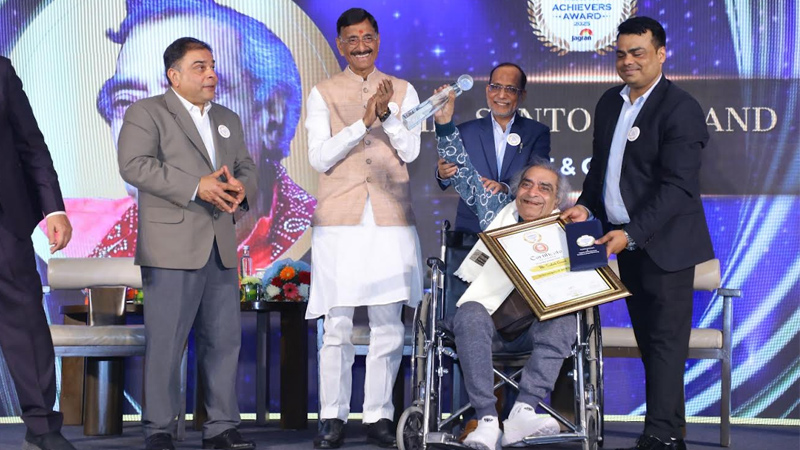
NEW DELHI: Hamdard Laboratories gathered a cross-section of India’s achievers in New Delhi on Friday, handing out the Hakeem Abdul Hameed Excellence Awards to figures who have left their mark across healthcare, education, sport, public service and the arts.
The ceremony, attended by minister of state for defence Sanjay Seth and senior officials from the ministry of Ayush, celebrated individuals whose work blends professional success with a sense of public purpose. It was as much a roll call of achievement as it was a reminder that influence is not measured only in profits or podiums, but in people reached and lives improved.
Among the headline awardees was Alakh Pandey, founder and chief executive of PhysicsWallah, recognised for turning affordable digital learning into a mass movement. On the sporting front, Arjuna Awardee and kabaddi player Sakshi Puniya was honoured for her contribution to the game and for pushing women’s participation onto bigger stages.
The cultural spotlight fell on veteran lyricist and poet Santosh Anand, whose songs have echoed across generations of Hindi cinema. At 97, Anand accepted the honour with characteristic humility, reflecting on a life shaped by perseverance and hope.
Healthcare honours spanned both modern and traditional systems. Manoj N. Nesari was recognised for strengthening Ayurveda’s place in national and global health frameworks. Padma shri Mohammed Abdul Waheed was honoured for his research-backed work in Unani medicine, while padma shri Mohsin Wali received recognition for his long-standing contribution to patient-centred care.
Education and social development also featured prominently. Padma shri Zahir Ishaq Kazi was honoured for decades of work in education, while former Meghalaya superintendent of Police T. C. Chacko was recognised for public service. Goonj founder Anshu Gupta received an award for his dignity-centred rural development initiatives, and the Hunar Shakti Foundation was honoured for empowering women and young girls through skill development.
The Lifetime Achievement Award went to former IAS officer Shailaja Chandra for her long career in public healthcare and governance, particularly in the traditional systems under Ayush.
Speaking at the event, Hamdard chairman Abdul Majeed said the awards were a tribute to those who combine excellence with empathy. “These awardees reflect Hakeem Sahib’s belief that healthcare, education and public service must ultimately serve humanity,” he said.
Minister Seth struck a forward-looking note, saying India’s young population gives the country a unique opportunity to become a global destination for learning, health and wellness by 2047.
The ceremony also featured the trailer launch of Unani Ki Kahaani, an upcoming documentary starring actor Jim Sarbh, set to premiere on Discovery on 11 February.
Instituted in memory of Unani scholar and educationist Hakeem Abdul Hameed, the awards have grown into a national platform that celebrates those building a more inclusive and resilient India. For one evening at least, the spotlight was not just on success, but on service with substance.







