News Broadcasting
TV18 goes live from NSE TV18 Media Centre


MUMBAI: The Television Eighteen Group (TV18) and the National Stock Exchange have come together to form the NSE-TV18 Media Centre.
CNBC AWAAZ went live this morning from the NSE-TV18 Media Centre housed at the NSE premise in Mumbai. The partnership aims to provide a platform to bring real-time reportage, corporate earnings and discussions with company management to a larger national and international audience.
On the launch of the NSE TV18 Media Centre, Television Eighteen India Limited managing director Raghav Bahl ‘We believe that this is a concrete step further in enhancing levels of transparency and communication with investors. This is a first in the history of the Indian stock markets and TV18 is extremely proud to partner India’s leading stock exchange, the NSE.’

National Stock Exchange managing director Ravi Narain added, ‘The setting up of the media centre is a step in line with global practices. Most of the leading exchanges worldwide have set up such platforms for real time coverage of markets. This I believe takes the exchange to the doorstep of the investor.’
CNBC Awaaz editor Sanjay Pugalia also pointed out, ‘CNBC Awaaz has successfully completed 2 years in India and is the fastest growing channel in the country today. CNBC Awaaz cuts through jargon and gives information in a language understood by everyone, reaching out to a wider audience and that is the reason why CNBC AWAAZ is solely responsible for 55% growth in the business genre viewership. The partnership with NSE is our endeavour to make real time stock market information available for the investors’.
The ‘e-inauguration’ beamed live on CNBC AWAAZ and was simulcasted on other TV18 network channels.Speaking on the occasion finance minister P Chidambaram said, ‘It is now time to focus our efforts on making information available instantaneously to the entire target audience – domestic and overseas. The joint initiative of TV18 and NSE to set up a media centre to bring real time linkages between markets, corporates and investing communities, live from the media centre is a step in this direction. I am sure that this would bring the viewer closer and will improve the level of communication between the company management and the shareholders’.
Market hour programming on CNBC-TV18 and CNBC Awaaz will go live from the NSE.Also earnings coverage of NSE listed companies and listings on the NSE will be announced live from the NSE TV18 media centre.






News Broadcasting
UDF poised to return to power in Kerala, says Manorama-CVoter survey
Massive opinion poll projects shift in Kerala politics ahead of 2026 Assembly elections.
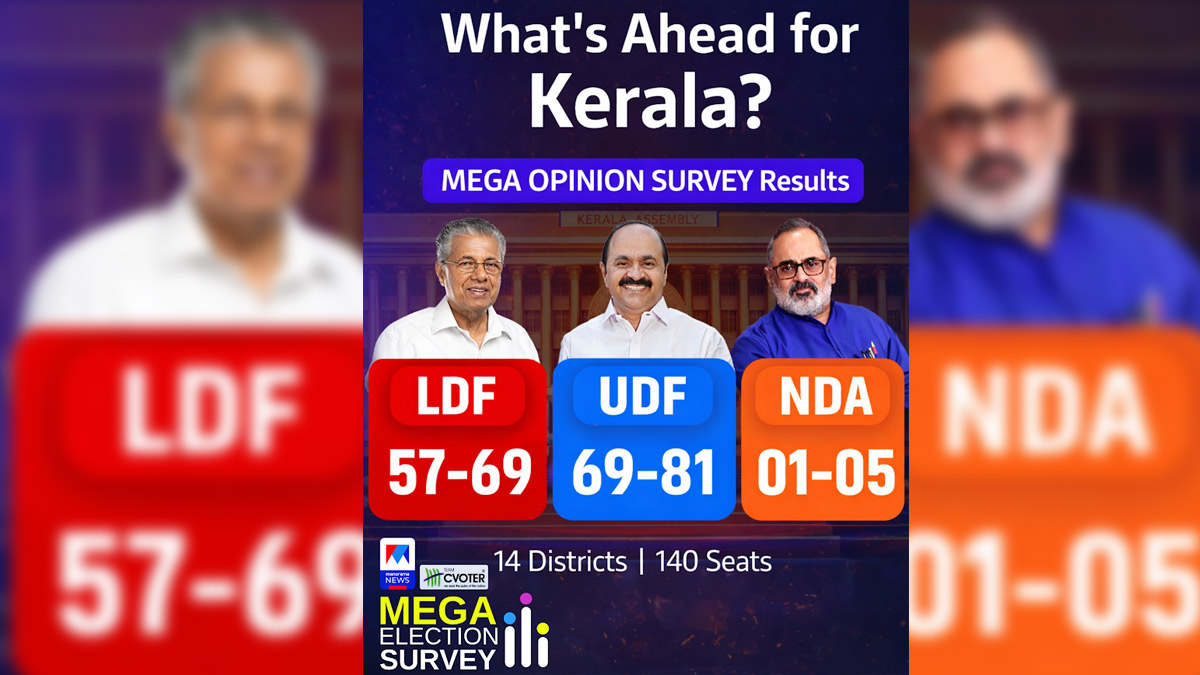
MUMBAI: The winds of change appear to be blowing through Kerala’s political landscape and this time, they seem to favour the United Democratic Front. A comprehensive mega opinion survey conducted by Manorama News in partnership with CVoter projects a potential comeback for the UDF in the upcoming Kerala Legislative Assembly Elections 2026. The survey, covering all 140 constituencies with a massive sample size of nearly 90,000 respondents, predicts the UDF could win between 69 and 81 seats.
The ruling Left Democratic Front (LDF) is expected to secure 57 to 69 seats, a significant drop from the 99 seats it won in the 2021 elections. This would mean the LDF losing 30 to 42 of its sitting seats. Meanwhile, the National Democratic Alliance (NDA), which drew a blank in 2021, is projected to open its account with 1 to 5 seats.
Region-wise, the UDF is expected to make strong gains in Malabar, winning 25 to 34 out of 48 seats, and in Central Kerala, where it could bag 29 to 33 out of 53 seats. In South Kerala, the LDF is likely to retain an edge with 21 to 25 seats, while the UDF may improve to 12 to 16 seats. The NDA could pick up 1 to 3 seats in the southern region.
The survey was conducted between 14 and 26 March 2026, with additional tracker and snap polls carried out from December 2025 to March 2026. A total of 89,693 respondents participated, ensuring representation across all demographics and social segments.
Manorama News has a strong track record of accuracy, with its previous projections closely matching the actual results of the 2019 and 2024 Lok Sabha elections as well as the 2021 Kerala Assembly polls.
In Kerala’s famously fierce political battles, this survey suggests the pendulum may be swinging back. Whether the final verdict matches these numbers or throws up another surprise, one thing is clear, the 2026 Assembly elections are shaping up to be one of the most keenly watched contests in the state’s history.






