News Broadcasting
TV18, Balaji scrips shine on strong Q1 results


MUMBAI: This is a result investors may have been waiting for. Television Eighteen put up a robust first quarter performance, pulling the scrip up by Rs 13 to close today in the BSE at Rs 605 in a market that slipped 61 points after four days of continuous rise.
On the television front, TV18 has doubled its revenues over the year-ago period while net profit has jumped 65 per cent to Rs 138.21 million. The company now has four channels – two in the business space and two general news channels.
The Group’s internet business is also poised for a scale up, having crossed $1 million (Rs 46.75 million) in the quarter. TV18 is eyeing acquisitions and will soon re-launch jobstreet.com and yatra.com. The company has already announced plans to hive off the internet business which will make it attractive for strategic investors.

“The scrip could lift up further, based on these results. The valuation of the internet business will also be interesting,” a market analyst says.
Balaji Telefilms, which announced its first quarter results yesterday, is the other media scrip which climbed 4.34 per cent to close the day at Rs 109.45 in the BSE. Analysts say this was on the back of a 39 per cent jump in the TV content producer’s net profit to close the quarter at Rs 173.77 million.
The market is yet to be enthused by UTV’s deal with Walt Disney Company, shedding marginally in the BSE to close 1.8 per cent down at Rs 168.65. The global media major had bought out Hungama TV and taken a 14.9 per cent stake in UTV for a total consideration of $44.5 million (approximately Rs 2 billion).
“The scrip will gain value once Disney chalks out a joint plan with UTV. It is not clear yet where Disney wants to take UTV forward,” says a market analyst.
Among the other media stocks to fall are Zee Telefilms (2.24 per cent to Rs 257.20) and NDTV (from Rs 156.2 to Rs 155.30). TV Today almost stayed flat to close at Rs 76.60.





News Broadcasting
UDF poised to return to power in Kerala, says Manorama-CVoter survey
Massive opinion poll projects shift in Kerala politics ahead of 2026 Assembly elections.
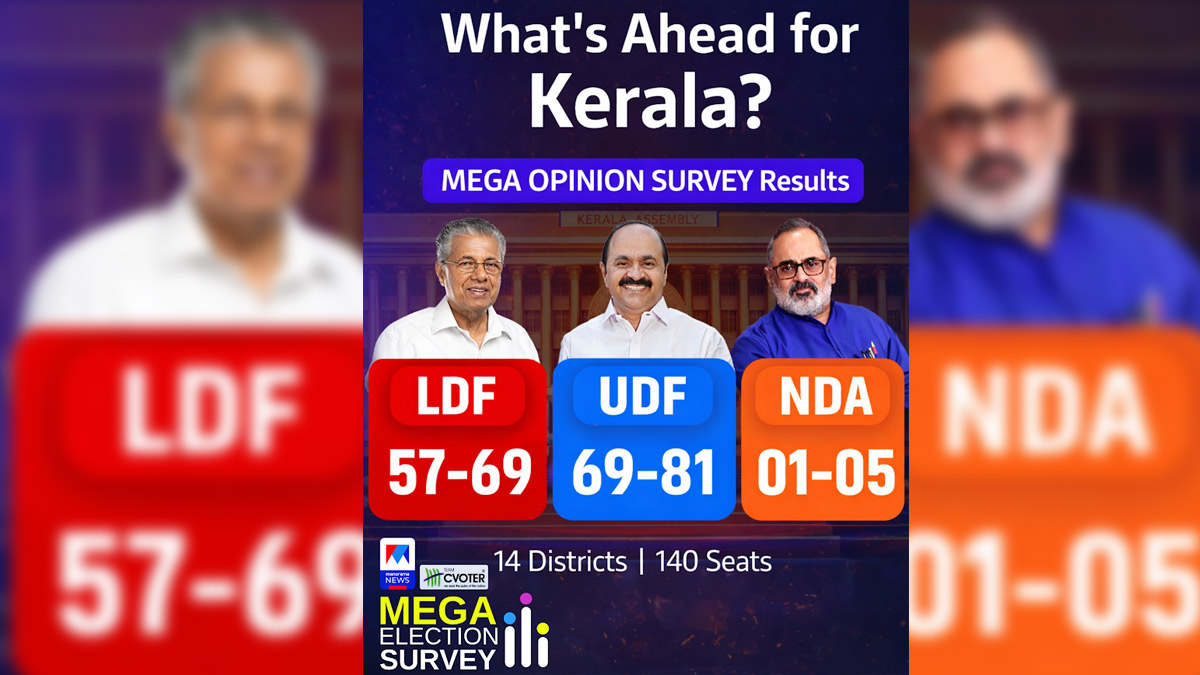
MUMBAI: The winds of change appear to be blowing through Kerala’s political landscape and this time, they seem to favour the United Democratic Front. A comprehensive mega opinion survey conducted by Manorama News in partnership with CVoter projects a potential comeback for the UDF in the upcoming Kerala Legislative Assembly Elections 2026. The survey, covering all 140 constituencies with a massive sample size of nearly 90,000 respondents, predicts the UDF could win between 69 and 81 seats.
The ruling Left Democratic Front (LDF) is expected to secure 57 to 69 seats, a significant drop from the 99 seats it won in the 2021 elections. This would mean the LDF losing 30 to 42 of its sitting seats. Meanwhile, the National Democratic Alliance (NDA), which drew a blank in 2021, is projected to open its account with 1 to 5 seats.
Region-wise, the UDF is expected to make strong gains in Malabar, winning 25 to 34 out of 48 seats, and in Central Kerala, where it could bag 29 to 33 out of 53 seats. In South Kerala, the LDF is likely to retain an edge with 21 to 25 seats, while the UDF may improve to 12 to 16 seats. The NDA could pick up 1 to 3 seats in the southern region.
The survey was conducted between 14 and 26 March 2026, with additional tracker and snap polls carried out from December 2025 to March 2026. A total of 89,693 respondents participated, ensuring representation across all demographics and social segments.
Manorama News has a strong track record of accuracy, with its previous projections closely matching the actual results of the 2019 and 2024 Lok Sabha elections as well as the 2021 Kerala Assembly polls.
In Kerala’s famously fierce political battles, this survey suggests the pendulum may be swinging back. Whether the final verdict matches these numbers or throws up another surprise, one thing is clear, the 2026 Assembly elections are shaping up to be one of the most keenly watched contests in the state’s history.






