News Broadcasting
“TV news has changed and it won’t change back”

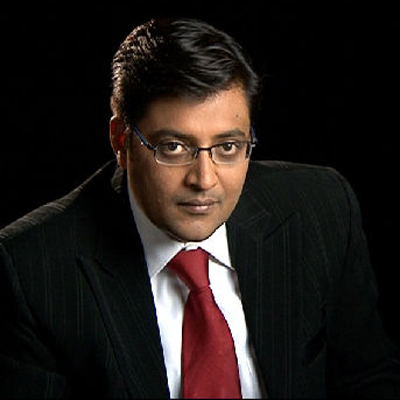
MUMBAI: “It’s ironical that a journalist who has been labelled as ‘self opinionated’ has been called for the session on ‘The electronic news media: on fine balance?’” began television’s most vociferous anchor and Times Now editor-in-chief, who has often faced criticism for his in-your-face brand of journalism.
Arnab Goswami was just being himself when he wondered aloud why he had been invited to deliver the keynote at the ongoing FICCI Frames 2014.

Taking centre stage, he proceeded to narrate the incident that made Times Now a household name and the six mantras that he bears in mind at all times.
“To all my critics I say that TV news has changed, and it won’t change back,” Goswami said to a loud applause from the audience.
He recalled how Times Now had relentlessly pursued the story of a small child called Prince who fell into a borewell in 2006 to get people to take the channel seriously. At the time, the channel had become the butt of jokes for the political class. “In 2006, we were mocked by politicians who termed us as ‘Times When’ rather than ‘Times Now’ and I then found my voice through Prince,” said the presenter notorious for his irreverent style.
Goswami went on to explain that the reason behind making Prince the talking point for days on end was to highlight the preferential treatment meted out to children of politicians and corporates vis-a-vis the common man of India.
With the same passion (some call it aggression) that he displays while moderating his much viewed debates, Goswami revealed the six rules he keeps close to his heart. “The old media is dead or it is dying”; “Politicians will always be touchy to criticism; you don’t be touchy about their touchiness”; “Opinion is important; I believe in opinion without prejudice”; “TV story telling has changed”; “News is a form of social content” and “We make people talk and think”.
The man who repeatedly drowns out all other voices on his show had to face a volley of questions at the session anchored by BBC senior correspondent Jon Sopel.
When asked why he didn’t think of becoming a politician, Goswami quipped that he wanted to enter people’s ‘mindspace’.
In reply to a question about the forthcoming elections, he said he would be unhappy if he didn’t get to interview Gujarat Chief Minister and BJP prime ministerial candidate Narendra Modi before the polls. He also said he wished the interview with Congress’ Rahul Gandhi had turned out better.
Goswami revealed that from the beginning of April, Times Now would embark on a series aimed at unearthing the skeletons in people’s closets, in a bid to make them accountable for their actions or words.
On the subject of journalism, he said there was a dearth of talent in the profession as the new generation was hungry for more assertive media. “Let me tell you that 2014 to 2025 is going to be the most amazing time for TV news to come,” he concluded.




News Broadcasting
Business Today MindRush returns to Mumbai, spotlight on India’s edge in a fractured world
Policymakers and corporate heavyweights gather to map supply chains, energy security and markets
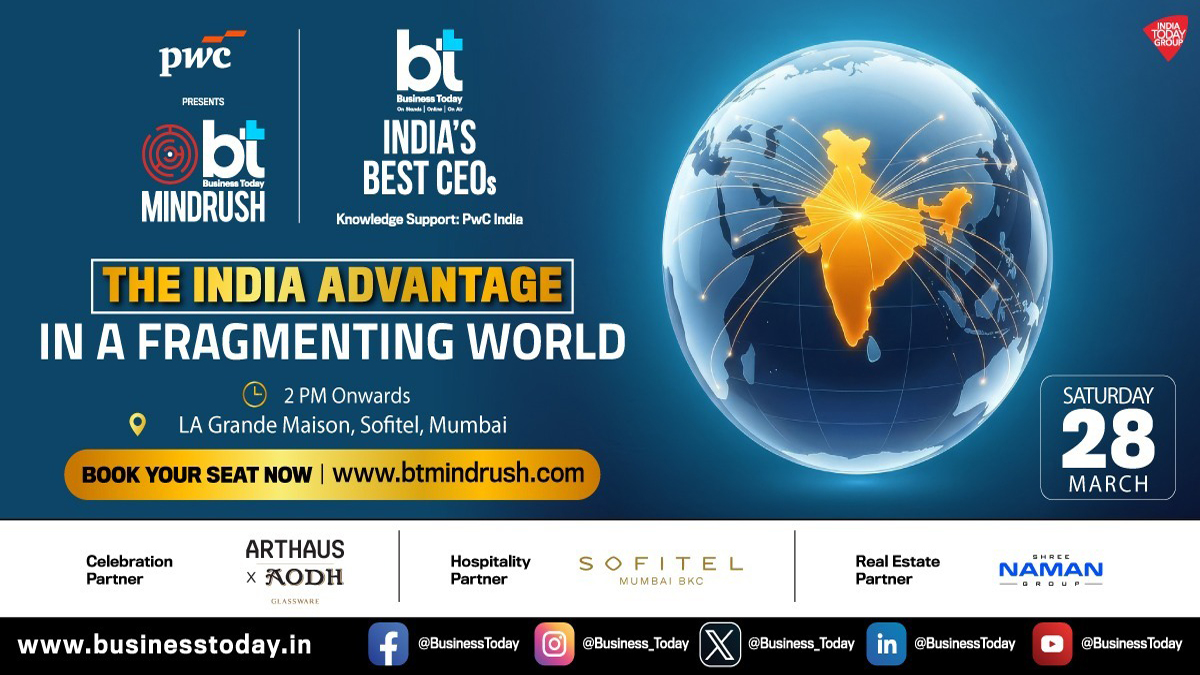
MUMBAI: As fault lines widen across global trade and geopolitics, Business Today is doubling down on India’s moment. The 14th edition of Business Today MindRush & Best CEOs Awards lands in Mumbai on March 28, pitching India’s strategic edge at the centre of a fragmenting world.
The day-long summit, presented by PwC, will bring together a tight mix of policymakers, industry leaders and market voices to decode shifting supply chains, maritime strategy, defence priorities, energy security and capital markets—sectors now deeply entangled with geopolitics.
M Nagaraju, secretary, department of financial services, ministry of finance, will headline the event, setting the tone for discussions that aim to track how India is repositioning itself amid disrupted trade routes and volatile energy dynamics.
The speaker slate reads like a cross-section of India Inc’s command centre. Krishna Swaminathan will zero in on sea lanes and supply chains, while Prashant Ruia is set to push the case for self-reliance in oil and gas. Ashish Chauhan will weigh in on capital markets at a pivotal juncture, as a panel featuring Vibha Padalkar, Sanjiv Mehta, Amish Mehta and Sanjeev Krishan debates navigating economic uncertainty.
Leadership under pressure will be another running theme. Madhavkrishna Singhania, Sharvil Patel, Karan Bhagat and Anurag Choudhary will unpack how businesses are steering through disruption. Arun Alagappan will turn the spotlight on fertilisers, Arundhati Bhattacharya will reflect on leadership transitions, while Anish Shah and S Vellayan will outline blueprints for building future-ready conglomerates.
The event will close with Aroon Purie setting the broader editorial lens, before the Best CEOs Awards recognise standout corporate leadership across sectors.
At a time when the global order looks increasingly splintered, MindRush 2026 is positioning itself as more than a conference—it is a signal that India intends not just to navigate the churn, but to shape it.








