News Broadcasting
TV gaining ground in Afghanistan despite obstacles: report


MUMBAI: Despite continued difficulties with security and reconstruction, television is gaining ground in Afghanistan as the most important news and entertainment source in urban areas, particularly the capital, Kabul.
Recent surveys have been conducted by US media and public opinion research organisation InterMedia.
Jacob English who is an InterMedia Project Manager for the Middle East and North Africa says, “Television use and importance is rising most quickly in Kabul, where socioeconomic conditions are better than in the rest of the country, and among young people 15-24.

“From 2005 to 2006, television access in the city rose from 59 to 78 per cent. Even urban residents who can’t afford to buy a television set have greater access to places where TV is available-others’ homes, cafes and work places. However, due to problems with infrastructure, mainly a lack of consistent electricity and little disposable income, television’s appeal is more socially desirable than affordable for many Afghans.”
In a country where 84 per cent of the population is rural, the urban-rural split is pronounced: nationwide only 37 per cent of Afghans claim to watch TV weekly, compared to 89 per cent in Kabul.
Kabul’s viewers can choose from six privately run channels. InterMedia found that Tolo TV, funded by an Australian based Afghan businessman, is most popular, with programs including a nightly newscast, roundtable discussions, Islamic programming, and shows on cinema, cooking, music and sports. Afghan State TV is the second most important information source.
The station’s principal focus is news, the tone of which is usually consistent with the government line. Other challenges remain. More than 25 years of war has devastated the country’s infrastructure, leaving radio as the most reliable means of news and entertainment (Afghanistan remains a radio culture – 92 per cent of Afghans own a radio, 73 per cent listen weekly).
In a country where 56 per cent of the people are under 34, young Afghans embrace television and other new technologies more readily than older generations. TV access among those 15-24 has remained steady at more than 30 per cent since 2004, but averages less than 15 per cent for those over 45.
International and local media producers realise this and are creating programmes to target young Afghans. Young Afghans, English says, are becoming more curious about new technologies and are most likely to drive media consumption patterns in the long run.
“Once this new generation sees and hears the images and voices of television, their demand for this media will likely rise. It’s unlikely that they will return to the radio of their parents,” English concludes.






News Broadcasting
India Today Group sweeps top honours at Ramnath Goenka Awards
Journalists recognised for fearless investigative and civic reporting.
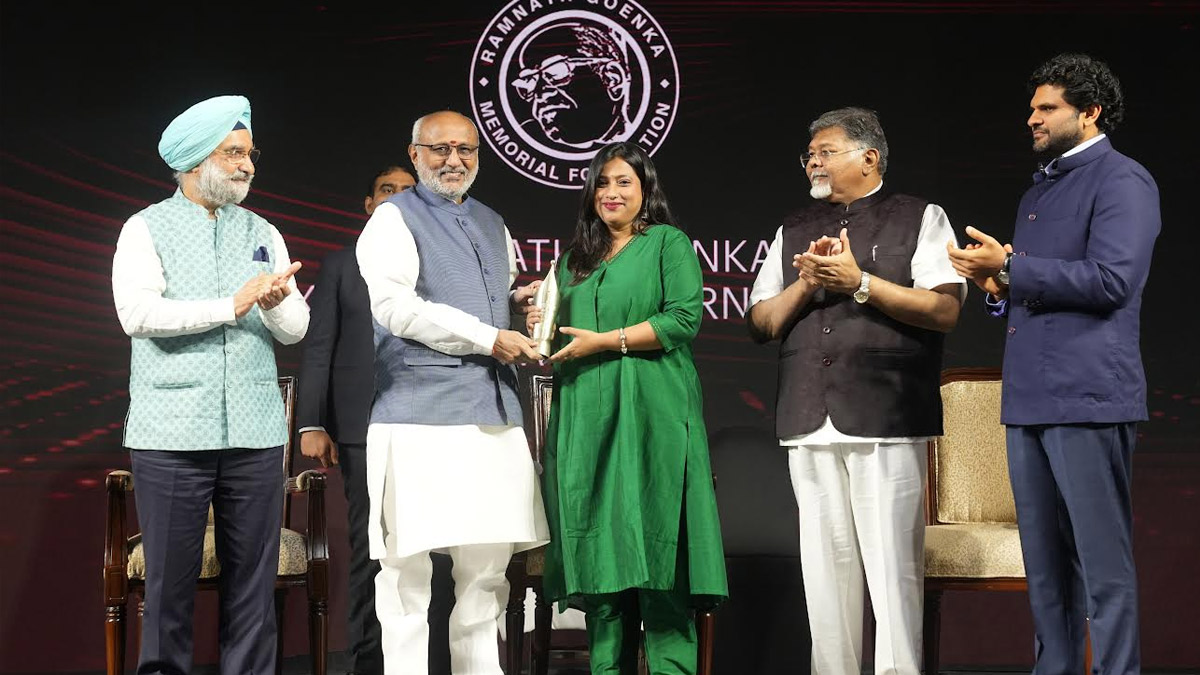
MUMBAI: India Today Group just turned the Ramnath Goenka Awards into its own trophy cabinet because when your reporters dig this deep, even the judges have to award a clean sweep. India Today Group journalists have secured multiple top honours at the latest edition of the prestigious Ramnath Goenka Excellence in Journalism Awards, reinforcing the network’s legacy as the gold standard of Indian journalism. The awards were conferred by vice president C. P. Radhakrishnan at a ceremony held on 27 March 2026.
Sreya Chatterjee won in the ‘Investigative Reporting – Broadcast’ category for her powerful India Today TV report ‘Operation Illegals: The Alarming Rise in Bangladeshi Infiltration Across India’s Fragile Eastern Frontier’. The investigation stood out for its depth, on-ground rigour and national relevance.
In the ‘Civic Journalism – Print/Digital’ category, Sreya Chatterjee along with Arvind Ojha were honoured for their indiatoday.in report on unregulated water extraction and the ‘Tanker Mafia’ in Delhi’s Bawana Industrial Area. The story exposed critical systemic gaps and environmental challenges affecting daily life.
Additionally, aajtak.in was recognised in the ‘Investigative Reporting – Print/Digital’ category for its hard-hitting exposé ‘The Surrogate Mother Market’, which highlighted the human, legal and ethical dimensions of the surrogacy ecosystem.
India Today Group emerged as the only network honoured in Investigative Journalism across both Print/Digital and Broadcast categories. The wins reflect the strength of its multi-platform newsroom and its unwavering commitment to credible, high-impact reporting that informs public discourse and drives accountability.
In an era when speed often trumps substance, these awards remind us that the most powerful stories are still the ones dug out with courage, told with clarity, and delivered with conscience, one fearless byline at a time.








