News Broadcasting
TV channels told to ‘clean up’ their content or face consequences

NEW DELHI: The government today came down heavily on various private sector television channels on issues relating to content described as `indecent’ and threatened to invoke rules and regulations if some spring cleaning is not done.
However, while not contradicting the government stand on the need to clean up the small screen of so-called adult stuff, the broadcast industry said it was ready to comply with rules and obtain certification from the Censor Board too, if necessary, provided there is adequate infrastructure to do the job quickly.
In a meeting today at the I&B ministry — surprisingly poorly attended by the industry — the issue of content on TV was discussed. It was categorically conveyed to the industry that the government was unhappy with the “non-cooperation” being extended by TV channels, which had promised self-censorship, but have done nothing more than pay lip service to the cause.

It was also highlighted that complaints regarding the fare shown on channels had been flowing in from various sources, indicative of the fact that the matter is of grave concern.
One of the possible actions that could be taken by the government is the non-registration of TV channels beaming into India under a proposed law on downlinking. Till that piece of legislation comes into effect, the government today said that action would be taken against errant channels under the programming guidelines listed in the Cable TV (Networks) Regulation Act, 1995.
The government also feels that apart from music videos, and film promos, various channels air films, certified `A’, that are not suitable for unrestricted public exhibition.
Interestingly, at the meeting, a representative from a Punjabi music channel said that there is no facility for getting certification for music videos in Punjab and getting it done in Delhi would be time consuming in a cut-throat and competitive market place. Censor Board chief and media personality Anupam Kher, who was present during the meeting, did not have any specific explanation to offer on this.
While the government did not bring up specific cases or instances of truant TV channels, it was felt that some music channels have been airing videos that were getting more explicit in nature.
“We did not take up individual cases, but feel that music channels, specially regional language ones like Punjabi, are the culprits and air stuff that would make anybody see red,” a senior ministry official said after the meeting.
But Kher did make a point that over the past six months, he has written about 250 letters to various channels on the issue of content and cautioning them to show some restraint. The response from the channels has been far from satisfactory, Kher made clear at the meeting.
A senior representative of the Indian Broadcasting Foundation, an apex body of broadcasters operating in India, who was also present during the meeting is understood to have told the government that most IBF members exercise self-restraint and those who don’t are yet to come within the fold of the organisation. IBF has also agreed to frame a code of conduct relating to content for its members.
Representatives from Star India, Zee Telefilms, MTV, Enadu, ETC, IBF and government officials attended today’s meeting, amongst others.






News Broadcasting
News18 India launches Command Centre war explainer with Arya
New show shifts from debates to decoding global conflicts and impacts
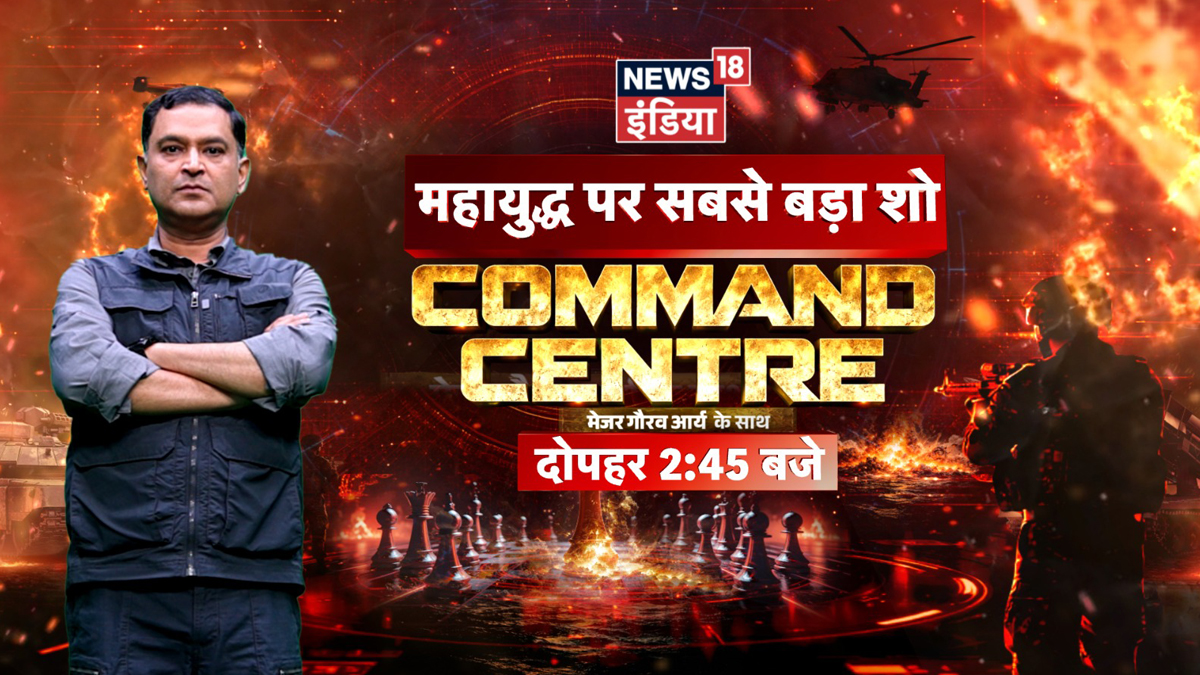
MUMBAI: News18 India has rolled out a new war-focused programme, Command Centre, featuring Gaurav Arya, as it looks to offer viewers a sharper, more grounded take on global conflicts amid rising tensions in West Asia.
Positioned as an “insider war room”, the show moves away from conventional panel debates and instead focuses on explaining military developments, decoding strategy and connecting global events to their everyday impact, from fuel prices to economic shifts.
The format leans heavily on visuals and data. The studio has been designed like a command hub, complete with large LED war maps, real-time graphics and an alert system to track developments as they unfold.
At the centre of it all is Arya, who brings his military background to simplify complex war strategies for viewers. His signature line, “Seedhi baat samjhiye”, anchors the show’s promise of clarity over noise.
News18 India managing editor Jyoti Kamal said, “Command Centre, featuring Major Gaurav Arya is designed to deliver accurate insights and a clear perspective on how evolving conflicts impact everyday life, from household budgets to national security. With expert voices analysing every development in real time, the show goes beyond headlines to decode what’s happening now, what it means, and what could come next.”
Echoing the intent, Gaurav Arya added, “In times of war, confusion is the biggest threat. With News18 India’s Command Centre, we are bringing viewers inside the war room, decoding strategies, tracking every escalation, and explaining, in the simplest terms, what it means for India and for every household. Seedhi baat samjhiye, this is where you understand not just what is happening, but what happens next.”
The weekday show will air in the afternoon slot and will also feature Gaurav Shukla, adding to its editorial depth.
With its mix of analysis, visuals and a clear focus on impact, the show reflects a broader shift in news consumption. Viewers are no longer just watching events unfold, they are looking to understand what those events mean for them.






