News Headline
Turbulence and Asian media meltdown


The economic crisis may reshape Asian media, says Media Partners Asia (MPA) Executive Director Vivek Couto. Companies will focus on cost savings, improved business models and, potentially, new acquisitions as asset prices fall.
The fragility of an American economy means it is getting harder to predict when Asia‘s media economies will return to better health following this year‘s downturn. As a result, these remain volatile times. Globally, the cost of capital has become high while economic growth continues to fall. At the same time, investors remain risk averse and credit continues to tighten. This is leading to further erosion in public market valuations for Asia media and limited funding options for both private and publicly-held media concerns.
Capitalising on the crisis through M&A could be a course for some, as the recent $1.1 billion transaction between Sina and Focus Media in China perfectly illustrates. Expect more crisis-driven deals to occur over the next 12-18 months though visibility on almost everything remains an issue.

The latest MPA research suggests advertising in Asia will grow by 1.5 per cent in 2009 versus its earlier expectations of 2.5 per cent, while growth in 2008 finished up at 5 per cent versus an earlier forecast of 5.6 per cent. Lower visibility and higher volatility also mean that recent ad growth estimates don‘t carry an upside potential anymore.
MPA‘s latest advertising forecasts have been downgraded due to volatility in Korea, Japan and India. A region-wide rebound of 5.8 per cent is expected in 2010. Excluding Australia and Japan, Asian ad growth will slow from 12.1 per cent in 2008 to 6.4 per cent next year, before a rebound to 9.4 per cent in 2010.
While MPA expects China and India to grow at trend levels of 10-13 per cent over the next three years, ad growth this year could be lower than forecast in both these markets.
In India, for instance, the economy is expected to grow by 6 per cent next year in real terms but could decelerate as low as 5 per cent, according to consensus. Meanwhile, the Indian ad market is expected to grow by 10.8 per cent next year but forward budgets for the next quarter indicate that dominant TV and print sectors face a tough time with growth, potentially coming in far lower than forecast. Elections in Q2 may boost spending but trend growth could come below MPA‘s 10-11 per cent forecast.
All of this means that the importance of monetising content through consumer transactions will grow as opposed to an over-reliance on brand spend, especially in places like India.The market share of digital in places like China will continue along an upward trajectory.
At the same time, new ad drivers will become even more important for traditional players: local as opposed to national ad markets in Indonesia, for instance, and regional markets in India as the recent advances by Star and Zee have shown.
Overall, MPA analysis indicates digital and out-of-home media will have a combined market share of close to 30 per cent by 2010 in China and Korea; more than 20 per cent in Japan, Australia and Taiwan; and more than 10 per cent in India. TV and print will continue to hold more than 40 per cent share in India, while TV will retain 60-70 per cent market share in Indonesia, Philippines and Thailand. Print will remain dominant in Malaysia, with more than 55 per cent share.
Potential buying opportunity
Media M&A talk has arisen because of the collapse of equity markets, risks around maturing debt and weak balance sheets. Publicly-traded market capitalisation for media companies fell by an average of 30-80 per cent last year in China, Japan, Korea, Australia, India, and Indonesia.
To be sure, equity market capitulation does not necessarily mean that media assets will actually sell at bargain-basement prices. After all, most have an intrinsic value far higher than what the fearful public and risk-averse institutional investors are currently prepared to pay.
Potential sellers today and in the future may include: Korean cable broadcaster On*Media (045710.KS); Indonesian terrestrial TV network Surya Citra Media (SCMA.JK); Indian broadcaster IBN-18 (IBN.BO); Chinese CAS supplier CDTV (STV.N) and media wannabe Xinhua Finance Media (XFML.OQ); Japanese satellite broadcaster WOWOW (4839.T); Chinese media giant TVB (0511.HK); and Australia‘s APN (APN.AX).
Debt issues, focus on Australia and Thailand
Asian companies with heavy debt leverage include: Australian publisher Fairfax (FXJ.AX), PBL Media and Thailand‘s True Corp (TRUE.BK). At least one of these is likely to sell parts of its troubled franchise in the months to come. True in particular faces a big credit crunch, having notched up around $180 million in liabilities, while its overall debt ratios will likely breach the covenants in its bank loan facility.
There was at least some good news for PBL Media at the end of last year with majority shareholder CVC Asia announcing that it would inject a further $230 million equity in PBL. Like many of its counterparts, PBL Media is struggling with one of Australia‘s worst ad downturns in a long time with the ad market expected to decline by more than 6 per cent this year.
Australia‘s Ten Network (TEN.AX) is also suffering – it saw TV revenues decline by 12 per cent in its latest quarter while overall group EBITDA fell 25 per cent. Canadian media major CanWest has steadfastly refused to consider selling its 57 per cent stake in Ten. Current economic hardships may force a rethink. CanWest has consolidated debt of close to $3 billion versus a market cap of only $60 million, and is increasingly exposed to Canada‘s worsening economy.
Pay-TV platforms
Opportunities in the private market include various pay-TV platforms needing funds for further expansion and digital deployment. Indonesia‘s Indovision, one of the fastest growing operators in Southeast Asia with over 500,000 pay-TV subscribers, potentially needs more funds to grow beyond its end-2009 target of 1.2 million customers. Meanwhile, numerous operators in India need new capital, as the cost of subscriber acquisition escalates and average revenue per user (ARPU) growth remains modest. Candidates include WWIL, Tata Sky, Dish TV (DTV.BO), DEN and Hathway, though only the latter has a positive EBITDA level at present.
Various next-generation broadcast satellite licences in Japan are also coming up for grabs in 2009 with J:COM, NBC and Time Warner‘s Turner slated to feature in potential acquiring consortiums. Future M&A in Korea is also worth highlighting, with new regulations allowing cable MSOs to increase market share coverage with more MSO acquisitions. In the near term however, Korean MSOs, weighed down by a combination of debt and IPTV competition, may look to pursue bargain acquisitions and alliances in the content space instead.
Global media and India
Gauging how M&A in Asia media may play out also depends on what happens in global media. The severity of the US downturn, as well as various debt issues, have hit global media companies, including most notably Viacom and NBC. Both own assets in key markets such as India, and supply quality programming and brands to various networks across Asia. NBC is scaling back the pace and extent of its investment across Asia ex-India while Viacom has scaled back operations again in Asia ex-India, this time even scaling back in profitable territories such as Japan.
How these companies manage the crisis is important: whether they choose to sell certain assets in Asia, or sell big assets, or merge with a competitor such as Time Warner and News Corp., could have a decisive impact on future trends.
India‘s IBN18, which has a highly-rated but costly GE channel JV (Colors) with Viacom, recently raised $25 million through a qualified institutional placement (AIP) to five institutional investors: T Rowe Price, Reliance Capital, Franklin Templeton, JM Financial and HSBC. IBN has also issued 15 million warrants to news media company TV18 (TVET.BO), convertible at Rs 102 per share, implying an infusion of about Rs 1.53 billion, which puts a lot of pressure on the TV18 balance sheet and limits its flexibility going forward. Future funding for IBN and Colors next year will need bigger players and more cash, which could lead to a better strategic result for the company.





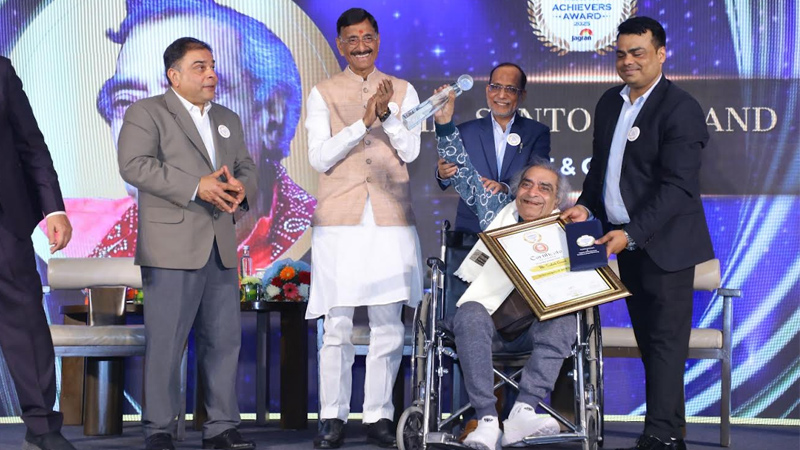
NEW DELHI: Hamdard Laboratories gathered a cross-section of India’s achievers in New Delhi on Friday, handing out the Hakeem Abdul Hameed Excellence Awards to figures who have left their mark across healthcare, education, sport, public service and the arts.
The ceremony, attended by minister of state for defence Sanjay Seth and senior officials from the ministry of Ayush, celebrated individuals whose work blends professional success with a sense of public purpose. It was as much a roll call of achievement as it was a reminder that influence is not measured only in profits or podiums, but in people reached and lives improved.
Among the headline awardees was Alakh Pandey, founder and chief executive of PhysicsWallah, recognised for turning affordable digital learning into a mass movement. On the sporting front, Arjuna Awardee and kabaddi player Sakshi Puniya was honoured for her contribution to the game and for pushing women’s participation onto bigger stages.
The cultural spotlight fell on veteran lyricist and poet Santosh Anand, whose songs have echoed across generations of Hindi cinema. At 97, Anand accepted the honour with characteristic humility, reflecting on a life shaped by perseverance and hope.
Healthcare honours spanned both modern and traditional systems. Manoj N. Nesari was recognised for strengthening Ayurveda’s place in national and global health frameworks. Padma shri Mohammed Abdul Waheed was honoured for his research-backed work in Unani medicine, while padma shri Mohsin Wali received recognition for his long-standing contribution to patient-centred care.
Education and social development also featured prominently. Padma shri Zahir Ishaq Kazi was honoured for decades of work in education, while former Meghalaya superintendent of Police T. C. Chacko was recognised for public service. Goonj founder Anshu Gupta received an award for his dignity-centred rural development initiatives, and the Hunar Shakti Foundation was honoured for empowering women and young girls through skill development.
The Lifetime Achievement Award went to former IAS officer Shailaja Chandra for her long career in public healthcare and governance, particularly in the traditional systems under Ayush.
Speaking at the event, Hamdard chairman Abdul Majeed said the awards were a tribute to those who combine excellence with empathy. “These awardees reflect Hakeem Sahib’s belief that healthcare, education and public service must ultimately serve humanity,” he said.
Minister Seth struck a forward-looking note, saying India’s young population gives the country a unique opportunity to become a global destination for learning, health and wellness by 2047.
The ceremony also featured the trailer launch of Unani Ki Kahaani, an upcoming documentary starring actor Jim Sarbh, set to premiere on Discovery on 11 February.
Instituted in memory of Unani scholar and educationist Hakeem Abdul Hameed, the awards have grown into a national platform that celebrates those building a more inclusive and resilient India. For one evening at least, the spotlight was not just on success, but on service with substance.