Applications
Truecaller dials up AI to reveal why they’re calling, not just who it is


MUMBAI: Call of the wild unknown may finally be tamed. Truecaller, the caller ID app that has become a lifeline for over 450 million users across 190 countries, has unveiled a fresh AI upgrade that promises to answer the question that nags us all when the phone rings: not just who’s calling, but why.
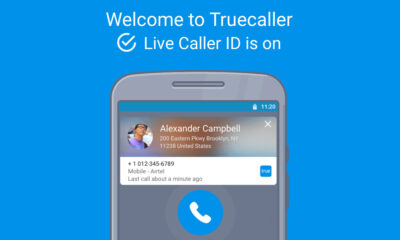
The new AI-powered Caller ID goes beyond flashing a name on screen. It analyses billions of signals from calls, messages and community feedback to deliver instant context whether the number belongs to a delivery rider, a customer support desk, or a scammer lurking in the shadows. With AI-summarised user comments now popping up in real time, users can see a one-line digest of hundreds of reports before deciding whether to swipe green or red.
And the timing couldn’t be sharper. Phone scams are no longer just nuisance calls, they’re an economic menace. In 2024 alone, Truecaller flagged over 56 billion spam and fraud calls, while the Global Anti-Scam Alliance and Feedzai pegged worldwide scam losses at a staggering 1.03 trillion dollars. With fraud networks evolving faster than telecom operators’ static spam tags, Truecaller’s adaptive AI acts as a global early-warning system: a number flagged for impersonation in one region can now be proactively labelled elsewhere, thanks to shared intelligence and behavioural modelling.

“People hesitate to answer unknown calls because they lack context, and in today’s world, context is everything,” said Truecaller global CEO Rishit Jhunjhunwala, of . “Truecaller was built to solve this: not just to identify who’s calling, but to help you understand why. Is it someone from your network, a delivery, a business or a scam? Our AI uses real-time data and contextual signals to give you clarity the moment your phone rings, turning uncertainty into informed choice.”
Unlike traditional caller ID systems that depend on delayed telecom databases, Truecaller’s intelligence is dynamic and continuously enriched by its engaged user community. Every day, millions of reports feed into its models, sharpening its ability to detect suspicious behaviour even before numbers have been widely reported. The AI can also indicate when a number is “likely a business” or “likely important” despite limited history, a key feature in regions where formal business verification lags behind.
For brands, Truecaller already offers a verified business badge to mark official identities. But the majority of insights shown to users come from its AI engine meaning no manual labelling or registration is required. From identifying spoofed calls to spotting robocall campaigns in their infancy, the system is designed to stay one step ahead of fraudsters.
The platform’s greatest edge, though, may be its scale. With a global community of 450 million active users across 190 plus countries, Truecaller has turned into a real-time safety net. Its AI doesn’t just learn from local spam reports; it cross-pollinates intelligence globally. A fraudster shut down in one country can’t simply resurface in another without detection, as the system shares behavioural cues across markets.
In an era where attention spans are shrinking but threats are multiplying, Truecaller is positioning itself as more than a caller ID, it’s a context engine. The company says it wants to move users from hesitation to confidence, ensuring that every buzz in your pocket comes with an informed choice attached. And in a world where scams are growing more sophisticated by the minute, that context might just be the most valuable ring tone of all.






Applications
With 57 per cent single new users, Ashley Madison rebrands as discreet dating platform
Platform says majority of new members now identify as single

INDIA: Ashley Madison is shedding the “married-dating” label that defined it for two decades, repositioning itself as a platform for discreet dating in what it calls the post-social media age.
The rebrand, unveiled in India on 27 February, 2026, marks a structural shift in business model and identity. Once synonymous with married dating, the company now describes itself as the “premier destination for discreet dating” under a new tagline: Where Desire Meets Discretion.
The pivot is data-driven. Internal figures show that 57 per cent of global sign-ups between 1 January and 31 December, 2025 identified as single: a notable departure from the platform’s married core. The company argues that its community has already evolved beyond its original positioning.
“In an age where our lives have been constantly put on public display, privacy has become the new luxury,” said Ashley Madison chief strategy officer Paul Keable. He framed the platform’s offering as “ethical discretion” for singles, separated, divorced and non-monogamous users seeking private connections.
The shift also taps into wider digital fatigue. A global survey conducted by YouGov for Ashley Madison, covering 13,071 adults across Australia, Brazil, Canada, Germany, India, Italy, Mexico, Spain, Switzerland, the UK and the US, found mounting discomfort with hyper-public online lives.
Among dating app users, 30 per cent cited constant swiping and messaging as a source of fatigue, while 24 per cent pointed to pressure to curate public-facing profiles and early personal disclosure. Some 27 per cent said fears of screenshots or information being shared contributed to exhaustion; an equal share cited unwanted attention.
The retreat from oversharing appears broader. According to the survey, 46 per cent of adults actively try to keep most aspects of their life private online. Only 8 per cent feel comfortable sharing most aspects publicly, while 35 per cent say they are becoming more selective about what they disclose.
Ashley Madison is betting that this cultural recalibration towards controlled visibility can be monetised. By doubling down on privacy infrastructure and reframing itself around discretion rather than infidelity, the company is attempting to convert reputational baggage into a premium proposition.






