News Headline
TRAI seeks stakeholders’ inputs on audience measurement overhaul

MUMBAI: Television audience measurement in India continues to remain one of the key subjects that evoke reactions from stakeholders. Given that advertising expenditures are typically guided by such data and, in the wake of the matter being raised at various fora, TRAI has come out with a public consultation on various facets of TV audience measurement and how the existing system could be made more robust.
Telecom Authority of India (TRAI)’s move gains importance as stakeholders during meetings with the regulator, leading up to the present consultation, had conveyed that the present measurement system, spearheaded by a joint industry body Broadcast Audience Research Council India (BARC India), has done a credible job till now, but additional improvements could be made, including making data collection more robust and finding ways to curb panel infiltrations leading to possible manipulations. More so as the industry has already invested in the present system over the past three years and it would be improper to try find alternate mechanisms at this juncture.
Keeping such views in mind, TRAI has raised issues relating to RPD(return path data) and whether set-top-boxes deployed in the country were technically adept at catching such figures — initiatives that would add to data robustness. The specific questions asked is: What percentage of STB supports transferring viewership data through establishing a reverse path/connection from STB? What will be the additional cost if existing STBs without return path are upgraded?

Asking whether regulatory tweaks were needed to reduce the impact of manipulation of measurement panels — an issue red-flagged by BARC India itself in an earlier consultation — TRAI has sought comments on the country-wide panel size and also the size of the individual panels in rural and urban areas.
The consultation paper highlights several such issues, including if BARC India, the organisation presently doing audience measurement, has been able to accomplish its purpose.
Industry observers said though the regulator may have raised pertinent issues, some of them could be answered by the stakeholders only if they decide to take a firm view on them. For example, TRAI asks whether the present sample size of bar-o-meters employed to collect data is adequate. The answer is, maybe no. But to increase the sample size, the stakeholders need to commit more financial investments and give BARC India the go-ahead — though annually some boxes are added to live up to promises made at the time Ministry of Information and Broadcasting green-lighted the BARC project.
The TRAI paper also seeks inputs from the stakeholders regarding shareholding/ownership pattern of BARC India and whether its credibility and neutrality can be enhanced further, while highlighting various methods of collating such data in other countries, including the US, the UK and France.
Some of the other issues highlighted in the TRAI paper are the following:
# Is there a need to promote competition in television rating services to ensure transparency, neutrality and fairness to give TAM rating?
# What regulatory initiatives/measures can be taken to make TV rating services more accurate and widely acceptable?
# Is the current audience measurement technique used by BARC apposite?
# Does broadcasting programmes that are out of their category or in different languages for some time during the telecast affect the TAM (TV audience measurement) rating? If so, what measures should be adopted to curb it?
# Can TV rating, based on limited panel homes, be termed as truly representative?
# What should be done to reduce the impact of manipulation of panel home data on overall TV ratings?
# What should be the panel size both in urban and rural India to give true representation of audience?
# What method/technology would help to rapidly increase the panel size for television audience measurement in India? What will be the commercial challenge in implementing such solutions?
# Should DPOs be mandated to facilitate collection of viewership data electronically, subject to consent of subscribers to increase data collection points for better TRPs?
# What percentage of STB supports transferring viewership data through establishing a reverse path/connection from STB? What will be the additional cost if existing STBs without return path are upgraded?
# What method should be adopted for privacy of individual information and to keep the individual information anonymous?
# What should be the level/granularity of information retrieved by the television audience measurement agency from the panel homes so that it does not violate principles of privacy?
# What measures need to be taken to address the issue of panel tampering/infiltration?
# Should BARC be permitted to provide raw level data to broadcasters? If yes, how secrecy of households, where the people meters are placed, can be maintained?
BARC India, set up in 2015, is a joint venture amongst broadcast and advertising industry bodies IBF, AAAI, ISA with Indian Broadcasting Foundation or IBF being a majority shareholder. India’s public broadcaster Prasar Bharati also sits on the BARC India board. Apart from TV audience data, BARC India is also exploring rolling out similar figures for digital platforms.





NEW DELHI: Hamdard Laboratories gathered a cross-section of India’s achievers in New Delhi on Friday, handing out the Hakeem Abdul Hameed Excellence Awards to figures who have left their mark across healthcare, education, sport, public service and the arts.
The ceremony, attended by minister of state for defence Sanjay Seth and senior officials from the ministry of Ayush, celebrated individuals whose work blends professional success with a sense of public purpose. It was as much a roll call of achievement as it was a reminder that influence is not measured only in profits or podiums, but in people reached and lives improved.
Among the headline awardees was Alakh Pandey, founder and chief executive of PhysicsWallah, recognised for turning affordable digital learning into a mass movement. On the sporting front, Arjuna Awardee and kabaddi player Sakshi Puniya was honoured for her contribution to the game and for pushing women’s participation onto bigger stages.
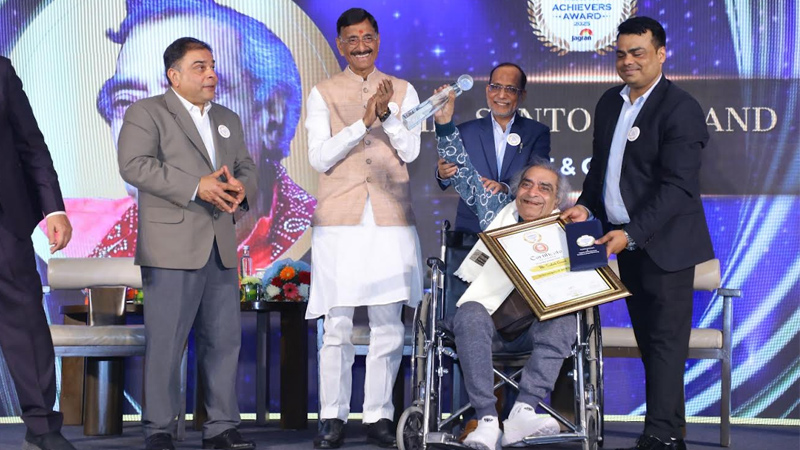
The cultural spotlight fell on veteran lyricist and poet Santosh Anand, whose songs have echoed across generations of Hindi cinema. At 97, Anand accepted the honour with characteristic humility, reflecting on a life shaped by perseverance and hope.
Healthcare honours spanned both modern and traditional systems. Manoj N. Nesari was recognised for strengthening Ayurveda’s place in national and global health frameworks. Padma shri Mohammed Abdul Waheed was honoured for his research-backed work in Unani medicine, while padma shri Mohsin Wali received recognition for his long-standing contribution to patient-centred care.
Education and social development also featured prominently. Padma shri Zahir Ishaq Kazi was honoured for decades of work in education, while former Meghalaya superintendent of Police T. C. Chacko was recognised for public service. Goonj founder Anshu Gupta received an award for his dignity-centred rural development initiatives, and the Hunar Shakti Foundation was honoured for empowering women and young girls through skill development.
The Lifetime Achievement Award went to former IAS officer Shailaja Chandra for her long career in public healthcare and governance, particularly in the traditional systems under Ayush.
Speaking at the event, Hamdard chairman Abdul Majeed said the awards were a tribute to those who combine excellence with empathy. “These awardees reflect Hakeem Sahib’s belief that healthcare, education and public service must ultimately serve humanity,” he said.
Minister Seth struck a forward-looking note, saying India’s young population gives the country a unique opportunity to become a global destination for learning, health and wellness by 2047.
The ceremony also featured the trailer launch of Unani Ki Kahaani, an upcoming documentary starring actor Jim Sarbh, set to premiere on Discovery on 11 February.
Instituted in memory of Unani scholar and educationist Hakeem Abdul Hameed, the awards have grown into a national platform that celebrates those building a more inclusive and resilient India. For one evening at least, the spotlight was not just on success, but on service with substance.






