News Headline
TRAI recommends high reserve prices for spectrum auction; TSPs unhappy

NEW DELHI: The Telecom Regulatory Authority of India (TRAI) today recommended rates for auction of spectrum in the 700 Mhz, 800 Mhz, 900 Mhz, 1800 Mhz, 2100 Mhz, 2300 Mhz and 2500 Mhz bands.
Earlier, TRAI chairman R S Sharma had said that the auction may be conducted in May or June this year.

The base spectrum price per MHz for Delhi metro will be Rs 1,595 crore for 700 MHz, Rs 848 crore for 800 MHz, Rs 399 crore for 1800 MHz, Rs 554 crore for 2100 MHz, Rs 143 crore for 2300 MHz and Rs 143 crore for 2500 MHz band.
TRAI said the base spectrum price per MHz for Karnataka (including Bangalore) will be Rs 740 crore for 700 MHz, Rs 303 crore for 800 MHz, Rs 558 crore for 900 MHz, Rs 185 crore for 1800 MHz, Rs 328 crore for 2100 MHz, Rs 98 crore for 2300 MHz and Rs 98 crore for 2500 MHz band.
One TSP, who did not want to be named, told Indiantelevision.com that the prices were prohibitive and the government may be asked to reconsider the recommendations.
The Authority reiterated its earlier recommendation that APT700 band plan should be adopted for the 700 MHz (698-806 MHz) spectrum band with FDD based 2×45 MHz frequency arrangement.
TRAI has also recommended that entire available spectrum (2x35MHz) in the 700 MHz band should be put to auction in the upcoming auction.
The Authority said test schedule for the roll-out obligations testing for 700 MHz should be released within a period of one year from the date of completion of auction in this band.
The same roll-out obligations, which were imposed on the successful bidder of spectrum in 800 MHz, 900 MHz, 1800 and 2100 MHz band in the auctions held in 2015, should be prescribed for these spectrum bands in the upcoming auctions for new entrants. The Authority also said no fresh roll-out obligation should be imposed on existing service providers who are already operating their services in 800, 900, 1800 or 2100 MHz band, in case they acquire additional block of spectrum in the same band.
The Authority recommended that the same eligibility criteria that have been made applicable for other bands viz. 800 MHz, 900 MHz, 1800 MHz and 2100 MHz band in January 2015 NIA should be made applicable for 2300 MHz and 2500 MHz bands. The same eligibility criteria should also be made applicable for 700 MHz band also.
Partial spectrum available in Bihar, Rajasthan and North-East LSAs should not be put to auction till such time it becomes available at least in 75 per cent of total number of districts of the LSA including the State capital(s).
The Authority recommended that DoT, in coordination with Defence and the TSPs, should complete the harmonisation process in the 1800 MHz band before upcoming auctions so that the entire spectrum that is made available due to this exercise is placed for bidding. The available spectrum must be put to auction in contiguous blocks, preferably in the block of 5 MHz.
It recommended that the 1800 MHz band administratively assigned spectrum to Aircel in Haryana and MP, and Tata in HP should be taken back. The Authority also recommended that the 800 MHz band be administratively assigned spectrum to Tata in WB and Quadrant in Punjab should be taken back. This spectrum should also be put to upcoming auction.
The Authority recommended that DoT, in coordination with Defence and the TSPs, should complete the harmonisation process in the 1800 MHz band before upcoming auctions so that the entire spectrum that is made available due to this exercise is placed for bidding. The available spectrum must be put to auction in contiguous blocks, preferably in the block of 5 MHz.
The Authority recommended that DoT should ensure that the spectrum surrendered by TTSL is not kept idle and takes appropriate legal remedies to put it in the upcoming auction.
Additionally, the entire available spectrum in 2100 MHz band, including spectrum taken back from STEL, should be put to auction.
Spectrum in 700 MHz band should be offered in the block size of 5 MHz (paired). In case a TSP is able to win more than one block of spectrum in the upcoming auctions, it should be allocated spectrum in contiguous blocks.
In case a TSP is able to win more than one block of spectrum in 2100 MHz band, it should be allocated spectrum in contiguous blocks. Similarly, if the TSP already having spectrum in the 2100 MHz band, acquires additional carrier, it should be ensured that all its carriers are contiguous.
Spectrum in the 2300 MHz and 2500 MHz bands should be put to auction in the block size of 10 MHz (unpaired). Currently, spectrum trading in 2300/2500 MHz band is permitted in the block size of 20 MHz. The Authority also recommended that after network synchronisation of all the TDD networks, spectrum trading in 2300/2500 MHz band should be permitted in the blocks of 10 MHz.
Existing provision of a cap of 25 per cent of the ‘total spectrum assigned’ in 700/800/900/1800/ 2100/2300/2500 MHz bands and 50 per cent within a given band in each of the access service area shall apply for total spectrum holding by each TSP.
The roll-out obligations to be imposed for licensees who acquire access spectrum in 700 MHz band should be: all towns/villages having population of 15,000 or more but less than 50,000 to be covered within five years of effective date of allocation of spectrum for access services and all villages having population of 10,000 or more but less than 15,000 to be covered within seven years of effective date of allocation of spectrum; to prevent, duplication of infrastructure, a TSP should also be permitted to fulfil the obligations by sharing network of other operator to the extent permissible as per guidelines/instructions applicable from time to time.
The Authority recommended that the quantum of test fee for the purpose of roll-out testing requirements may be reduced to 20 per cent of the existing rates for testing in the block headquarters (for phase 3, 4 and 5 of the rollout obligations) and similarly for testing of coverage in rural SDCAs.






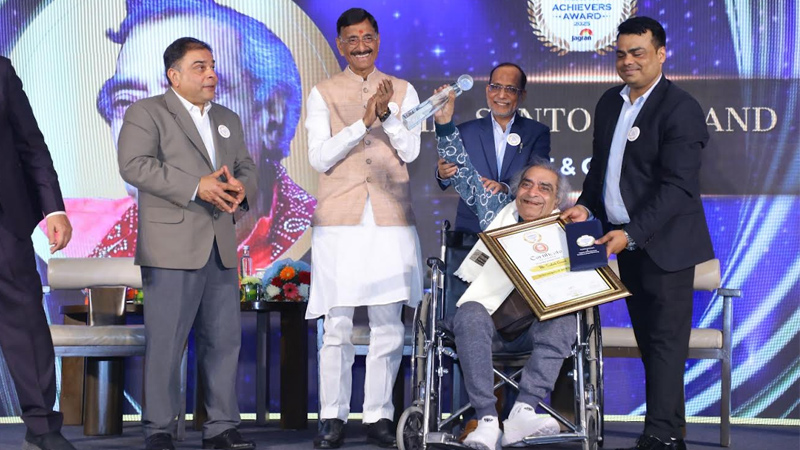
NEW DELHI: Hamdard Laboratories gathered a cross-section of India’s achievers in New Delhi on Friday, handing out the Hakeem Abdul Hameed Excellence Awards to figures who have left their mark across healthcare, education, sport, public service and the arts.
The ceremony, attended by minister of state for defence Sanjay Seth and senior officials from the ministry of Ayush, celebrated individuals whose work blends professional success with a sense of public purpose. It was as much a roll call of achievement as it was a reminder that influence is not measured only in profits or podiums, but in people reached and lives improved.
Among the headline awardees was Alakh Pandey, founder and chief executive of PhysicsWallah, recognised for turning affordable digital learning into a mass movement. On the sporting front, Arjuna Awardee and kabaddi player Sakshi Puniya was honoured for her contribution to the game and for pushing women’s participation onto bigger stages.
The cultural spotlight fell on veteran lyricist and poet Santosh Anand, whose songs have echoed across generations of Hindi cinema. At 97, Anand accepted the honour with characteristic humility, reflecting on a life shaped by perseverance and hope.
Healthcare honours spanned both modern and traditional systems. Manoj N. Nesari was recognised for strengthening Ayurveda’s place in national and global health frameworks. Padma shri Mohammed Abdul Waheed was honoured for his research-backed work in Unani medicine, while padma shri Mohsin Wali received recognition for his long-standing contribution to patient-centred care.
Education and social development also featured prominently. Padma shri Zahir Ishaq Kazi was honoured for decades of work in education, while former Meghalaya superintendent of Police T. C. Chacko was recognised for public service. Goonj founder Anshu Gupta received an award for his dignity-centred rural development initiatives, and the Hunar Shakti Foundation was honoured for empowering women and young girls through skill development.
The Lifetime Achievement Award went to former IAS officer Shailaja Chandra for her long career in public healthcare and governance, particularly in the traditional systems under Ayush.
Speaking at the event, Hamdard chairman Abdul Majeed said the awards were a tribute to those who combine excellence with empathy. “These awardees reflect Hakeem Sahib’s belief that healthcare, education and public service must ultimately serve humanity,” he said.
Minister Seth struck a forward-looking note, saying India’s young population gives the country a unique opportunity to become a global destination for learning, health and wellness by 2047.
The ceremony also featured the trailer launch of Unani Ki Kahaani, an upcoming documentary starring actor Jim Sarbh, set to premiere on Discovery on 11 February.
Instituted in memory of Unani scholar and educationist Hakeem Abdul Hameed, the awards have grown into a national platform that celebrates those building a more inclusive and resilient India. For one evening at least, the spotlight was not just on success, but on service with substance.






