News Broadcasting
TRAI recommendations on accreditation of rating agencies accepted: Tewari


NEW DELHI: Even as the industry body Broadcast Audience Research Council (BARC) is struggling with its teething problems, the Information and Broadcasting Ministry (I &B) has accepted view of the Telecom Regulatory of India (TRAI) that the minimum number of homes that a rating agency should measure should be 20,000 within six months of the guidelines coming into force, after which the number should be increased by 10,000 every year to reach 50,000.
Minister Manish Tewari has said that his Ministry would place these guidelines before the union cabinet, a note for which has already been circulated. The Ministry had earlier asked the regulator to provide its guidelines on the issue, after which TRAI had in September released its recommendations including a condition that they be notified within two months.

He said most recommendations had been “more or less accepted.” “Once we have the cabinet approval, we will notify the guidelines,” he added. Interestingly, Tewari, during his speech, also touched upon the dispute on whether the foreign direct investment should be raised for the print media. While the Press Council of India (PCI) had submitted its recommendations that the current levels of FDI in print media should be maintained, the Indian Newspaper Society (INS) had favoured raising the limit to 49 per cent. “We are trying to build a political consensus after all media is a sensitive area,” Tewari said.
The TV audience measurement mechanism has been a subject of controversy in the past with many channels expressing dissatisfaction with TAM ratings.
Tewari said the amendments to the Press and Registration Books Act were already on the Ministry website and stakeholders’ had sought fresh consultations on issues including ‘paid news’, which had been slated for Tuesday.
Replying to a question related to setting up of a National Gaming and Animation Centre in Mohali in Punjab, Tewari said there was a problem as it was intended to be a Public-Private Partnership (PPP) but the private sector had not responded.
He said government was considering a plan to set up the institute with Japanese assistance. Tewari said bills to give special status to Film and Television Institute of India (FTII) and Satyajit Ray Film and TV Institute had been sent to the Law Ministry. He said another proposal to give the status of ‘institute of national importance’ to the Indian Institute of Mass Communication was by and large ready.






News Broadcasting
Network18 channels lead YouTube news viewership in March 2026
CNN-News18, News18 India and CNBC channels top categories with record views
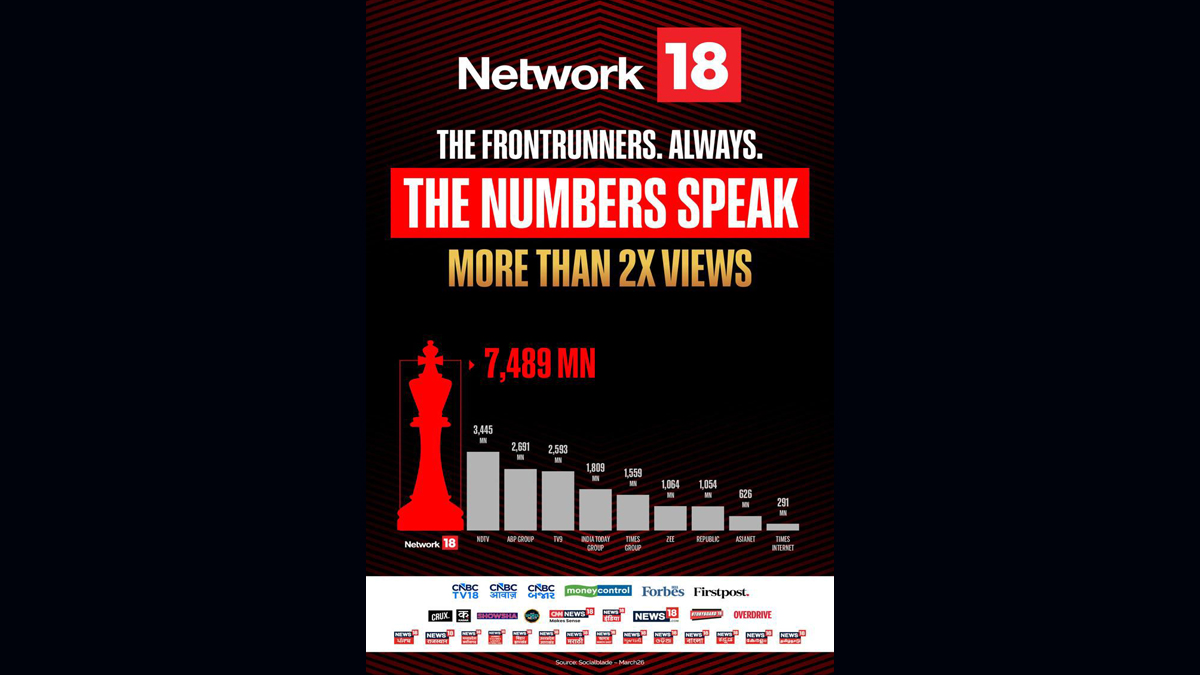
MUMBAI: When the world hit refresh on breaking news, Network18’s channels were already streaming ahead. As geopolitical tensions and war-driven headlines fuelled a surge in global news consumption, the network’s digital playbook delivered big clocking record Youtube viewership across English, Hindi and business news categories in March 2026.
At the forefront was CNN-News18, which emerged as the clear leader in the English news segment with 130 million live and video-on-demand views. The channel edged past competitors such as Times of India (126.5 million), Times Now (101.1 million), India Today (88.2 million) and NDTV (77.5 million), according to Databeings data for March.
In the Hindi news arena, News18 India delivered a commanding performance, racking up a staggering 3,297 million views on YouTube. The channel comfortably outpaced NDTV India, which recorded 3,119 million views, underlining its deep reach and consistent engagement with mass audiences, as per Playboard data.
The network’s dominance wasn’t confined to general news. In the Hindi business segment, CNBC Awaaz topped the charts with 92 million views, narrowly ahead of Zee Business (90 million) and well ahead of ET Now Swadesh (57 million). Meanwhile, its English counterpart CNBC-TV18 posted a strong 58 million views, reinforcing the network’s cross-category strength.
The spike in viewership reflects a broader shift in audience behaviour, with viewers increasingly turning to digital platforms particularly Youtube for real-time updates and in-depth coverage during high-intensity news cycles. For Network18, the numbers signal more than just scale; they underline the effectiveness of a multi-platform strategy that blends speed, credibility and continuous coverage.
In a month where the news never paused, it seems viewers chose to stay tuned where the stream never stopped.






