News Broadcasting
Trai likely to recommend 5-8 % hike in cable rates

NEW DELHI: Broadcast and cable regulator, Trai, is expected to recommend a 5-8 per cent annual hike in the cable TV prices, in line with the yearly rise in inflation for the calendar year 2004.
The new prices will come into effect from 26 December and an announcement will be made before that.
“We cannot keep the cable prices frozen forever and there would be some increase in the pricing. We expect the annual hike to be equivalent to the consumer price index rise or the annual increase in inflation,” Trai chief Pradip Baijal said today.

Quizzed whether the price revision could work out to between 5-8 per cent as increase in inflation, Baijal agreed saying, “It should be in that region.”
Though Telecom regulatory Authority of India (Trai) today issued The Telecommunication (Broadcasting and Cable) Services (Second) Tariff Order 2004, effective from today itself, the prices are to be kept in the coolers till new rates or a formula to calculate it is announced by Trai.
The regulator is reviewing the subscription charges that were frozen since December 26, 2003. Trai said in a statement today: “This revision is expected to be completed in November 2004, so that it can take effect from 26 December 2004, that is one year from the date from which the prices had been frozen.”
The authority through its order dated 15 January, 2004 and subsequent amendments had specified that the all cable TV-related charges (excluding taxes) were being frozen as of 26 December 2003.
A number of representations had been received seeking clarification on the manner in which new pay channels can be priced and the impact on retail prices. Similarly, clarifications have also been sought on the impact of channels that were free-to-air on 26 December, 2003 and having later converted to pay.
According to Trai, this issue has been carefully considered by the authority. Since new channels will be coming into the market, a mechanism has to be provided for pricing of these new channels. At the same time, there is a need to conserve the protection provided to the consumers by the Tariff Order dated 15 January, 2004.





News Broadcasting
UDF poised to return to power in Kerala, says Manorama-CVoter survey
Massive opinion poll projects shift in Kerala politics ahead of 2026 Assembly elections.
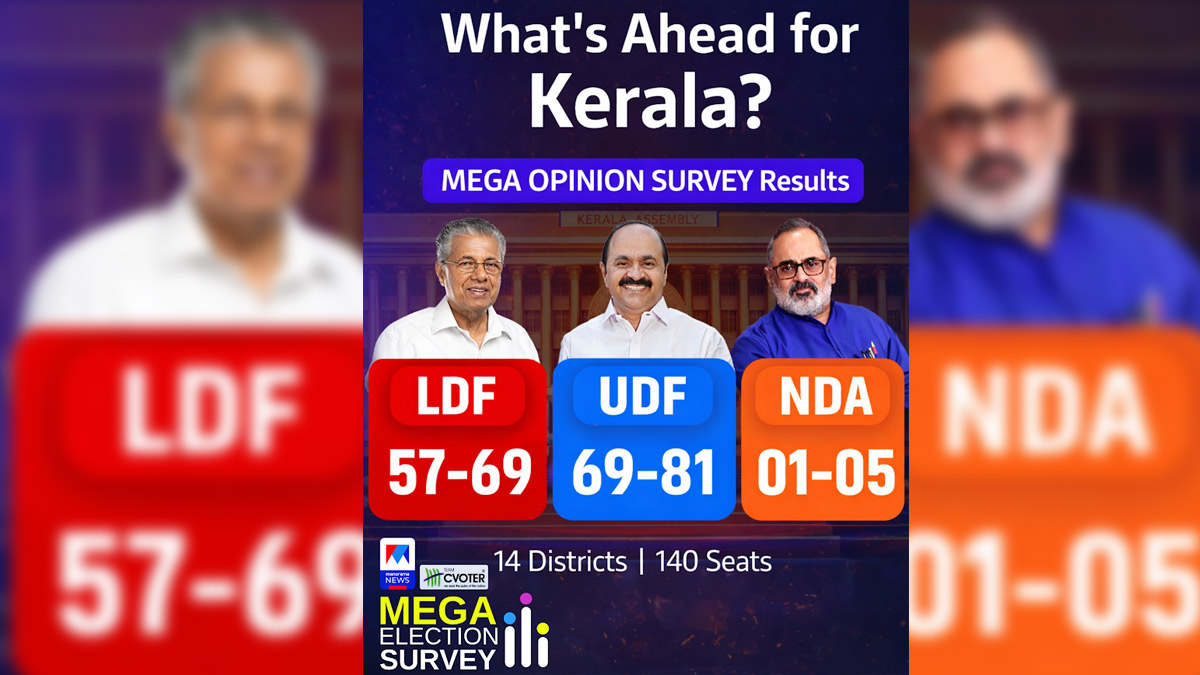
MUMBAI: The winds of change appear to be blowing through Kerala’s political landscape and this time, they seem to favour the United Democratic Front. A comprehensive mega opinion survey conducted by Manorama News in partnership with CVoter projects a potential comeback for the UDF in the upcoming Kerala Legislative Assembly Elections 2026. The survey, covering all 140 constituencies with a massive sample size of nearly 90,000 respondents, predicts the UDF could win between 69 and 81 seats.
The ruling Left Democratic Front (LDF) is expected to secure 57 to 69 seats, a significant drop from the 99 seats it won in the 2021 elections. This would mean the LDF losing 30 to 42 of its sitting seats. Meanwhile, the National Democratic Alliance (NDA), which drew a blank in 2021, is projected to open its account with 1 to 5 seats.
Region-wise, the UDF is expected to make strong gains in Malabar, winning 25 to 34 out of 48 seats, and in Central Kerala, where it could bag 29 to 33 out of 53 seats. In South Kerala, the LDF is likely to retain an edge with 21 to 25 seats, while the UDF may improve to 12 to 16 seats. The NDA could pick up 1 to 3 seats in the southern region.
The survey was conducted between 14 and 26 March 2026, with additional tracker and snap polls carried out from December 2025 to March 2026. A total of 89,693 respondents participated, ensuring representation across all demographics and social segments.
Manorama News has a strong track record of accuracy, with its previous projections closely matching the actual results of the 2019 and 2024 Lok Sabha elections as well as the 2021 Kerala Assembly polls.
In Kerala’s famously fierce political battles, this survey suggests the pendulum may be swinging back. Whether the final verdict matches these numbers or throws up another surprise, one thing is clear, the 2026 Assembly elections are shaping up to be one of the most keenly watched contests in the state’s history.






