News Headline
TRAI asks MSOs, b’casters to sign MoU on interconnect agreements in phase III

MUMBAI: The Telecom Regulatory Authority of India (TRAI) has given time till 30 April, 2015 to both broadcasters and multi system operators (MSOs) to enter into a memorandum of understanding (MoU) with regards to interconnect agreements in phase III of digital addressable system (DAS) areas.
During the seventh task force meeting for successful completion of phase III and IV of digitization, a representative from TRAI informed that in case the broadcasters and MSOs fail to reach any agreement, the Authority will intervene in the matter, as per regulations. “While broadcasters were asked to give report every fortnight, the same has not started coming,” said the TRAI representative.

The representative also mentioned that in the transition period both analogue as well as digital signals can be provided by the MSOs in phase III areas. “As per the regulations digital signal can be provided in areas undergoing transition without waiting for the cutoff date,” he added.
The meeting was convened under the chairmanship of Information and Broadcasting Ministry additional secretary JS Mathur, who said, “While there has been some progress on the issue of interconnect agreements for phase III areas but there are still many areas which need to be addressed by broadcasters.”
During the meeting, an IndusInd Media and Communication Limited (IMCL) representative said that while they had sent interconnect requests to all broadcasters, as per the TRAI directive, they had received response from only one broadcaster, while Siti Cable was still awaiting a response from all. A Siti Cable representative said, “Broadcasters are filing cases of piracy against MSOs if they start providing digital signal in the phase III areas.”
MSOs pointed out that the situation is critical and TRAI must take immediate necessary action to resolve the issue. MSOs also want the entertainment tax, levied by State Governments, rationalised.
Representatives of broadcasters said that they would approach TRAI for clarification on the interconnect agreements to be signed for the transition period. “No such issues of interconnect agreements were raised during phase I and phase II of digitisation and the set top boxes (STBs) were still seeded. Why are these issues being raised now?” questioned broadcasters.
Broadcasters also raised concerns on the HITS (Headends In The Sky) platform of delivery with regard to addressability although it is mentioned that it is addressable from the day one. Broadcasters also opined that DAS regulations should apply from the date MSOs take digital signal.
According to Mathur, consumers have the right to know what they have to pay for the digital signal and so, it is imperative that broadcasters and MSOs work out agreements between them without further loss of time. He added, “Channel package rates have to be in public domain. Broadcasters must now finalise all issues with MSOs so as to have a lead time of implementation.”
While the universe for phase I and II was extremely limited, phase III has to cover all the urban areas of the country. This would thus require exhaustive planning along with suitable investments. “Both broadcasters and MSOs must now finalise their agreements and inform TRAI within the stipulated time period of 30 April,” said Mathur, while suggesting that TRAI should convene a meeting soon after the time period it has given for finalising the action plan for smooth and timely transition.
Mathur also expressed dissatisfaction over the public awareness campaign for digitisation in phase III areas carried out by the stakeholders so far. He asked all stakeholders and particularly the broadcasters to start the publicity campaign forthwith.
While the Ministry is still awaiting data on carriage fee and subscription revenue from both the Indian Broadcasting Foundation (IBF) and the News Broadcasters Association (NBA), an NBA representative assured that it will be sent before the next meeting.
Mathur also enquired about the initiatives being taken by MSOs for using indigenously manufactured STBs. Responding to this, an MSO representatives said that the dialogue with indigenous STB manufacturers was on.
Consumer Electronics and Appliances Manufacturers Association (CEAMA) representative informed that they had fruitful discussions with some MSOs in which they made some financing offers to MSOs for the supply of STBs.
Representative of CEAMA further added that they were now facing a major competition from the suppliers of ASEAN countries since the government, as per the ASEAN agreement signed in 2009, has reduced the import duty on STBs imported from ASEAN countries to two per cent only against 10 per cent from other countries. He said, “MSOs may neglect local STB manufacturers and start importing from ASEAN countries, but this will be against ‘Make in India’ initiative of the Government.”
Meanwhile a CEAMA representative requested the I&B Ministry to look into the issue, while informing that they were also in the process of writing to the Ministry of Commerce about this development. In order to know the use of indigenously manufactured STBs, Mathur directed that the information on utilisation of domestically manufactured STBs may also be sought from all MSOs along with the seeding plans.






NEW DELHI: Hamdard Laboratories gathered a cross-section of India’s achievers in New Delhi on Friday, handing out the Hakeem Abdul Hameed Excellence Awards to figures who have left their mark across healthcare, education, sport, public service and the arts.
The ceremony, attended by minister of state for defence Sanjay Seth and senior officials from the ministry of Ayush, celebrated individuals whose work blends professional success with a sense of public purpose. It was as much a roll call of achievement as it was a reminder that influence is not measured only in profits or podiums, but in people reached and lives improved.
Among the headline awardees was Alakh Pandey, founder and chief executive of PhysicsWallah, recognised for turning affordable digital learning into a mass movement. On the sporting front, Arjuna Awardee and kabaddi player Sakshi Puniya was honoured for her contribution to the game and for pushing women’s participation onto bigger stages.
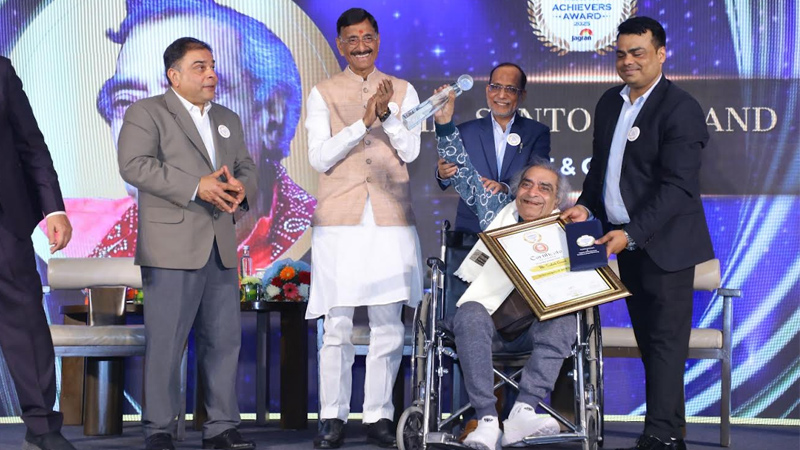
The cultural spotlight fell on veteran lyricist and poet Santosh Anand, whose songs have echoed across generations of Hindi cinema. At 97, Anand accepted the honour with characteristic humility, reflecting on a life shaped by perseverance and hope.
Healthcare honours spanned both modern and traditional systems. Manoj N. Nesari was recognised for strengthening Ayurveda’s place in national and global health frameworks. Padma shri Mohammed Abdul Waheed was honoured for his research-backed work in Unani medicine, while padma shri Mohsin Wali received recognition for his long-standing contribution to patient-centred care.
Education and social development also featured prominently. Padma shri Zahir Ishaq Kazi was honoured for decades of work in education, while former Meghalaya superintendent of Police T. C. Chacko was recognised for public service. Goonj founder Anshu Gupta received an award for his dignity-centred rural development initiatives, and the Hunar Shakti Foundation was honoured for empowering women and young girls through skill development.
The Lifetime Achievement Award went to former IAS officer Shailaja Chandra for her long career in public healthcare and governance, particularly in the traditional systems under Ayush.
Speaking at the event, Hamdard chairman Abdul Majeed said the awards were a tribute to those who combine excellence with empathy. “These awardees reflect Hakeem Sahib’s belief that healthcare, education and public service must ultimately serve humanity,” he said.
Minister Seth struck a forward-looking note, saying India’s young population gives the country a unique opportunity to become a global destination for learning, health and wellness by 2047.
The ceremony also featured the trailer launch of Unani Ki Kahaani, an upcoming documentary starring actor Jim Sarbh, set to premiere on Discovery on 11 February.
Instituted in memory of Unani scholar and educationist Hakeem Abdul Hameed, the awards have grown into a national platform that celebrates those building a more inclusive and resilient India. For one evening at least, the spotlight was not just on success, but on service with substance.






