News Broadcasting
“To make in India, but to benchmark it in the world:” Fareed Zakaria


MUMBAI: With PM Narendra Modi inaugurating the Make in India Week 2016 on 13 February, the second day of the week started with the CNN Asia Business Forum 2016. With seven sessions lined back to back, the forum enthralled delegates with a series of dynamic dialogues. The interactive discussion briefly explored new ideas, growing technology, secrets of leadership and the challenges Asia faces plus the tactics.
Gracing the forum with their presence were eminent personalities like Finance Minister of India Arun Jaitley, Cisco executive chairman John Chambers, GE president and CEO South Asia Banmali Agrawala, Mahindra Group chairman Anand Mahindra, Aditya Birla Group chairman Kumar Managalam Birla, Emerson Electric Co. president Edward Monser, Google India and South East Asia MD Rajan Anandan, Snapdeal co-founder and CEO Kunal Bhal, Vinnova director general Charlotte Brogren, DJI director of strategic partnerships Michael Perry, AirAsia group CEO Tony Fernandes, Kerry Logistic Network chairman George Yeo and US Ambassador to India Richard Verma.
The sessions were moderated by CNN’s business anchors Fareed Zakaria, Richard Quest and CNN Asia Pacific editor Andrew Stevens.

With a mission to make the viewers understand about the world around us, Zakaria addressed the ‘State of the World’ by providing a snapshot of the global geopolitics.
“The world is in a mess almost everywhere you look but you certainly have to start with the Middle East to understand how the people are anxious and uncertain about things,” Zakaria said.
With countries like Lybia or Syria facing crisis in the current scenario against to what it was 40 years back, Zakaria strongly believes that the states system, which was built back during the World War I is essentially collapsing. “The states at that time were ruled by highly repressive dictators who knew law and order very well. But what has happened 10 years back is that these dictatorships have one by one have proved to be more and more fragile,” he says.
The one characteristic that remains common and extremely important is that in these nations, the dictator left and what was noticed later on is the fact that there was no state or administrative institution to maintain political order. Going further, he explains that underneath the state it was noticed that there was no civic society or organisation to maintain social order and underneath that what you discover is that there is no nation.
Zakaria points out, “People have retreated to identities that make them unavoidably hostile to one another. When order collapses you look for something that gives you security and stability and that security does not come in the Middle East from your national identity. These nations were created recently. It’s coming from much older identities like Siaa, Sunni, Arabians, etc, who are 1000 – 2000 year old identities. They have created an inbuilt sectoring of religious conflicts that persist and is going to take some time to be sorted out.”
US engine has become the largest engine for producing liquid hydrocarbon in the world. The unbalanced supply and demand are the two engines that rightly explain the crisis. Zakaria explains, “The one engine in the US, which saw a growth from $1 million – $10 million in 10 years and the other engine being the declining demand in China.”
Zakaria sheds light on how Europe faced crisis and how in the past 25 years the European Union has solved every economical challenge. “Every time the people thought the European Union is going to collapse, it endured, deepened and strengthened itself. Those were economic challenges but now they are facing political challenges about national identity and that proves to be harder to solve,” adds the CNN anchor.
“If you look at the western hemisphere, the US is still probably the most powerful economy today. It’s growing fast at a pace twice as Europe and four times faster than Japan and is growing past many emerging markets like Brazil or South Africa. What is happening in Asia is an export dominated growth and a move that is shifting more to domestic consumption. For these countries, the decline of all has been an avoid depressing,” he says.
The challenge that India has to face is how it deals with the issues and the opportunities from the global perspective. One of the discussions shed light on how India is doing compared to China, Turkey, Vietnam or Indonesia and that comparison is the key issue for India to recognise that there is a global competition for investment, for tropical, for talent and how does India solves this key issue.
“When Manmohan Singh announced reforms for India in early 1990s, he compared it with South Korea. At that time, the GDP for the two countries were same but later South Korea became bigger by contributing 13 times more to the GDP than India. But India has potential to grow and has done well from then to now. Today South Korea’s per capita GDP is 20 times that of India’s. So the world moves on and India is doing extremely well but it needs to look around and make sure it does as well as what the rest nations are doing,” concluded Zakaria.





News Broadcasting
Network18 channels lead YouTube news viewership in March 2026
CNN-News18, News18 India and CNBC channels top categories with record views
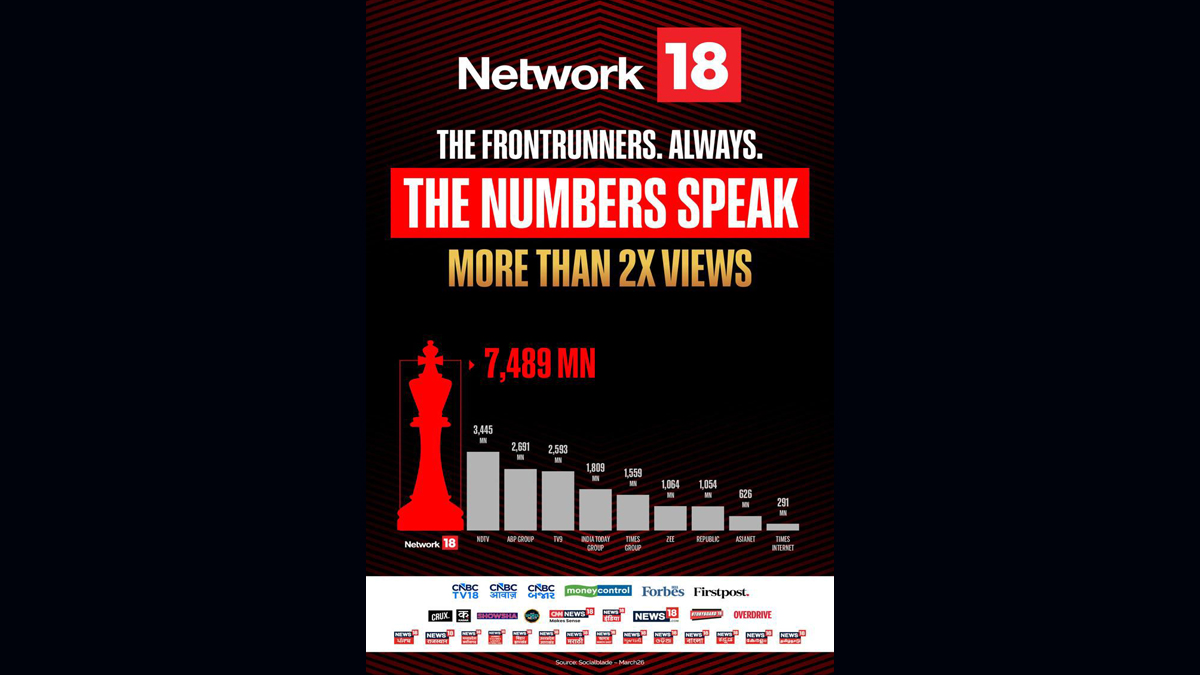
MUMBAI: When the world hit refresh on breaking news, Network18’s channels were already streaming ahead. As geopolitical tensions and war-driven headlines fuelled a surge in global news consumption, the network’s digital playbook delivered big clocking record Youtube viewership across English, Hindi and business news categories in March 2026.
At the forefront was CNN-News18, which emerged as the clear leader in the English news segment with 130 million live and video-on-demand views. The channel edged past competitors such as Times of India (126.5 million), Times Now (101.1 million), India Today (88.2 million) and NDTV (77.5 million), according to Databeings data for March.
In the Hindi news arena, News18 India delivered a commanding performance, racking up a staggering 3,297 million views on YouTube. The channel comfortably outpaced NDTV India, which recorded 3,119 million views, underlining its deep reach and consistent engagement with mass audiences, as per Playboard data.
The network’s dominance wasn’t confined to general news. In the Hindi business segment, CNBC Awaaz topped the charts with 92 million views, narrowly ahead of Zee Business (90 million) and well ahead of ET Now Swadesh (57 million). Meanwhile, its English counterpart CNBC-TV18 posted a strong 58 million views, reinforcing the network’s cross-category strength.
The spike in viewership reflects a broader shift in audience behaviour, with viewers increasingly turning to digital platforms particularly Youtube for real-time updates and in-depth coverage during high-intensity news cycles. For Network18, the numbers signal more than just scale; they underline the effectiveness of a multi-platform strategy that blends speed, credibility and continuous coverage.
In a month where the news never paused, it seems viewers chose to stay tuned where the stream never stopped.






