News Broadcasting
Times Now – Republic TV slugfest continues as ratings gap narrows

BENGALURU: The on-air spat about numerouno status continued between the two biggest players in the English News genre. The slugfest commenced with the launch of Republic TV in week 19 of 2017 on Saturday May 6 2017 with the new channel breaking Times Now’s firm hold on the pole position in the genre and how! Republic TV opened at the top of the English News genre with a stupendous 2.117 million weekly impressions, followed far behind with the usurped leader Times Now with 1.148 million weekly impressions in week 19 of 2017.
Twelve weeks later, in week 30 (Saturday 22 July 2017 to Friday 28 July 2017), Republic TV still continues to rule the genre. Broadcast Audience Research Council of India (BARC) data for week 30 must of the top 5 English News must be a jolt for the newcomer with Times Now two narrowing the margin to just 2,000 weekly impressions. Republic TV scored 1.074 million weekly impressions and Times Now 1.072 million impressions! Earlier, the closest the two channels ratings had come was in week 24 of 2017 when Republic TV garnered 0.963 million weekly impressions to Times Now’s 0.935million weekly impressions.
Trailing far behind at third place in week 30 was India Today Television with 0.375 million weekly impressions as per BARC data for the top 5 English News channels – All India (U+R): NCCS AB: Males 22+ Individuals. NDTV 24×7 was fourth with 0.360 million weekly impressions followed close behindby CNN News 18 with 0.354 million weekly impresssions.

As reported earlier post week 19, theArnabGoswami led new entrant raised the hackles of the existing players- accusations of theft, of rigging the ratings, running a ratings battle on Republic TV and its competition. It was suddenly an all-out war – multiple Goliaths had got together to demolish the fledgling David. The older channels ganged up together to stifle the new channel that the industry says followed practises that were of a doubtful nature. Ultimatums were given to the official ratings agency – BARC, it either stopped publishing Republic TV viewership data or the other Indian English News channels represented by the News Broadcasting Association (NBA) would withdraw their watermarks and hence disable BARC from publishing a fair picture of ratings lists. The NBA backed channels returned to the BARC fold in week 22.
However, just post 1100 hours on Thursday 3 August 2017, both the channels claimed leadership in the genre by slicing and dicing BARC data to the component that was most favourable to each. Times Now quoted relative share numbers and claimed first place, while Republic TV harped on its leadership position during the primetime debate hours of 900 pm to 1100 pm. Republic TV now turned around and without naming the channel, accused it of using money muscle and unfair trade practises.
Over the past twelve weeks- eleven weeks actually if one were to eliminate the neglect the ratings for week 21 of 2017, Republic TV’s overall combined ratings are about a third more at 13.368 million impressions than Times Now’s 10.068 million impressions. Please refer to the figure below for weekly impressions by the two channels between weeks 19 and 30 of 2017 excluding week 21.







News Broadcasting
UDF poised to return to power in Kerala, says Manorama-CVoter survey
Massive opinion poll projects shift in Kerala politics ahead of 2026 Assembly elections.
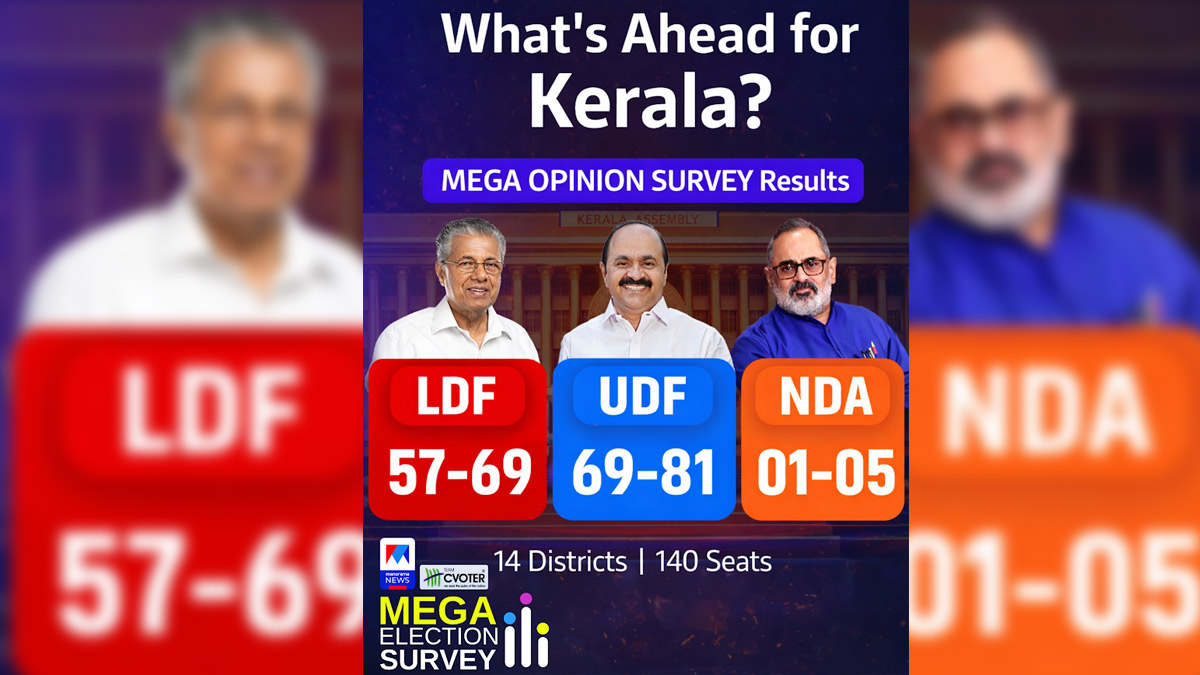
MUMBAI: The winds of change appear to be blowing through Kerala’s political landscape and this time, they seem to favour the United Democratic Front. A comprehensive mega opinion survey conducted by Manorama News in partnership with CVoter projects a potential comeback for the UDF in the upcoming Kerala Legislative Assembly Elections 2026. The survey, covering all 140 constituencies with a massive sample size of nearly 90,000 respondents, predicts the UDF could win between 69 and 81 seats.
The ruling Left Democratic Front (LDF) is expected to secure 57 to 69 seats, a significant drop from the 99 seats it won in the 2021 elections. This would mean the LDF losing 30 to 42 of its sitting seats. Meanwhile, the National Democratic Alliance (NDA), which drew a blank in 2021, is projected to open its account with 1 to 5 seats.
Region-wise, the UDF is expected to make strong gains in Malabar, winning 25 to 34 out of 48 seats, and in Central Kerala, where it could bag 29 to 33 out of 53 seats. In South Kerala, the LDF is likely to retain an edge with 21 to 25 seats, while the UDF may improve to 12 to 16 seats. The NDA could pick up 1 to 3 seats in the southern region.
The survey was conducted between 14 and 26 March 2026, with additional tracker and snap polls carried out from December 2025 to March 2026. A total of 89,693 respondents participated, ensuring representation across all demographics and social segments.
Manorama News has a strong track record of accuracy, with its previous projections closely matching the actual results of the 2019 and 2024 Lok Sabha elections as well as the 2021 Kerala Assembly polls.
In Kerala’s famously fierce political battles, this survey suggests the pendulum may be swinging back. Whether the final verdict matches these numbers or throws up another surprise, one thing is clear, the 2026 Assembly elections are shaping up to be one of the most keenly watched contests in the state’s history.






