News Broadcasting
Times Network restructures sales team; aims to accelerate growth


MUMBAI: Times Network has restructured its sales team, which reflects a new stronger growth-oriented operating model.
As part of the restructuring, Times Network head branded content Hemant Arora has been elevated as Times Now and ET Now sales head. Arora has more than 17 years of experience in media sales, including print, internet and television. He started his career at The Times of India in 1997.

Hersh Bhandari has been given the charge as Times Now national head of ad sales. “I expect Hersh to restore the true premium value that the lead English News platform deserves to the business,” said Times Network MD & CEO MK Anand.
Shilpa Shetty will take over as ET Now national head of ad sales. Since joining ET Now, Shetty has been instrumental in increasing the channel’s revenue. A tough taskmaster, she is also the first woman to rise to the position of head of sales from within the Times Network.
Gaurav Dhawan has been made the head of English Entertainment channels’ cluster. With 17 years of extensive experience in managing advertising revenue driven business across television, print and web, Dhawan has an advantage in meeting his challenging new assignment, where he is pitted against Star’s English Entertainment business.
ET Now north head Jogajyoti Pati has been elevated as Times Network national head of ad sales, whereas Rohit Tugnait will don the new role of zoOm national head of ad sales & brand solutions.
The initiative aims at providing significant growth opportunities and greater responsibilities to the existing leadership in the advertising and sales team, which will also inculcate the Network’s new brand philosophy of – ‘Now or Nothing.’
Anand added, “This refinement in our working model is designed to keep up with the momentum we had been sailing on through whole of the last year. While 2015 was one of hygiene improvements, 2016 will be a watershed year during which we will make an all-out effort to correct our price:value equation and build our revenue base.”







News Broadcasting
Network18 channels lead YouTube news viewership in March 2026
CNN-News18, News18 India and CNBC channels top categories with record views
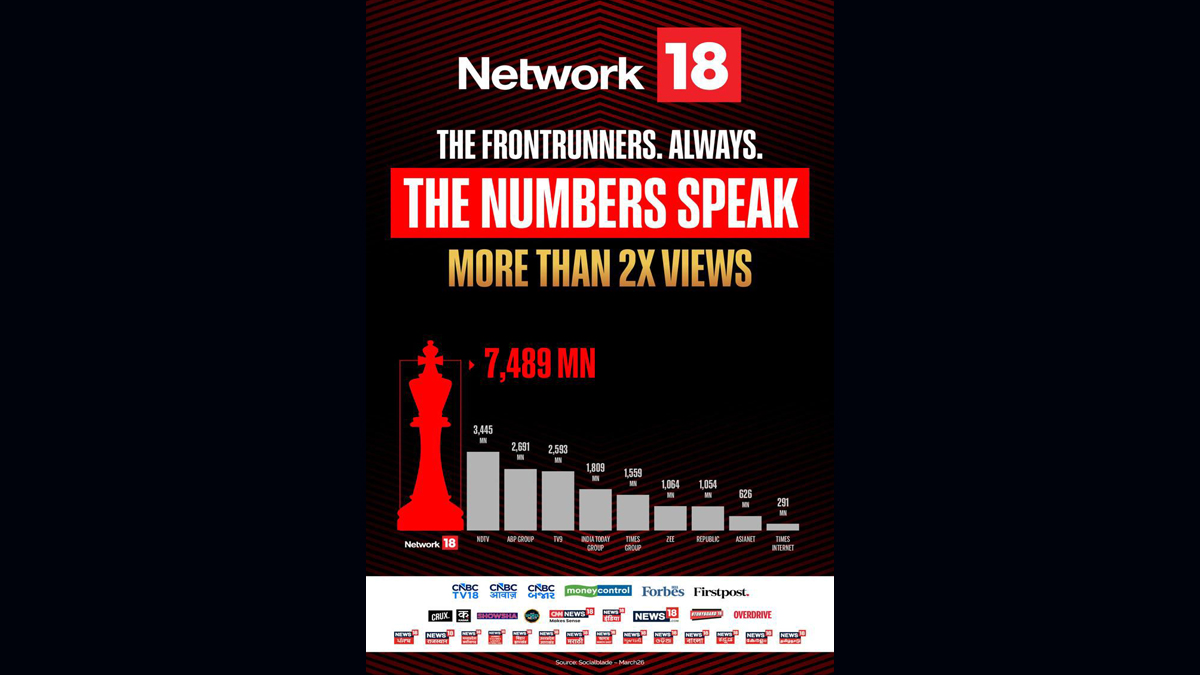
MUMBAI: When the world hit refresh on breaking news, Network18’s channels were already streaming ahead. As geopolitical tensions and war-driven headlines fuelled a surge in global news consumption, the network’s digital playbook delivered big clocking record Youtube viewership across English, Hindi and business news categories in March 2026.
At the forefront was CNN-News18, which emerged as the clear leader in the English news segment with 130 million live and video-on-demand views. The channel edged past competitors such as Times of India (126.5 million), Times Now (101.1 million), India Today (88.2 million) and NDTV (77.5 million), according to Databeings data for March.
In the Hindi news arena, News18 India delivered a commanding performance, racking up a staggering 3,297 million views on YouTube. The channel comfortably outpaced NDTV India, which recorded 3,119 million views, underlining its deep reach and consistent engagement with mass audiences, as per Playboard data.
The network’s dominance wasn’t confined to general news. In the Hindi business segment, CNBC Awaaz topped the charts with 92 million views, narrowly ahead of Zee Business (90 million) and well ahead of ET Now Swadesh (57 million). Meanwhile, its English counterpart CNBC-TV18 posted a strong 58 million views, reinforcing the network’s cross-category strength.
The spike in viewership reflects a broader shift in audience behaviour, with viewers increasingly turning to digital platforms particularly Youtube for real-time updates and in-depth coverage during high-intensity news cycles. For Network18, the numbers signal more than just scale; they underline the effectiveness of a multi-platform strategy that blends speed, credibility and continuous coverage.
In a month where the news never paused, it seems viewers chose to stay tuned where the stream never stopped.






