News Broadcasting
Time Warner hires NBC’s Randy Falco as CEO of AOL unit


MUMBAI: Time Warner Inc. has hired NBC Universal Television group president Randy Falco as chairman and chief executive officer of its AOL unit, replacing Jonathan Miller.
The announcement was made by Time Warner Inc.’s chairman and CEO Richard D Parsons and president and COO Jeff Bewkes, asserts an official release.
Commenting on Falco’s appointment Parsons said, “Jeff Bewkes and I are very pleased that a top operating executive of Randy Falco’s expertise and experience will be leading AOL into its next stage of development. A key to Time Warner’s digital future, AOL is showing early success in transitioning to an advertising-focused business model, and Randy is a first-rate choice to ensure AOL realizes its promise.”

As president of NBC’s broadcast and network operations division, Falco was in charge of the facilities and operations of the NBC television network worldwide, adds the release.
Falco added, ” My challenge will be to execute on the strategy that I believe will make AOL once again the leader of the online world. I see a tremendous opportunity for meaningful growth at AOL and will work hard with the fine people at AOL to make sure the company lives up to its full potential.”
Time Warner, parent of AOL is a US based integrated media and communications company whose businesses include interactive services, cable systems, filmed entertainment, television networks and publishing.
Based in Dulles, Virginia, AOL is a global web services company that operates web destinations, runs the country’s Internet access business, and provides a full set of advertising solutions.






News Broadcasting
Network18 channels lead YouTube news viewership in March 2026
CNN-News18, News18 India and CNBC channels top categories with record views
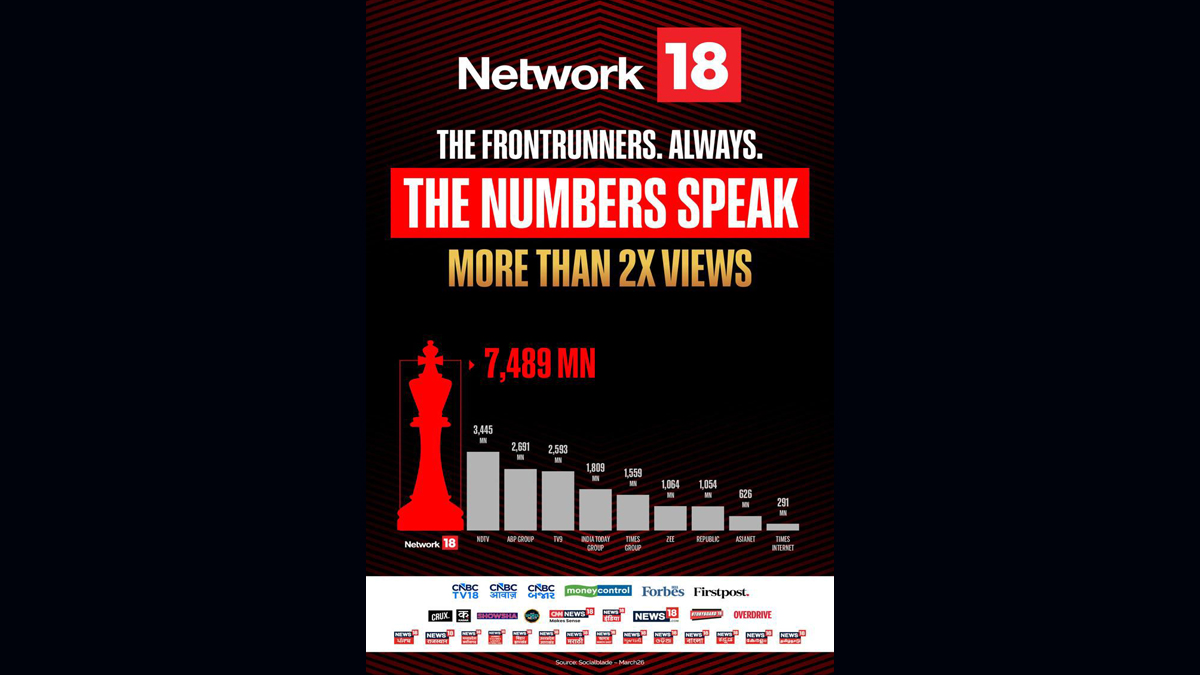
MUMBAI: When the world hit refresh on breaking news, Network18’s channels were already streaming ahead. As geopolitical tensions and war-driven headlines fuelled a surge in global news consumption, the network’s digital playbook delivered big clocking record Youtube viewership across English, Hindi and business news categories in March 2026.
At the forefront was CNN-News18, which emerged as the clear leader in the English news segment with 130 million live and video-on-demand views. The channel edged past competitors such as Times of India (126.5 million), Times Now (101.1 million), India Today (88.2 million) and NDTV (77.5 million), according to Databeings data for March.
In the Hindi news arena, News18 India delivered a commanding performance, racking up a staggering 3,297 million views on YouTube. The channel comfortably outpaced NDTV India, which recorded 3,119 million views, underlining its deep reach and consistent engagement with mass audiences, as per Playboard data.
The network’s dominance wasn’t confined to general news. In the Hindi business segment, CNBC Awaaz topped the charts with 92 million views, narrowly ahead of Zee Business (90 million) and well ahead of ET Now Swadesh (57 million). Meanwhile, its English counterpart CNBC-TV18 posted a strong 58 million views, reinforcing the network’s cross-category strength.
The spike in viewership reflects a broader shift in audience behaviour, with viewers increasingly turning to digital platforms particularly Youtube for real-time updates and in-depth coverage during high-intensity news cycles. For Network18, the numbers signal more than just scale; they underline the effectiveness of a multi-platform strategy that blends speed, credibility and continuous coverage.
In a month where the news never paused, it seems viewers chose to stay tuned where the stream never stopped.






