News Broadcasting
Time to consolidate gains: Star News president Ravina Raj Kohli

NEW DELHI: There’s a pep in her voice and the strides are more confident. What’s more, Star News president Ravina Raj Kohli can also afford to laugh at herself and the channel she heads as she quips: “We are probably the only news channel that is making news.” But jokes apart, it’s real hard work from now, she proclaims with aplomb.
Having zoomed to the No. 2 spot in about four months time, as Kohli would like to assert — competitors’ and critics’ sniggering, notwithstanding— the time has now come for consolidating the little gains and further
broadbase the viewership by giving content that the “viewers want to watch and not what we want to show as a channel.”
More importantly, Kohli is not averse to discuss controversies surrounding Star News and the company, Media Content Communications India Pvt. Ltd. (MCCS), that has been licenced the Star News brand to run the show from India.
“We got off to a great start and the operation is now settling down, living up to the channel’s philosophy `aap ko rakhe aage’ (keeps you, the viewer, in step with time). The machinery is pretty oiled now,” Kohli explains in an interview to indiantelevision.com, sitting at Star News’
spacious-but-now-looking-cramped office on Delhi’s Parliament Street.
She also feels that the “viewer is better served now” with competition all around, and the “innovations” that Star News has tried out are bearing fruit. “We don’t want to do what others (news channels) do. We want to do things the people’s way. But I agree that our style is less formal and less conventional,” Kohli opines.
More than the people, Star News is building programmes as brands like the National Reporter (“the closest that we come to conventional news format”), City 100 and Star Reporter. “Remember most news channels are known by the programmes they air and not by the people they have,” Kohli says, adding quickly that there would always be exceptions to the rule.
Still, in India it seems to work the other way round. People would like to watch the faces they know, identify with and believe in rather than just programmes on certain news channels. People would like to watch Prannoy Roy, Rajdeep Sardesai and Naghma on NDTV’s channels; Prabhu Chawla, Deepak Chaurasia and Gautam Roy on Aaj Tak; Larry King on CNN or even Suneet Tandon
on Doordarshan.
Kohli is quick to add that most of the names that can be considered brands were built over a period of time and at Star’s expense. “We are still a young channel to have people as brands; some of them like Ajay and Aparna are already quite popular. Moreover, many of the people who are considered brands today have been built up by Star after spending huge amount of money on promotion and marketing over the years,” she points out.
According to Kohli, though Star News is not cutting down on outsourcing or putting a complete stop to it, but the natural ending of Rajat Sharma’s contract for Aaj Ki Baat later this year is because of the tight budget the channel is working on. Especially for the type of show that Aaj Ki Baat is.
“It is a news show, something that we can produce in-house with the infrastructure at our disposal. With the type of budget that I have, I cannot afford to have outside producers producing news shows for us,” Kohli says.
Some celebrity-anchor shows like Akbar Ka Durbar and Vir Ke Teer on Star News are produced by Star News with MJ Akbar and Vir Sanghvi being guest anchors like Vinod Dua on Kaun Banega Mukhyamantri. Rajat Sharma’s
Independent Media Pvt. Ltd is producing Aaj Ki Baat, at the moment.
Selective outsourcing like crime show Red Alert and Mera Gaon Mera Desh would continue on Star News owing to the reason that the manpower and networking that is needed for such programming is too much for Star News to handle at present.
Asked if the single largest Indian shareholder in MCCS, Suhel Seth (with 30 per cent stake) is likely to end up with 51 per cent stake to conform to the revised uplink norms, Kohli says “various options are being studied.”
She adds: “Our lawyers are studying the revised guidelines and various options. But if you ask me today whether Suhel would be the majority stakeholder, then I cannot answer the question because I myself don’t know the answer.”
However, she feels that the controversy surrounding Star News was “not needed” and also that the company does not (DOES NOT) think the Indian government is out on a witch-hunt.
“The sequence of events (leading up to the controversy) reinforce that Star News has made a great impact (on competition), but the government has the right to set guidelines and we’d conform,” Kohli states, adding that she, as a resident Indian, is fully in control of Star News channel and has “never been told by Star to do something or not to do it.”
Kohli would also like the industry to collaborate on coverage of big events, which are not breaking news, so that huge resources are not duplicated by various news channels.
“It’s (collaborations) done abroad and I think we should do it in India too, instead each of us ending up spending huge amounts on coverage of big and planned events that cannot be termed breaking news,” she explains.
As a first step in this direction, she points out, for example, an exclusive interview of Leander Paes from the US recently was a collaborative effort between Star News and Sahara Samay, the news channels operation of the Subrata Roy-promoted Sahara Group. “We got the interview recorded in the US and split the cost. The interview was run on both the channels with each other giving the other credit,” Kohli says.
Considering that Star News is being regarded by a section of the India media houses as a `national threat’ that is making a “monkey of Indian laws”, such collaborations may go a long way in soothing ruffled feathers. Any more takers?
Also read:
Rajat Sharma, Star News to part ways







News Broadcasting
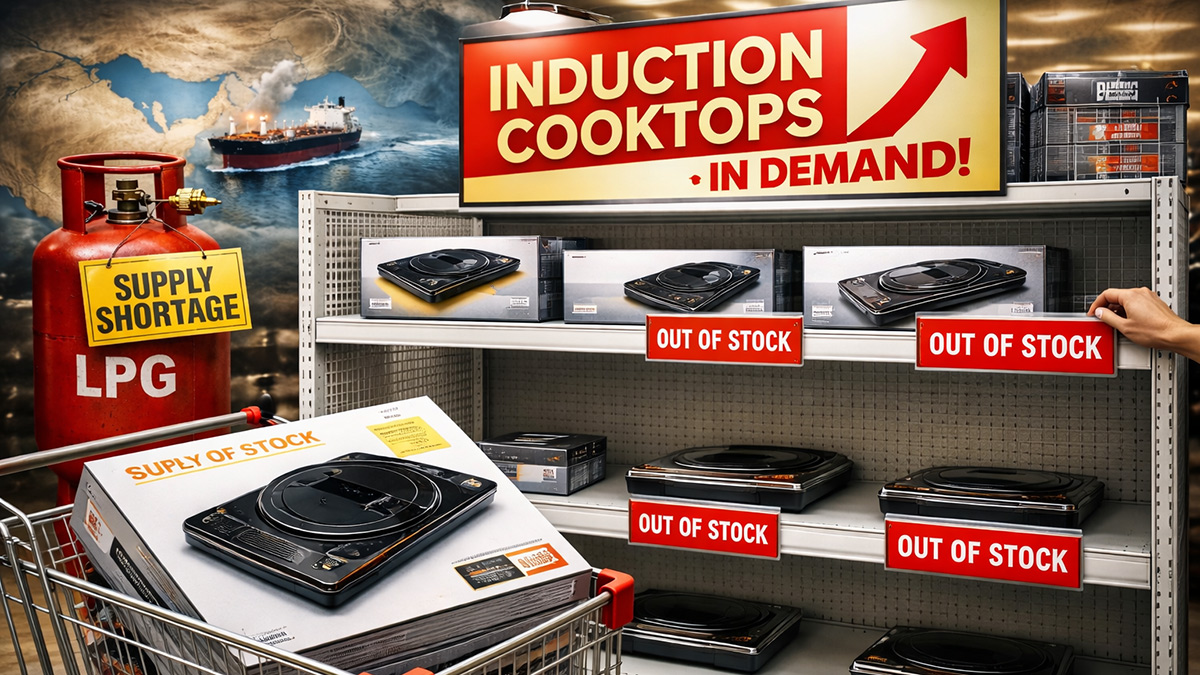
Induction cooktop demand spikes 30× amid LPG supply concerns
Supply worries linked to West Asia tensions push households and restaurants to turn to electric cooking alternatives
MUMBAI: As geopolitical tensions in West Asia ripple through global energy supply chains, the familiar blue flame in Indian kitchens is facing an unexpected challenger: electricity.
What began as concerns over the availability of liquefied petroleum gas (LPG) has quickly evolved into a technology-driven shift in cooking habits. Households across India are increasingly turning to induction cooktops and other electric appliances, initially as a backup but now, for many, a necessity.
A sudden surge in demand
Recent data from quick-commerce and grocery platform BigBasket highlights the scale of the shift. According to Seshu Kumar Tirumala, the company’s chief buying and merchandising officer, demand for induction cooktops has risen dramatically.
“Induction cooktops have seen a significant surge in demand, recording a fivefold jump on 10 March and a thirtyfold spike on 11 March,” Tirumala said.
The increase stands out sharply when compared with broader kitchen appliance trends. Most appliance categories are growing within 10 per cent of their typical demand levels, while induction cooktops have witnessed explosive growth as households rush to secure an alternative cooking option.
Major e-commerce platforms including Amazon and Flipkart have reported rising searches and orders for induction stoves. Quick-commerce apps such as Blinkit and Zepto have also witnessed stock shortages in major metropolitan areas including Delhi, Mumbai and Bengaluru.
What was once considered a convenient appliance for hostels, small kitchens or occasional use has suddenly become an essential addition in many homes.
A crisis thousands of miles away
The trigger for this shift lies far beyond India’s kitchens.
Escalating conflict in the Middle East has disrupted shipping routes through the Strait of Hormuz, one of the world’s most critical energy corridors. Nearly 85 to 90 per cent of India’s LPG imports pass through this narrow waterway, making the country particularly vulnerable to supply disruptions.
The ripple effects have been swift.
India currently meets roughly 60 per cent of its LPG demand through imports, and tightening global supply has already begun to affect domestic availability and prices.
Earlier this month, the price of domestic LPG cylinders increased by Rs 60, while commercial cylinders rose by more than Rs 114.
To discourage panic buying and hoarding, the government has also extended the mandatory waiting period between domestic refill bookings from 21 days to 25 days.
Restaurants feel the pressure
The strain is not limited to households. Restaurants, hotels and roadside eateries are also grappling with supply constraints as commercial LPG availability tightens under restrictions imposed through the Essential Commodities Act.
In cities such as Bengaluru and Chennai, restaurant associations report that commercial LPG availability has dropped by as much as 75 per cent, forcing many establishments to rethink their kitchen operations.
Some restaurants have reduced menu offerings, while others are rapidly installing high-efficiency induction systems, creating hybrid kitchens where electricity now shares the workload with gas.
For smaller eateries and roadside dhabas, the shift is less about sustainability and more about survival.
A potential structural shift
The government has maintained that there is no nationwide LPG crisis and has directed refineries to increase production to stabilise supply.
Nevertheless, the developments of March 2026 may already be triggering a longer-term behavioural shift.
For decades, LPG has been the backbone of cooking in Indian households. However, recent disruptions have highlighted the risks of relying on a single fuel source.
Increasingly, households appear to be hedging against uncertainty by adopting electric cooking options to guard against price volatility and delivery delays.
If the current trend continues, the induction cooktop, once viewed as a niche appliance, could emerge as a quiet symbol of India’s evolving kitchen economy.