iWorld
The future of original content

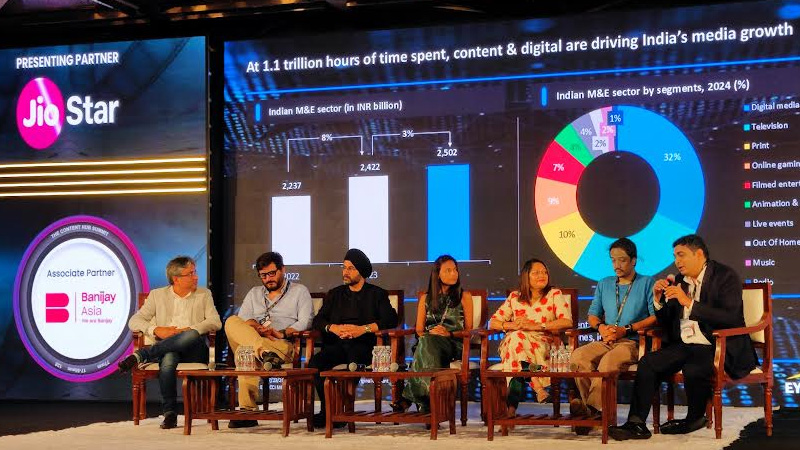
MUMBAI: The 9th edition of the Content Hub Summit 2025 came roaring into Mumbai this week, promising answers to a question plaguing the media world: how do you stay original when the world’s drowning in content?
Raghav Anand, partner at Ernst & Young LLP, kicked things off with some eye-watering numbers: the Indian media and entertainment (M&E) sector is now worth Rs 2.5bn, fuelled by 1.1trn hours of content consumption. “That’s a massive amount of attention,” said Anand. But with time spent on platforms now plateauing, he warned the next battleground will be retention, not reach.
And yet, India’s churning out a gobsmacking 200,000 hours of original content a year—leading globally in volume. TV still dominates, but OTT, film and music are closing in fast. What’s changing is how and why content is made and the growing shadow of generative AI has everyone both curious and cautious.

Goldie Behl, founder of Rose Audio Visuals, dismissed the obsession with “originality” as misplaced. “There’s nothing truly original. Everything’s borrowed, lived, or inspired. What matters is conviction,” he said, adding that content made with honesty and emotional depth is what ultimately cuts through.
Aditi Shrivastava, co-founder and CEO of Pocket Aces, echoed the point, emphasising that her studio’s approach is to test stories at micro-scale before scaling up. “We find communities not demographics on social platforms. We create short, relatable pieces and build from there,” she said, adding that this modular testing lets them co-create with audiences in real time.
Saugata Mukherjee, head of content at SonyLIV, was clear-eyed about what makes content stick: identity and consistency. “We built the platform on shows rooted in Indian culture. Our audience knows what we stand for, and that’s why they return.” Originals, he said, drive both customer acquisition and retention, with long-running franchises offering a steady heartbeat.
Tejkarran Singh Bajaj, SVP and head of originals at Jio Studios, admitted times are “exciting but very difficult”. His team resists trend-chasing and instead banks on instinct: “We don’t make franchises. We find stories worth telling, ones that feel truly Indian.” That means even adaptations are reworked with a cultural lens, not just scene-by-scene lifts.
Anuj Gosalia, founder of Terribly Tiny Tales, described today’s attention economy as “weaponised dopamine”, calling short-form ‘TV minus minus’—and still wildly effective. “People used to mock reels and TikToks. Now every A-lister’s on them. Micro-dramas will be the same,” he predicted.
Swati Patnaik, creative director at Applause Entertainment, argued that the secret sauce of global success is local flavour. “The more rooted the story, the more it travels,” she said. “It’s not about the plot; it’s the point of view. That’s what cuts across borders.”
As for AI, the mood was one of cautious intrigue rather than full-blown enthusiasm. Behl questioned whether AI can ever replicate emotional depth. “When an actor cries on screen, can AI make us feel that? I’ve yet to see it,” he said.
Still, Anand noted that GenAI is already driving 20–25 per cent cost savings and slashing production time. The challenge, then, is less whether AI will be used and more how ethically and meaningfully it will be integrated.
India’s original content scene is at a thrilling and slightly terrifying crossroads. The audience is fragmented, hungry, and overloaded. AI is knocking. Attention spans are plummeting. But as this year’s Content Hub Summit showed, the real winners will be those who tell deeply human stories with cultural authenticity, creative courage, and a sharp eye on what viewers really want.







Gaming
Sony raises PS5 prices for second time in under a year
US disc edition jumps $100 to $649.99 as memory costs surge.

MUMBAI: Sony just hit the pause button on affordable gaming because when memory prices skyrocket, even the Playstation has to pay the premium. Sony has announced its second price increase for the Playstation 5 range in less than a year, citing pressures in the global economic landscape and a sharp rise in memory component costs driven by AI demand.
In the US, the PS5 disc edition will rise from $549.99 to $649.99, a $100 hike while the digital edition increases to $599.99. The more powerful PS5 Pro will jump $150 to $899.99. The Playstation Portal remote player will also rise by $50 to $249.99. The new prices take effect on 2 April 2026.
Similar increases have been applied in the UK (£90 per model), Europe and Japan. Sony last raised PS5 prices in the US in August 2025.
“We know that price changes impact our community, and after careful evaluation, we found this was a necessary step to ensure we can continue delivering innovative, high-quality gaming experiences to players worldwide,” Sony said in a blog post.
The hikes come amid an unprecedented surge in memory prices, as manufacturers prioritise supply for AI data centres. Analysts say Sony had likely secured price protections for components that have now expired, forcing the company to protect its hardware margins.
Ampere Analysis research director of games Piers Harding-Rolls told CNBC that further increases from Microsoft and Nintendo would not be surprising, though Nintendo may hesitate to raise the price of its recently launched Switch 2 while establishing the new platform.
The increases arrive eight months before the highly anticipated release of GTA 6, which is expected to drive strong console sales. However, early reactions online have been a mix of disappointment and resignation, with growing concern that premium gaming is increasingly becoming a hobby for higher-income players.
In a sector already grappling with tariffs, inflation and component shortages, Sony’s move underscores a tough reality: even the most popular consoles are not immune to the rising cost of keeping up with the latest technology.








