News Broadcasting
Testing Times: Zee-Bhaskar seek damages over media campaign

NEW DELHI/MUMBAI: After reporting news, media companies are making news. Literally.
The Subhash Chandra-promoted Essel group and Bhopal-based Bhaskar group have dragged the big daddy of news paper business, Bennett, Coleman & Co. Ltd, publishers of Times of India and Economic Times, to court over breach of copyright laws relating to a media campaign and sought Rs. 1,000 million in damages, apart from an apology.
The civil suit, filed by the Essel-Bhaskar combine through Diligent Media in Mumbai high court, was heard today.

The petitioner has claimed that its advertisement campaign for a proposed print medium product — `SPEAK UP, ITS IN YOUR DNA’; was “hijacked” by the Times of India group to suit a campaign for Maharashtra Times, a publication of the Times group. It has also been stated that the action of the rival amounted to infringement of copyright laws with a view to derive “unfair business advantage.”
When contacted, Essel Group vice-president Ashish Kaul said, “It certainly was disappointing to see a group of repute indulge in unfair practices.”
When contacted, The Times of India brand director Rahul Kansal says, “TOI has chosen not to comment on this issue for the time being until we formulate what we want to say in this matter.”
The matter came up for hearing today in the court of Justice D.G.Karnik. The counsel for the defendant (TOI group), while stating that the plaintiff had offered not to pursue any legal action through a letter dated 29 March if an unconditional apology is tendered, requested time till 4 April from the court to consider the offer.
According to information available the court heard both the sides and directed Bennett Coleman & Co Ltd not to issue any further advertisements similar or of the same nature as that of the plaintiff. The matter will be heard on Monday.
The Essel-Bhaskar combine, which had announced plans of launching Hindi and English newspapers, had plastered the whole of Mumbai with a teaser campaign that had a picture of a man with the tag line `Speak up, It’s in your DNA.’ Reportedly, the TOI group hurriedly unveiled a campaign, prepared late last week, for a regional newspaper and added the words `Maharashtra Times’ to the DNA tagline to read `Speak Up, it’s in your DNA— Maharashtra Times.’







News Broadcasting
Network18 channels lead YouTube news viewership in March 2026
CNN-News18, News18 India and CNBC channels top categories with record views
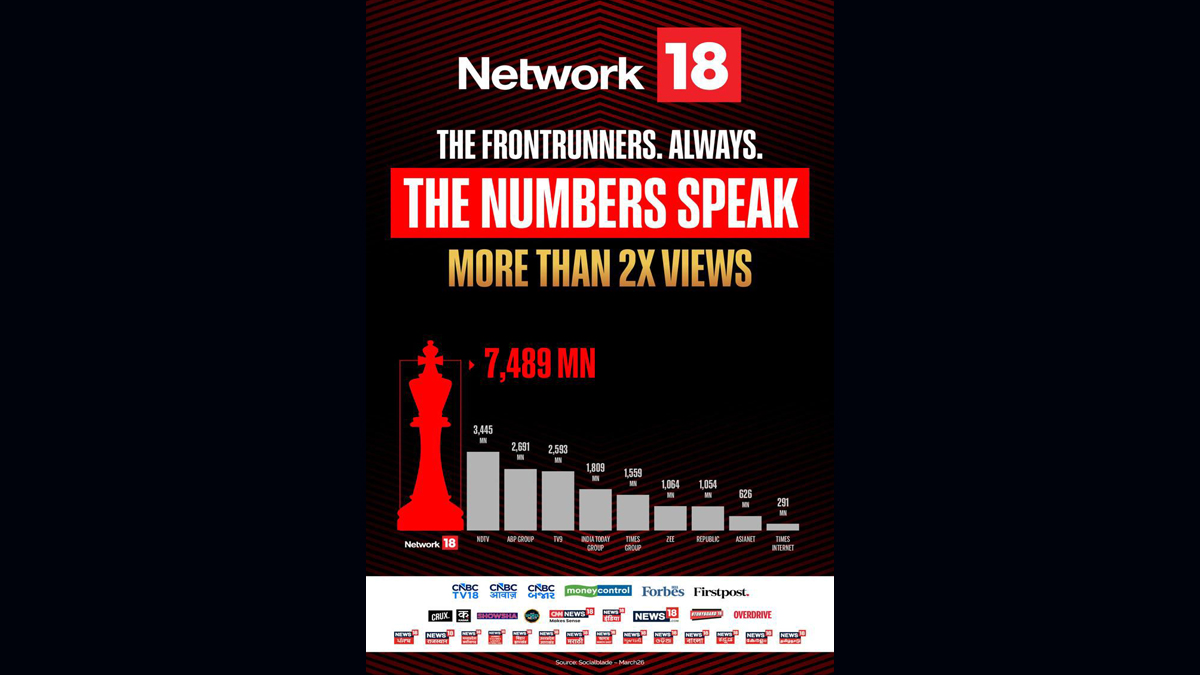
MUMBAI: When the world hit refresh on breaking news, Network18’s channels were already streaming ahead. As geopolitical tensions and war-driven headlines fuelled a surge in global news consumption, the network’s digital playbook delivered big clocking record Youtube viewership across English, Hindi and business news categories in March 2026.
At the forefront was CNN-News18, which emerged as the clear leader in the English news segment with 130 million live and video-on-demand views. The channel edged past competitors such as Times of India (126.5 million), Times Now (101.1 million), India Today (88.2 million) and NDTV (77.5 million), according to Databeings data for March.
In the Hindi news arena, News18 India delivered a commanding performance, racking up a staggering 3,297 million views on YouTube. The channel comfortably outpaced NDTV India, which recorded 3,119 million views, underlining its deep reach and consistent engagement with mass audiences, as per Playboard data.
The network’s dominance wasn’t confined to general news. In the Hindi business segment, CNBC Awaaz topped the charts with 92 million views, narrowly ahead of Zee Business (90 million) and well ahead of ET Now Swadesh (57 million). Meanwhile, its English counterpart CNBC-TV18 posted a strong 58 million views, reinforcing the network’s cross-category strength.
The spike in viewership reflects a broader shift in audience behaviour, with viewers increasingly turning to digital platforms particularly Youtube for real-time updates and in-depth coverage during high-intensity news cycles. For Network18, the numbers signal more than just scale; they underline the effectiveness of a multi-platform strategy that blends speed, credibility and continuous coverage.
In a month where the news never paused, it seems viewers chose to stay tuned where the stream never stopped.






