News Broadcasting
Ten Sports partners with MindShare for Pepsi movie festival


MUMBAI: Ten Sports is now going the movies way. The channel will air five greatest sports movies of recent times during April and May.
As part of its philosophy to bring wholesome sports entertainment to its viewers, Ten Sports will become the first sports channel in the country to telecast sports-based feature films.
The new programme Pepsi Playtime TV – The Sports Movie Festival, has been developed along with Pepsi and MindShare, to provide complete sports entertainment to viewers.

The festival begins on 28 April with the telecast of Remember the Titans, starring Oscar winner Denzil Washington, Will Patton and Wood Harris. Each week the movies will premiere on Friday at 8 pm, followed by a repeat on Sunday at 10:30 am.
The other movies lined up apart from Remember the Titans are He Got Game (5 May), Color of Money (12 May), The Air up There (19 May) and The Rookie (27 May).
Taj Television Limited CEO Chris McDonald said, “At Ten Sports, we have always tried to be innovators in our programming mix. Sports and movies are two passions of the Indian sub-continent and we are very pleased to be able to offer this powerful combination to millions of homes across India.”
On behalf of Pepsi, MindShare Delhi general manager Sundar Raman said, “Our understanding shows affinity in viewership between the two genres of sports and movies. Pepsi is known to connect with youth in a unique and differential manner using movies and sports as platform. In Ten Sports we found an ideal partner to bring these two together. The Pepsi Playtime movies on Ten Sports is a unique way of leveraging Pepsi TV campaign by bringing these two large platform together with like minded partners.”







News Broadcasting
Network18 channels lead YouTube news viewership in March 2026
CNN-News18, News18 India and CNBC channels top categories with record views
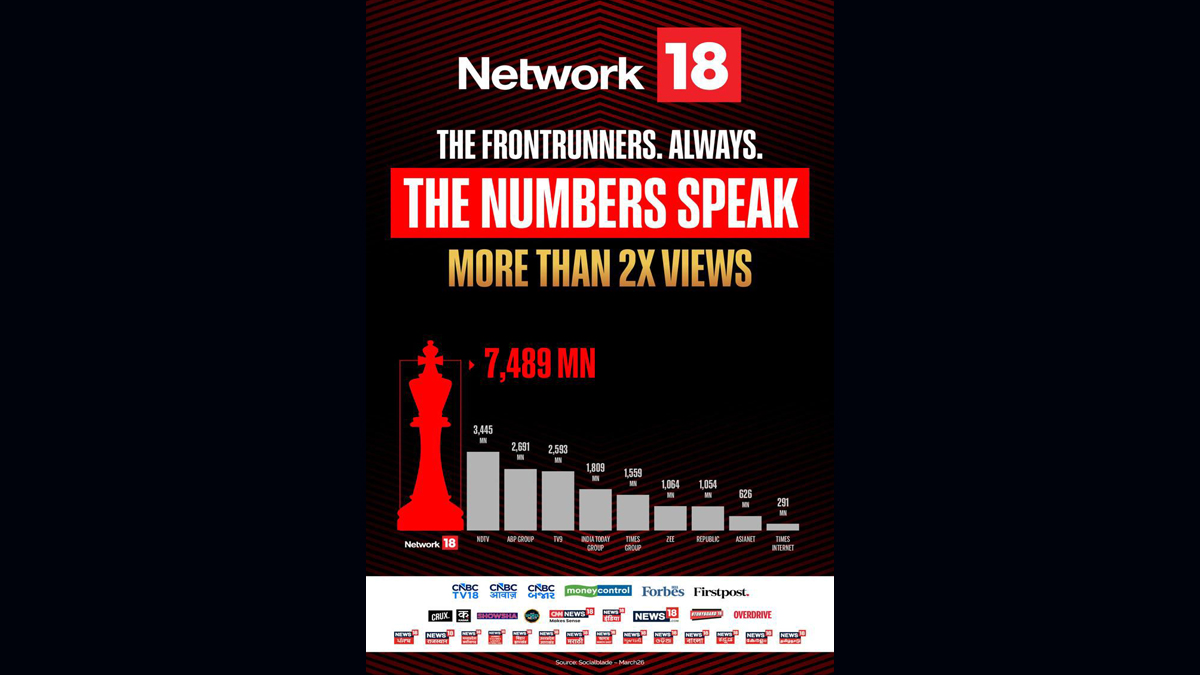
MUMBAI: When the world hit refresh on breaking news, Network18’s channels were already streaming ahead. As geopolitical tensions and war-driven headlines fuelled a surge in global news consumption, the network’s digital playbook delivered big clocking record Youtube viewership across English, Hindi and business news categories in March 2026.
At the forefront was CNN-News18, which emerged as the clear leader in the English news segment with 130 million live and video-on-demand views. The channel edged past competitors such as Times of India (126.5 million), Times Now (101.1 million), India Today (88.2 million) and NDTV (77.5 million), according to Databeings data for March.
In the Hindi news arena, News18 India delivered a commanding performance, racking up a staggering 3,297 million views on YouTube. The channel comfortably outpaced NDTV India, which recorded 3,119 million views, underlining its deep reach and consistent engagement with mass audiences, as per Playboard data.
The network’s dominance wasn’t confined to general news. In the Hindi business segment, CNBC Awaaz topped the charts with 92 million views, narrowly ahead of Zee Business (90 million) and well ahead of ET Now Swadesh (57 million). Meanwhile, its English counterpart CNBC-TV18 posted a strong 58 million views, reinforcing the network’s cross-category strength.
The spike in viewership reflects a broader shift in audience behaviour, with viewers increasingly turning to digital platforms particularly Youtube for real-time updates and in-depth coverage during high-intensity news cycles. For Network18, the numbers signal more than just scale; they underline the effectiveness of a multi-platform strategy that blends speed, credibility and continuous coverage.
In a month where the news never paused, it seems viewers chose to stay tuned where the stream never stopped.






