News Headline
TDSAT provides reprieve to FM players till 4 July


MUMBAI: Some good news for the private FM radio players as Telecom Dispute Settlement Appellate Tribunal (Tdsat) has directed the government to firm up its views on radio broadcast policy by 4 July. In the interim, status quo prevails.
The status quo has been interpreted by the industry as not having to pay annual licence fee that gets due on 29 April for some cities like Mumbai, Delhi, Kolkata and Bangalore.
A Tdsat bench today provided this short-term reprieve for the private FM radio players on a petition filed by a group of FM radio broadcasters, including Radio Today Broadcasting, Music Broadcast Pvt Ltd and Entertainment Network who run FM stations in various cities under the brand name Red FM, Radio City and Radio Mirchi respectively.

It had been alleged in the petition that government inaction or delay on sector regulator’s suggestions on radio broadcast policy was resulting in financial losses for the private players.
The government counsel today submitted before Tdsat that the information and broadcasting ministry has almost firmed up a radio broadcast policy paper, which has been circulated amongst various relevant ministries for feedback before it is taken to the cabinet for a final approval.
After this submission, Tdsat postponed the hearing to 4 July and directed the government to finalise its views on the matter by then.
Today’s Tdsat development is being seen as a succor. A senior executive of a FM radio company said that the status quo mentioned by the tribunal would mean that hefty licence fee in advance for the full year would not have to be coughed up by most major players.
Annual renewal fee is calculated as the original price at which the license had been auctioned in a city plus an annual 15 per cent hike. For example, each of the Mumbai FM stations went for approximately Rs. 120 million apiece, while an original Delhi licence cost slightly over Rs. 90 million.
Industry players are alleging that the present regulatory framework of licence fee, coupled with other factors, is financially bleeding the FM ventures as ad revenues generated from the stations are not adequate to sustain the business.
A couple of closure notices in Pune and Lucknow have been also served by Radio Mirchi and Radio City.
The industry is lobbying, amongst other things, for revenue share model, akin to that prevailing in the telecom sector, and permission to attract foreign investment.
I&B minister Jaipal Reddy recently said that his ministry has taken a decision to allow 20 per cent FDI in FM radio ventures that will also include investments by FIIs. This, however, has to get a formal Cabinet nod.
The draft policy paper circulated by the ministry has suggested a complex formula to switch over to revenue share regime. The details are not yet available with Indiantelevision.com.



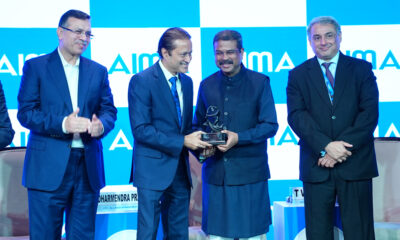




NEW DELHI: Hamdard Laboratories gathered a cross-section of India’s achievers in New Delhi on Friday, handing out the Hakeem Abdul Hameed Excellence Awards to figures who have left their mark across healthcare, education, sport, public service and the arts.
The ceremony, attended by minister of state for defence Sanjay Seth and senior officials from the ministry of Ayush, celebrated individuals whose work blends professional success with a sense of public purpose. It was as much a roll call of achievement as it was a reminder that influence is not measured only in profits or podiums, but in people reached and lives improved.
Among the headline awardees was Alakh Pandey, founder and chief executive of PhysicsWallah, recognised for turning affordable digital learning into a mass movement. On the sporting front, Arjuna Awardee and kabaddi player Sakshi Puniya was honoured for her contribution to the game and for pushing women’s participation onto bigger stages.
The cultural spotlight fell on veteran lyricist and poet Santosh Anand, whose songs have echoed across generations of Hindi cinema. At 97, Anand accepted the honour with characteristic humility, reflecting on a life shaped by perseverance and hope.
Healthcare honours spanned both modern and traditional systems. Manoj N. Nesari was recognised for strengthening Ayurveda’s place in national and global health frameworks. Padma shri Mohammed Abdul Waheed was honoured for his research-backed work in Unani medicine, while padma shri Mohsin Wali received recognition for his long-standing contribution to patient-centred care.
Education and social development also featured prominently. Padma shri Zahir Ishaq Kazi was honoured for decades of work in education, while former Meghalaya superintendent of Police T. C. Chacko was recognised for public service. Goonj founder Anshu Gupta received an award for his dignity-centred rural development initiatives, and the Hunar Shakti Foundation was honoured for empowering women and young girls through skill development.
The Lifetime Achievement Award went to former IAS officer Shailaja Chandra for her long career in public healthcare and governance, particularly in the traditional systems under Ayush.
Speaking at the event, Hamdard chairman Abdul Majeed said the awards were a tribute to those who combine excellence with empathy. “These awardees reflect Hakeem Sahib’s belief that healthcare, education and public service must ultimately serve humanity,” he said.
Minister Seth struck a forward-looking note, saying India’s young population gives the country a unique opportunity to become a global destination for learning, health and wellness by 2047.
The ceremony also featured the trailer launch of Unani Ki Kahaani, an upcoming documentary starring actor Jim Sarbh, set to premiere on Discovery on 11 February.
Instituted in memory of Unani scholar and educationist Hakeem Abdul Hameed, the awards have grown into a national platform that celebrates those building a more inclusive and resilient India. For one evening at least, the spotlight was not just on success, but on service with substance.






