News Broadcasting
Swaraj remains I&B minister in cabinet reshuffle

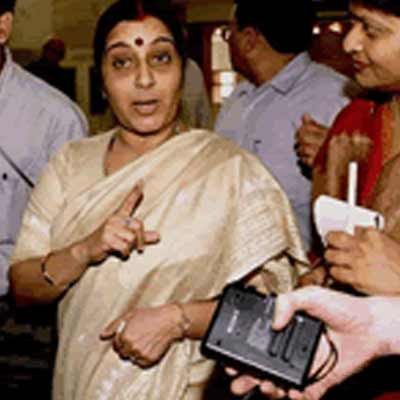
At the end of it all, speculation of her moving out of the information and broadcasting ministry proved unfounded. A major cabinet reshuffle undertaken by Prime Minister AB Vajpayee today that witnessed the swearing in of four cabinet ministers and nine ministers of state, also saw I&B minister Sushma retaining her portfolio.
In the lead-up to the reshuffle, speculation was rife in the capital last week that Swaraj might be relieved of her present responsibilities and entrusted with new work, one rumour being that she was in the running for presidentship of the ruling Bharatiya Janata Party.
Information technology, telecommunications and parliamentary affairs minister Pramod Mahajan, who was seen as a likely candidate to take charge of the I&B ministry as well, ultimately failed to dislodge Swaraj. Another name that was thrown up – former Hindi film star Shatrugan Sinha – was seen as not having much credibility. At the end of it all Sinha got the health and family welfare minister’s post.

One immediate fallout of this is that that the introduction of conditional access systems (CAS) that Swaraj has been pushing through opposing legislators and political rivals passionately, is likely to see its passage by the end of the month.
The Bill relating to the amendments to the Cable TV (Networks) Regulation Act 1995, which will pave the way for final implementation of CAS in phases in the country, has been passed by Lok Sabha (the Lower House of Indian Parliament). But it awaits the Rajya Sabha’s (Upper House) okay and this is now is expected to go through during the monsoon session of Parliament that begins 15 July.







News Broadcasting
News18 India launches Command Centre war explainer with Arya
New show shifts from debates to decoding global conflicts and impacts

MUMBAI: News18 India has rolled out a new war-focused programme, Command Centre, featuring Gaurav Arya, as it looks to offer viewers a sharper, more grounded take on global conflicts amid rising tensions in West Asia.
Positioned as an “insider war room”, the show moves away from conventional panel debates and instead focuses on explaining military developments, decoding strategy and connecting global events to their everyday impact, from fuel prices to economic shifts.
The format leans heavily on visuals and data. The studio has been designed like a command hub, complete with large LED war maps, real-time graphics and an alert system to track developments as they unfold.
At the centre of it all is Arya, who brings his military background to simplify complex war strategies for viewers. His signature line, “Seedhi baat samjhiye”, anchors the show’s promise of clarity over noise.
News18 India managing editor Jyoti Kamal said, “Command Centre, featuring Major Gaurav Arya is designed to deliver accurate insights and a clear perspective on how evolving conflicts impact everyday life, from household budgets to national security. With expert voices analysing every development in real time, the show goes beyond headlines to decode what’s happening now, what it means, and what could come next.”
Echoing the intent, Gaurav Arya added, “In times of war, confusion is the biggest threat. With News18 India’s Command Centre, we are bringing viewers inside the war room, decoding strategies, tracking every escalation, and explaining, in the simplest terms, what it means for India and for every household. Seedhi baat samjhiye, this is where you understand not just what is happening, but what happens next.”
The weekday show will air in the afternoon slot and will also feature Gaurav Shukla, adding to its editorial depth.
With its mix of analysis, visuals and a clear focus on impact, the show reflects a broader shift in news consumption. Viewers are no longer just watching events unfold, they are looking to understand what those events mean for them.