News Broadcasting
State panel okays delayed release of non-Kannada films


BANGALORE: The panel headed by Karnataka chief secretary KP Pandey has given in to the demands of the Karnataka Film Producers Association (KFPA) and the Karnataka Film Directors Association (KFDA) on non-Kannada Films’ release in Karnataka.
According to the agreement, non-Kannada films will be released in the state only after seven weeks from the date of release in their own states and that only six prints of each film would be permitted for the state. The decision has come into effect since Tuesday, 24 August.
According to media reports, the pro-Kannada film lobby, which had been demanding a twelve-week delay and a maximum of for prints, has agreed to soften its stand. The sub-committee also plans to intimate other film chambers in other states and the South India Film Chamber of Commerce to co-operate in implementing the six print norm.
Karnataka Film Chambers of Commerce (KFCC) president S Ramesh is quoted in media reports as saying, “This decision will come into effect Tuesday and violators will be dealt with strictly, including a permanent ban in Karnataka.”

Regarding the reversal of reduction of entertainment tax for non-Kannada films from 70 per cent to 40 per cent, the panel has assured that a decision can be expected from the government within 15 days. The panel in the meantime plans to study the entertainment tax pattern of other states.
“The exhibitors and distributors of non-Kannada films will receive a body blow if the decision of the panel is implemented by the government. Many theaters will be forced to close down if we are not allowed to exhibit the movie simultaneously with other parts in the country.
Today, movies are being launched worldwide on the same day and here in Karnataka we are going a step backward. Generally pirated CDs and DVDs of a movie are available after the first day itself. So the Kannada film fraternity, instead of improving the quality of their films are indirectly encouraging piracy of non-Kannada film,” said one Bangalore-based theater owner.
“Many distributors have made payments in advance for booking non-Kannada movies. Their returns for the booking of films will go for a toss. More ever, Hindi is a national language, can anyone, even a state government delay or ban a national language film in this way? In any case the six print limit is okay for Hindi or English films, but as many as 20 prints are released of Telugu and Tamil films, and the price paid for these films by the distributors sometime runs to crores of rupees!” he added.
Industry sources are also unsure about the fate of various multiplexes, which are coming up in and around Bangalore, in today’s changed scenario.







News Broadcasting
Network18 channels lead YouTube news viewership in March 2026
CNN-News18, News18 India and CNBC channels top categories with record views
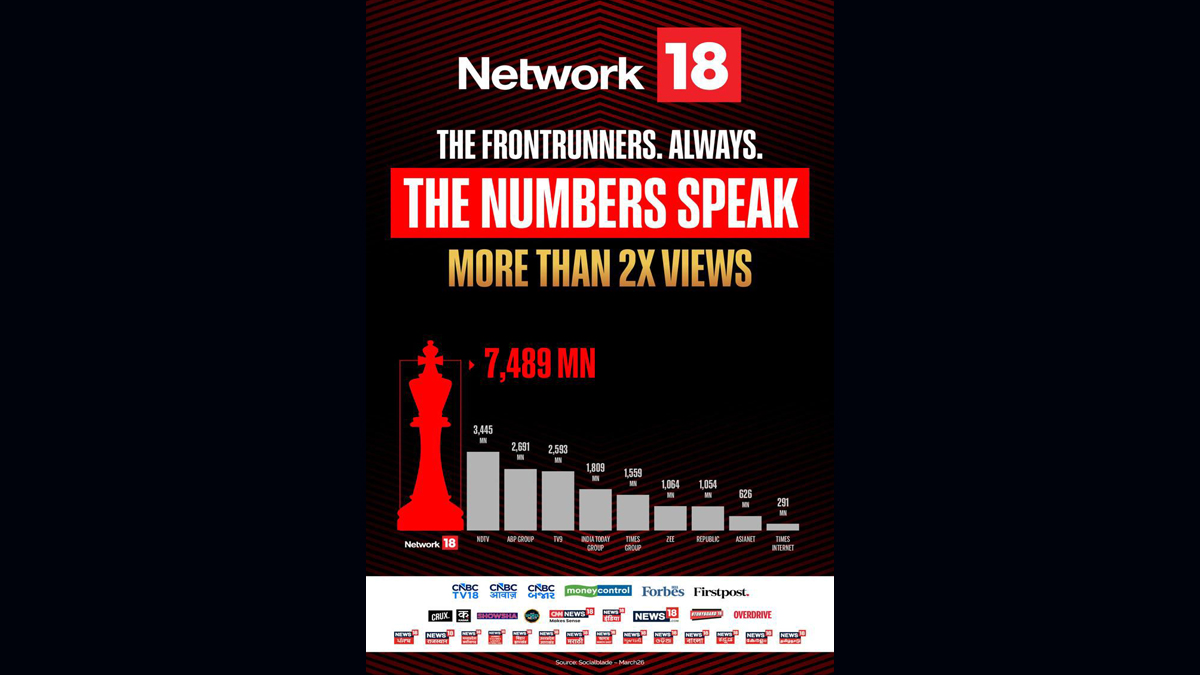
MUMBAI: When the world hit refresh on breaking news, Network18’s channels were already streaming ahead. As geopolitical tensions and war-driven headlines fuelled a surge in global news consumption, the network’s digital playbook delivered big clocking record Youtube viewership across English, Hindi and business news categories in March 2026.
At the forefront was CNN-News18, which emerged as the clear leader in the English news segment with 130 million live and video-on-demand views. The channel edged past competitors such as Times of India (126.5 million), Times Now (101.1 million), India Today (88.2 million) and NDTV (77.5 million), according to Databeings data for March.
In the Hindi news arena, News18 India delivered a commanding performance, racking up a staggering 3,297 million views on YouTube. The channel comfortably outpaced NDTV India, which recorded 3,119 million views, underlining its deep reach and consistent engagement with mass audiences, as per Playboard data.
The network’s dominance wasn’t confined to general news. In the Hindi business segment, CNBC Awaaz topped the charts with 92 million views, narrowly ahead of Zee Business (90 million) and well ahead of ET Now Swadesh (57 million). Meanwhile, its English counterpart CNBC-TV18 posted a strong 58 million views, reinforcing the network’s cross-category strength.
The spike in viewership reflects a broader shift in audience behaviour, with viewers increasingly turning to digital platforms particularly Youtube for real-time updates and in-depth coverage during high-intensity news cycles. For Network18, the numbers signal more than just scale; they underline the effectiveness of a multi-platform strategy that blends speed, credibility and continuous coverage.
In a month where the news never paused, it seems viewers chose to stay tuned where the stream never stopped.






