News Headline
Star India commits to renew agreements with MSOs only on basis of RIO, hearing concludes

NEW DELHI: Judgment was reserved today by the Telecom Disputes Settlement and Appellate Tribunal (TDSAT) in the ‘deep-rooted’ dispute between Hathway and Taj TV, after the hearing that commenced on 25 August and continued on a day-to-day basis.
Before the Tribunal reserved its order, Star India filed an affidavit in which it said it would ‘henceforth’ enter into agreements under the Reference Interconnect Order on a year-to-year basis with all multi-system operators.

It said the RIO would commence three months after the expiry of the erstwhile agreement and would only be on the basis of a published RIO.
It also said it will sign any new agreement on cost per subscriber basis with MSOs operating at national level.
However, it listed eight MSOs working at regional or state level with which it already has CPS agreements and said these will continue for the term for which they are valid and thus last the full term.
The eight MSOs are Inspire Infotech of Delhi, Novabase Digital Entertainment of Delhi, E-Infrastructure and Entertainment, Bangalore, Satellite Channels, Poona Cables Systems and Services of Pune, Sky Channel of Delhi, Home Cable Networks of Chittore District in Andhra Pradesh and City TV of Coimbatore.

Primarily, the Tribunal would have to decide on two matters: the first is an interpretation of the date of renewal under Clause 5(16) of the Telecom (Digital Addressable Systems) Interconnect Regulations relating to renewal of agreements, and the other is about the rates according to the arguments put forth by the various parties.
Earlier, counsel Tejveer Singh Bhatia who had been asked by TDSAT chairman Aftab Alam and member Kuldip Singh to assist the Tribunal in clarifying certain issues said the Regulations were clear that if certain channels were provided to one MSO, they had to be provided to any other MSO that asked for them. However, this did not mean that the terms would be the same for all MSOs.
Furthermore, even if channels were put in bouquets, the rates could not be the same as some were regional channels meant for specific areas and others were national channels and the charges would depend on eyeballs. Hence, the negotiation may differ from region to region. But this also meant creation of RIO agreements for every region depending on number of eyeballs.
He also claimed that the Interconnect Regulations allowed him to change the terms and conditions from time to time.
But he was categorical that a RIO could not be thrust upon him as it was only an offer. Clause 5(10) provides the remedy in case the broadcaster turns down a RIO agreement.
He said that the ‘must carry; clause did not mean automatically that the broadcaster will be paid for every channel he beams. It would depend to the number of channels that the subscriber decides to take.
During the hearing, the Tribunal heard various counsel on behalf of Taj TV and Zee TV, Star India, Hathway, Bhaskar (MSO) from Jabalpur and Scod, an MSO from Mumbai and Navi Mumbai.
When listing the case for 25 August, the Tribunal had said: “Unfortunately, the dispute between the two sides is playing out in highly aggressive way and one may add in a rather unpleasant manner. It seems to be affecting a large number of people in viewing their favourite TV channels. The disputants themselves are approaching the Tribunal on a weekly basis complaining against the actions of each other and seeking some interim directions of the Tribunal consuming a lot of time on arguments on miscellaneous applications.”
The Tribunal noted that both sides had assured that they would avoid issuing the offensive advertisements against each other.
In the order last month, the Tribunal directed Taj TV to file their respective replies in petitions nos.319(C) of 2014 and 47(C) of 2014 and asked Hathway to file its rejoinder.
The Tribunal noted that the dispute has arisen at a stage when the earlier fixed fee agreement between the parties has come to end and they are unable to come to agreed terms for a fresh agreement and under the circumstances the MSO has no option but to take the broadcasters’ channels on their RIO terms.






NEW DELHI: Hamdard Laboratories gathered a cross-section of India’s achievers in New Delhi on Friday, handing out the Hakeem Abdul Hameed Excellence Awards to figures who have left their mark across healthcare, education, sport, public service and the arts.
The ceremony, attended by minister of state for defence Sanjay Seth and senior officials from the ministry of Ayush, celebrated individuals whose work blends professional success with a sense of public purpose. It was as much a roll call of achievement as it was a reminder that influence is not measured only in profits or podiums, but in people reached and lives improved.
Among the headline awardees was Alakh Pandey, founder and chief executive of PhysicsWallah, recognised for turning affordable digital learning into a mass movement. On the sporting front, Arjuna Awardee and kabaddi player Sakshi Puniya was honoured for her contribution to the game and for pushing women’s participation onto bigger stages.
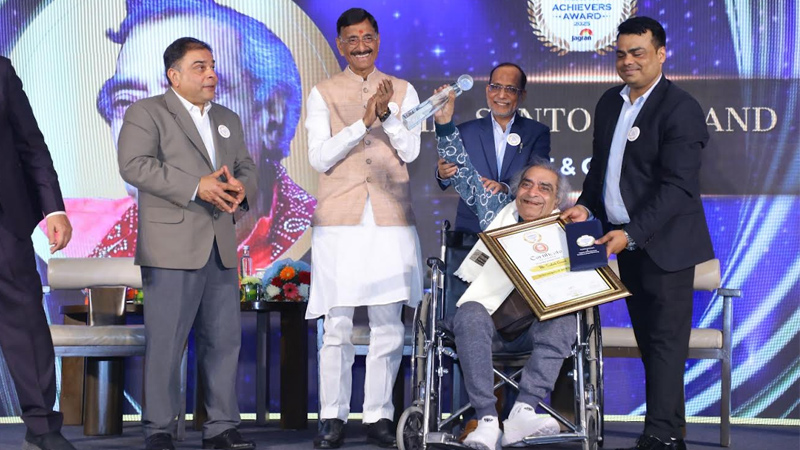
The cultural spotlight fell on veteran lyricist and poet Santosh Anand, whose songs have echoed across generations of Hindi cinema. At 97, Anand accepted the honour with characteristic humility, reflecting on a life shaped by perseverance and hope.
Healthcare honours spanned both modern and traditional systems. Manoj N. Nesari was recognised for strengthening Ayurveda’s place in national and global health frameworks. Padma shri Mohammed Abdul Waheed was honoured for his research-backed work in Unani medicine, while padma shri Mohsin Wali received recognition for his long-standing contribution to patient-centred care.
Education and social development also featured prominently. Padma shri Zahir Ishaq Kazi was honoured for decades of work in education, while former Meghalaya superintendent of Police T. C. Chacko was recognised for public service. Goonj founder Anshu Gupta received an award for his dignity-centred rural development initiatives, and the Hunar Shakti Foundation was honoured for empowering women and young girls through skill development.
The Lifetime Achievement Award went to former IAS officer Shailaja Chandra for her long career in public healthcare and governance, particularly in the traditional systems under Ayush.
Speaking at the event, Hamdard chairman Abdul Majeed said the awards were a tribute to those who combine excellence with empathy. “These awardees reflect Hakeem Sahib’s belief that healthcare, education and public service must ultimately serve humanity,” he said.
Minister Seth struck a forward-looking note, saying India’s young population gives the country a unique opportunity to become a global destination for learning, health and wellness by 2047.
The ceremony also featured the trailer launch of Unani Ki Kahaani, an upcoming documentary starring actor Jim Sarbh, set to premiere on Discovery on 11 February.
Instituted in memory of Unani scholar and educationist Hakeem Abdul Hameed, the awards have grown into a national platform that celebrates those building a more inclusive and resilient India. For one evening at least, the spotlight was not just on success, but on service with substance.






