News Headline
Special programmes on DD Bharati to mark Gandhi Jayanti and Dusherra


NEW DELHI: DD Bharati will present a special play, “The Poet And The Prophet”, to mark Gandhi Jayanti on 2 October.
The telecast will be at 05:30 pm, repeat telecast at 01:30 am and 09:30 am. The play is based on the exchange of letters and articles between Mahatma Gandhi and Rabindranath Tagore over a period of 25 years with the Indian freedom struggle as the backdrop.

The dance drama “Mohan and Rambha” on Mahatma Gandhi is another programme being telecast on 2 October at 10:00 pm, repeat telecast at 06:00 am and 02:00 pm. The telecast is a tribute to the memory of the late Prof. Ramchandra Gandhi and shows how Mahatma Gandhi was initiated into the chanting of Rama-Nama.
On the basis of Mahatma’s own account on his initiation into chanting Rama-Nama by maid servant Rambha, writer-philosopher late Prof Ramchandra Gandhi has explored the meaning of this extraordinary testimony in ‘Mohan and Rambha’. It is contemplation on enquiry and illumination, love and martyrdom, homage to the power (‘shakti’) which sustains sages. The extraordinary creative partnership between late writer-philosopher Prof Ramchandra Gandhi and eminent danseuse Shovana Narayan formed the pioneering effort in opening the doors to dance-plays highlighting the narrative tradition of Kathak and also for its unique quest into unknown yet so relevant facets in the lives of contemporary sages.
Narayan brings out with equal prowess the relation of faith and belief between the maid servant and young Mohandas. Through questions asked, she has touched upon many issues relating to women, untouchability and human discrimination which were so close to Mahatma’s heart.
DD National and DD News will telecast live the Dussehra proceedings from Ram Lila Maidan where Prime Minister Narendra Modi will be present.
On the occasion of Dussehra, DD Bharati presents live telecast of Radhotsavam from Hyderabad at 7:00 am on 3 October. The Rathotsavam festival is a highly emotional event known for the flow of bhakti sangeet, keertans, bhajans and full pitched rendering by the devotees who accompany the procession of the deity. The Rathotsavam of Tirumala is significant for its salient features. The Rath is dragged by devotees and temple staff with the help of secure four-inch thick jute ropes all along the thiru mada streets surrounding the temple shrine. The Rathotsavam has a special spiritual message embedded in the Kathopanishad which compared it to blending of the soul with the body.
DD Bharati will present in association with the External Affair Ministry “Devi Durga” on 3 October at 05:00 pm, repeat telecast at 01:00 am and 09:00 am. This programme traces the genesis of the Durga Pooja. The film explores the amalgamation of cultures and racial features in the facial features of the goddess. The film journeys through time to present how the imagination and the image of the goddess have kept up with the changing times. Today the goddess is global; worshipped across the globe and across India.
Another programme being telecast in the documentary section is “Almoriana” at 06:00 pm, repeat telecast at 02:00 am and 10:00 am. “Almoriana” is a film by Vasudha Joshi and the film is a cinematic document of the Dussehra festival in the Himalayan town of Almora in Uttaranachal.
DD Bharati will also telecast live Mysore Dasara Procession at 01:00 pm on 4 October with the Nandi Dhwaja Pooja which marks the start of Mysore Dasara Procession from Mysore Palace Premises. There will be live telecast Of the Torch Light Parade at 07:00 pm on 4th October from Bannimantap Grounds.
On Vijayadashami, the traditional Dasara procession (locally known as Jamboo Savari) is held on the streets of Mysore city. The main attraction of this procession is the idol of the Goddess Chamundeshwari which is placed in a golden howdah on the top of a decorated elephant. This idol is worshipped by the royal couple and other invitees before it is taken around in the procession. Colourful tableaux, dance groups, music bands, armed forces, folklores, the royal identities, decorated elephants, horses and camels form a part of the procession which starts from the Mysore Palace and culminates at a place called Bannimantap, where the Banni tree (Prosopis spicigera) is worshipped. According to a legend of the Mahabharata, Banni tree was used by the Pandavas to hide their arms during their one-year period of Agnatavasa (living life incognito). Before undertaking any warfare, the kings traditionally worshipped this tree to help them emerge victorious in the war.
The Dasara festivities would culminate on the night of Vijayadashami with an event held in the grounds at Bannimantap known as Panjina Kavayithu (torch-light parade).





NEW DELHI: Hamdard Laboratories gathered a cross-section of India’s achievers in New Delhi on Friday, handing out the Hakeem Abdul Hameed Excellence Awards to figures who have left their mark across healthcare, education, sport, public service and the arts.
The ceremony, attended by minister of state for defence Sanjay Seth and senior officials from the ministry of Ayush, celebrated individuals whose work blends professional success with a sense of public purpose. It was as much a roll call of achievement as it was a reminder that influence is not measured only in profits or podiums, but in people reached and lives improved.
Among the headline awardees was Alakh Pandey, founder and chief executive of PhysicsWallah, recognised for turning affordable digital learning into a mass movement. On the sporting front, Arjuna Awardee and kabaddi player Sakshi Puniya was honoured for her contribution to the game and for pushing women’s participation onto bigger stages.
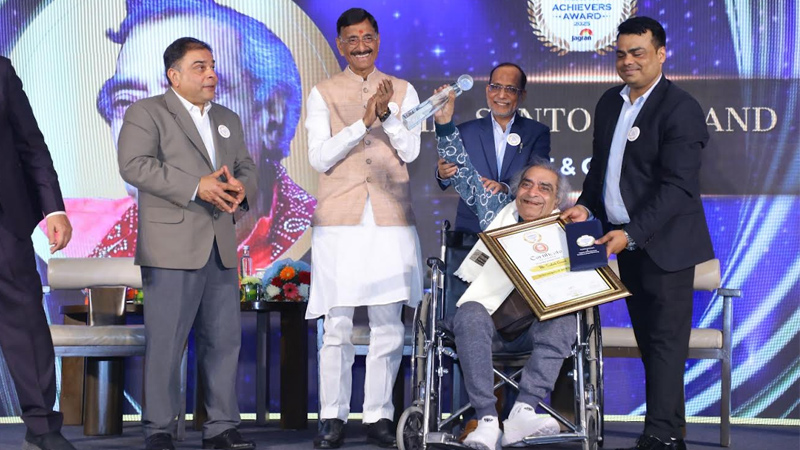
The cultural spotlight fell on veteran lyricist and poet Santosh Anand, whose songs have echoed across generations of Hindi cinema. At 97, Anand accepted the honour with characteristic humility, reflecting on a life shaped by perseverance and hope.
Healthcare honours spanned both modern and traditional systems. Manoj N. Nesari was recognised for strengthening Ayurveda’s place in national and global health frameworks. Padma shri Mohammed Abdul Waheed was honoured for his research-backed work in Unani medicine, while padma shri Mohsin Wali received recognition for his long-standing contribution to patient-centred care.
Education and social development also featured prominently. Padma shri Zahir Ishaq Kazi was honoured for decades of work in education, while former Meghalaya superintendent of Police T. C. Chacko was recognised for public service. Goonj founder Anshu Gupta received an award for his dignity-centred rural development initiatives, and the Hunar Shakti Foundation was honoured for empowering women and young girls through skill development.
The Lifetime Achievement Award went to former IAS officer Shailaja Chandra for her long career in public healthcare and governance, particularly in the traditional systems under Ayush.
Speaking at the event, Hamdard chairman Abdul Majeed said the awards were a tribute to those who combine excellence with empathy. “These awardees reflect Hakeem Sahib’s belief that healthcare, education and public service must ultimately serve humanity,” he said.
Minister Seth struck a forward-looking note, saying India’s young population gives the country a unique opportunity to become a global destination for learning, health and wellness by 2047.
The ceremony also featured the trailer launch of Unani Ki Kahaani, an upcoming documentary starring actor Jim Sarbh, set to premiere on Discovery on 11 February.
Instituted in memory of Unani scholar and educationist Hakeem Abdul Hameed, the awards have grown into a national platform that celebrates those building a more inclusive and resilient India. For one evening at least, the spotlight was not just on success, but on service with substance.






