Applications
Sanjay Dutt gives digital payments a Vega boost with Getepay launch

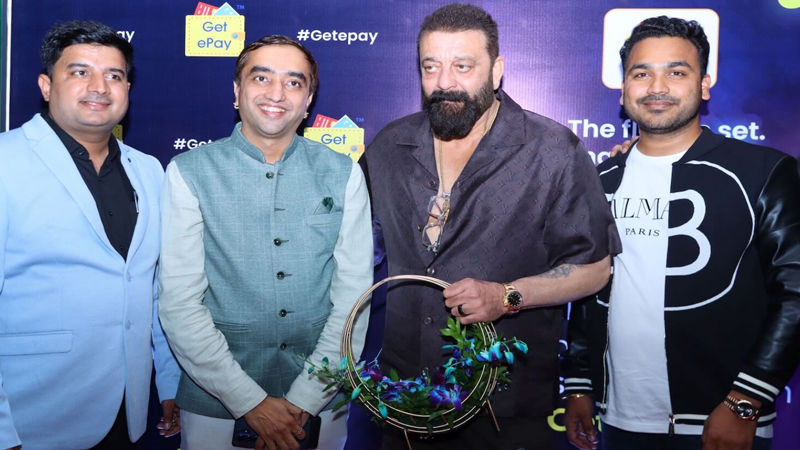
MUMBAI: When Sanjay Dutt says something’s “solid,” you know it packs a punch. And this time, the star wasn’t talking about a movie but about Vega, the indigenously developed payment switch from Getepay that promises to change how India transacts.
At a glittering launch event at Taftoon Lounge, BKC, Mumbai, Dutt joined hands with Pravin Sharma, founder and managing director of Getepay, to unveil Vega, a homegrown, next-gen payment switch that’s as fast as it is secure. Headquartered in Jaipur, Getepay has steadily built its reputation as a digital payments enabler, and with Vega, it’s now aiming for the big league.
“I’ve always believed in backing things that are real, solid, and made with heart and that’s exactly what Vega is,” Dutt said, cheering for a platform designed to empower India’s entrepreneurs, from local shopkeepers to small-town retailers. “This is about giving every entrepreneur the confidence to go digital. That’s the Bharat I want to cheer for.”

Built on a microservices-based architecture, Vega delivers high-speed, high-volume transaction processing while ensuring real-time settlements and automated reconciliation. Think of it as the invisible engine powering India’s cashless ambitions routing transactions seamlessly even when networks are jammed.
For Getepay’s Sharma, the launch marks a milestone moment. “Vega is not just a technological leap, it’s a bridge for millions of micro and small entrepreneurs powering India’s economy. With Vega, we aim to simplify digital payments for banks and merchants alike,” he explained. “Sanjay Dutt was the perfect fit, he represents strength, resilience, and relatability, just like our users across Bharat.”
Under the hood, Vega connects banks and fintechs through a future-ready framework, ensuring compliance with Indian regulatory standards while maintaining top-notch reliability. Its modular design enables faster deployment, giving financial partners a smooth upgrade to modern infrastructure without business disruption.
Beyond its tech prowess, Vega underscores Getepay’s commitment to Make in India, financial inclusion, and digital empowerment. The company envisions a future where even the smallest entrepreneur whether a tea stall owner or a kirana shop operator can accept digital payments with the same ease and confidence as a corporate giant.
In a digital economy where speed, trust, and scalability are everything, Vega may well be the switch that powers Bharat’s next leap. And with Sanjay Dutt playing cheerleader, the digital revolution just found its blockbuster moment.







Applications
With 57 per cent single new users, Ashley Madison rebrands as discreet dating platform
Platform says majority of new members now identify as single

INDIA: Ashley Madison is shedding the “married-dating” label that defined it for two decades, repositioning itself as a platform for discreet dating in what it calls the post-social media age.
The rebrand, unveiled in India on 27 February, 2026, marks a structural shift in business model and identity. Once synonymous with married dating, the company now describes itself as the “premier destination for discreet dating” under a new tagline: Where Desire Meets Discretion.
The pivot is data-driven. Internal figures show that 57 per cent of global sign-ups between 1 January and 31 December, 2025 identified as single: a notable departure from the platform’s married core. The company argues that its community has already evolved beyond its original positioning.
“In an age where our lives have been constantly put on public display, privacy has become the new luxury,” said Ashley Madison chief strategy officer Paul Keable. He framed the platform’s offering as “ethical discretion” for singles, separated, divorced and non-monogamous users seeking private connections.
The shift also taps into wider digital fatigue. A global survey conducted by YouGov for Ashley Madison, covering 13,071 adults across Australia, Brazil, Canada, Germany, India, Italy, Mexico, Spain, Switzerland, the UK and the US, found mounting discomfort with hyper-public online lives.
Among dating app users, 30 per cent cited constant swiping and messaging as a source of fatigue, while 24 per cent pointed to pressure to curate public-facing profiles and early personal disclosure. Some 27 per cent said fears of screenshots or information being shared contributed to exhaustion; an equal share cited unwanted attention.
The retreat from oversharing appears broader. According to the survey, 46 per cent of adults actively try to keep most aspects of their life private online. Only 8 per cent feel comfortable sharing most aspects publicly, while 35 per cent say they are becoming more selective about what they disclose.
Ashley Madison is betting that this cultural recalibration towards controlled visibility can be monetised. By doubling down on privacy infrastructure and reframing itself around discretion rather than infidelity, the company is attempting to convert reputational baggage into a premium proposition.