GECs
Samsung Mobiles is India’s Most Attractive Brand, Sony takes 2nd place

MUMBAI: The latest report from TRA (Trust Research Advisory) – India’s leading brand insights company – titled India’s Most Attractive Brands 2013 (MAB 2013) was released.
Samsung Mobiles emerged as India’s Most Attractive Brand in 2013. India’s second Most Attractive brand is the consumer durables leader Sony, followed by Nokia as the third most attractive across all categories.

India’s top three Most Attractive brands are very close together with just two per cent separating them. Following at fourth place is LG, the South Korean consumer electronics leader with eight per cent attractiveness score lag from the previous. Placed at India’s fifth Most Attractive brand is India’s home-grown conglomerate – Tata – trailing its predecessor by 11 per cent. The results are based on a primary survey conducted with 2,505 consumer-influencers across 16 cities based on TRA’s proprietary matrix of 36 Brand Attractiveness Traits.
Launching the report, TRA (a Comniscient Group company) CEO N. Chandramouli observed, “The force of attractiveness is a primal force that affects all of us with the same intensity – whether it be attraction with other humans, objects, places or brands. As a brand insights company, TRA spent years understanding the basics of attractiveness by delving into several subjects ranging from philosophy to physiology, religion and communication, and have developed a robust proprietary matrix for deciphering the complex subject of Brand Attractiveness.”
At the All India level, Lux, the bath/beauty brand from the HUL stable is India’s sixth Most Attractive brand nearly 48 per cent behind Tata in Attractiveness Quotient. The next four brands are within single-digit gaps of each other with Maruti Suzuki ranked seventh, Godrej ranked eighth, Bajaj ranked ninth, and Dell the Technology leader, ranked India’s tenth Most Attractive brand. India’s top 10 attractive brands include two mobile phone brands, two consumer electronics brands, and three from the diversified category, one each from FMCG, Automobile and Technology categories.
Elaborating on the usefulness of TRA’s matrix, Chandramouli added, “Brands spend billions in advertisements trying to be attractive to consumers, but at best such approaches range between ad-hoc and haphazard. TRA’s Brand Attractiveness matrix will give brands a scientific tool and methodologies to improve their Attractiveness Quotient with their consumers, helping brands deploy their resources more efficiently and target their messages more accurately.”
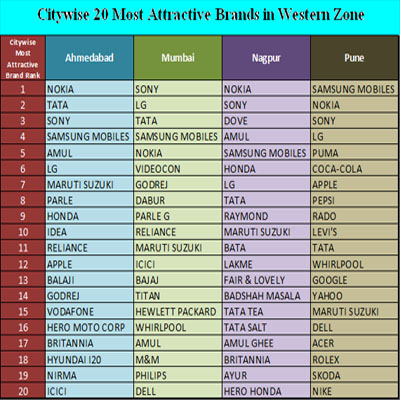
In Western India, the Attractiveness Quotients are quite different from national scores with Sony being ranked as West Zone’s Most Attractive brand. This is followed by LG at second place, Tata at third, and Samsung Mobiles as Western India’s fourth Most Attractive brand. Mumbai’s choices for the top three attractive brands were Sony, LG and Tata respectively.






GECs
Sahara One reports financial results, notes director exit and business realignment
Muted revenues, steady expenses and strategic adjustments shape company’s current phase
MUMBAI: In a tale where the sands seem to be slipping faster than they can be gathered, Sahara One Media and Entertainment Limited has reported another quarter of wafer-thin income and widening losses, even as a boardroom exit adds to the unease.
The company informed the Bombay Stock Exchange that its board, in a meeting held on April 4, approved its unaudited financial results for the quarter ended September 30, 2025. The numbers paint a stark picture. Total income for the quarter stood at just Rs 0.13 lakh, unchanged sequentially and sharply down from Rs 0.26 lakh a year earlier.
Losses, meanwhile, deepened. The company posted a net loss of Rs 24.16 lakh for the quarter, compared to Rs 18.81 lakh in the June quarter and Rs 39.69 lakh in the same period last year. For the six months ended September 2025, the cumulative loss stood at Rs 39.69 lakh, while the full-year loss for FY25 was reported at Rs 60.72 lakh.
Expenses continued to outweigh income by a wide margin. Total expenses for the quarter came in at Rs 24.30 lakh, led by employee benefit costs of Rs 6.51 lakh and other expenses of Rs 17.78 lakh. Earnings per share remained in the red at Rs (0.11) for the quarter.
The balance sheet reflects a company with significant assets on paper but limited operational momentum. Total assets stood at Rs 23,065.57 lakh as of September 30, 2025, broadly unchanged from March 2025. Equity share capital remained steady at Rs 2,152.50 lakh, while total equity was reported at Rs 18,004.85 lakh.
Cash and cash equivalents saw a modest uptick to Rs 6.75 lakh from Rs 4.68 lakh earlier, supported by a positive operating cash flow of Rs 180.01 lakh for the period.
Yet, beneath these numbers lies a more complex narrative. The company’s auditors flagged their inability to obtain sufficient evidence to form a conclusion on the financial statements, citing lack of access to records. They also raised concerns over the company’s ability to continue as a going concern, pointing to insufficient funds, delayed recoveries, and stalled content investments.
Adding to the governance overhang, the company disclosed that Rana Zia has resigned as whole-time director, effective October 16, 2025, citing other professional commitments. The resignation, noted and accepted by the board, also brings an end to her role across company committees.
Regulatory pressures continue to loom large. The Securities and Exchange Board of India has already initiated penal actions for non-compliance with listing norms, with trading in the company’s shares remaining suspended. There is also a risk of promoter demat accounts being frozen.
Legacy legal issues remain unresolved. A substantial deposit of Rs 694,027.88 thousand linked to the long-running OFCD dispute involving Sahara group entities is still under the purview of the Supreme Court of India. Restrictions on asset disposal continue to weigh on the company’s financial flexibility.
Operationally, challenges persist across multiple fronts. Advances worth Rs 1,92,916 thousand given for film content remain stuck, with delays in project completion and uncertain recoverability. The company’s YouTube channel, despite being operational, has generated no revenue for over three years due to compliance lapses. In a further twist, management has indicated that revenues may have been fraudulently diverted through unauthorised changes to its AdSense account, with a police complaint in the works.
There are also missed revenue opportunities. Television content rights continue to be used by a related party despite the expiry of the licence agreement, with fresh negotiations still underway.
For now, Sahara One Media and Entertainment Limited appears caught between legacy disputes and present-day operational hurdles. As losses linger and governance questions mount, the road to recovery looks less like a sprint and more like a slow trudge through shifting sands.






