News Broadcasting
Sahara, DD ad sales revenues for England series gross Rs 2 billion


MUMBAI: The first chapter of Nimbus’ boss Harish Thawani’s audacious gamble with the India cricket story is over with a battered English side glad to be back in the cooler climes of Old Blighty and the Indians getting some well deserved rest before they head out to the Caribbean.
For Thawani however, the rollercoaster he’s been on since his Nimbus Communications swung the telecast rights to India cricket for the next four years with a bank-breaking $ 612.18 million composite bid has barely begun. The India-England tour — the first of ten international series (and four domestic cricket seasons) that constitutes the deal — is over and the calculators are out tallying the revenue numbers.
Indiantelevision.com’s discussions on the matter with media buyers indicate that the series, which involved three Tests and six ODIs (one was washed out), has generated about Rs 2003 million in ad sales from national broadcaster Doordarshan and Sahara One. Going by these calculations, DD accounted for Rs 987 million while Sahara One mopped up Rs 1016 million.

But what is of critical importance to Nimbus is really how much it is able to net from this series. Indiantelevision.com estimates show the ad sales revenue picture for this series looking something like this: Nimbus’ Net income from DD is Rs 630 million (deducting 25% share to DD and 15% agency commission) and for Sahara it is Rs 864 million. That makes a total of just under Rs 1500 million ($ 35 million).
Considering that Nimbus’ bid for the India territory rights was a whopping $ 504.09 million, there’s a huge mountain still that Thawani’s privately held Mumbai sports management company has left to climb to clear the profit threshold.
THAWANI’S GAMEPLAN
Having said that, and going by a recent report in Forbes, Thawani is already in the clear on the international territory rights (Nimbus’ bid here broke down as $ 108.09 million). The report says that Nimbus has sold BCCI’s telecast rights internationally for $130 million. The jury’s still out on that one though, with some industry observers calculating that Nimbus could not have made more than $ 89 million from the sale of international rights.
As for the India part, everything points to Nimbus launching its own sports channel before the end of the year and for this the market expectation is that Thawani will soon be announcing another round of funding for this purpose.
Thawani claims that investors are currently valuing Nimbus at $400 million to $500 million, which would mean that Nimbus has tripled in valuation terms in less than a year. It was last August that UK-based private equity and venture fund 3i acquired around 33 per cent stake in Nimbus for $45.50 million (approx Rs 1.97 billion).
In conclusion, what is the downside in this gamble (for Thawani and any investor who wants to buy into his vision) and what could be the upside. That is really what will have guided Thawani in making what still remains a hugely difficult play to pull off. As the head of a broadcast concern told Indiantelevision.com, the current thinking is that there is just no way anyone can make more than $ 550 million from this deal. So at the outset itself, Nimbus is looking at a $ 62 million hit on its investment, or $ 15.5 million per year spread over four years.
But there is the upside as well, which is that with all the new broadcast delivery platforms that are opening (DTH, IPTV, mobile TV) and if all the constellations of a booming economy, a brilliantly performing team and the kind of possibilities that a young on-the-go populace provide are in consonance, then $ 800 million might well be within reach.
Before jumping to conclusions either way, it might be worth remembering a certain Kunal Dasgupta and his now well documented masterstroke of a gamble on the ICC cricket rights in 2002 for a then unheard of $ 208 million. There is no one who today does not see the SET India CEO’s bid as a really inspired play.
A potential loss of $ 62 million versus a best case gain of $ 200 million. Which way the dice falls by the time 2010 comes around will determine whether Thawani is ultimately acknowledged as a visionary or someone whose go for broke gamble went bust. Unsurprisingly, there are many a respected industry stalwart who believe that if anyone can pull this off, it is the fashionably bald head honcho of Nimbus.





News Broadcasting
Kamlesh Singh receives Haldi Ghati Award from MMCF
India Today Group editor honoured for three decades of journalism at Udaipur ceremony.
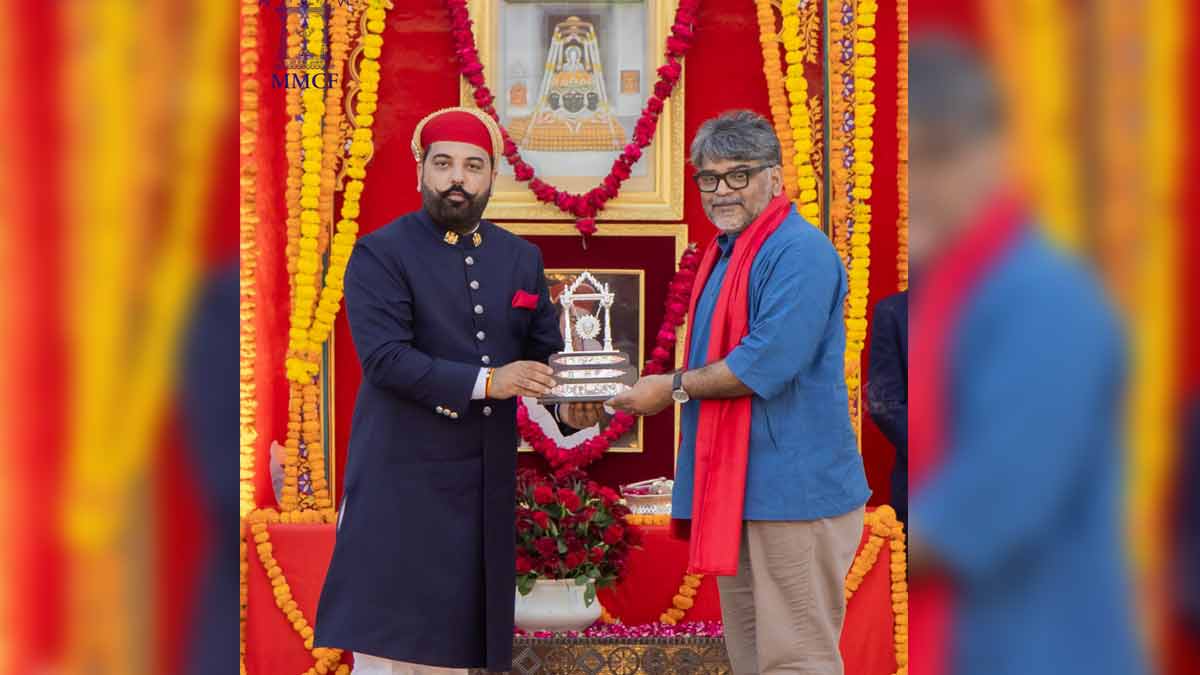
MUMBAI- Kamlesh Singh just turned a lifetime of sharp words into a shiny shield because when journalism wakes up a society, even the Maharana of Mewar wants to pin a medal on it.
The Maharana of Mewar Charitable Foundation (MMCF) conferred its prestigious Haldi Ghati Award on Kamlesh Singh, a senior editor at the India Today Group, during a ceremony in Udaipur on 15 March 2026. The national award, instituted in 1981-82, recognises “work of permanent value that initiates an awakening in society through the medium of journalism.”
Singh, who leads several editorial initiatives including Aaj Tak Radio, the Teen Taal community and The Lallantop, was presented the honour by Lakshyaraj Singh Mewar, Managing Trustee of MMCF. The citation highlighted his three decades of contributions to Indian media, innovations in digital journalism, mentoring young reporters, and his popular podcast persona “Tau” on Teen Taal, which fosters thoughtful public discourse.
The Haldi Ghati Award, named after the historic Battle of Haldighati symbolising valour and resilience, is one of four national awards given annually by MMCF. Past recipients include Tavleen Singh, Piyush Pandey and Raj Chengappa.
Other honourees this year included Padma Vibhushan Pt Hari Prasad Chaurasia, Vedamurti Devvrat Rekhe, Treeman of India Marimuthu Yoganathan, Vir Chakra Capt Rizwan Malik, and US-based researcher Molly Emma Aitken, who received the Colonel James Tod Award for contributions to understanding Mewar’s spirit and values.
In an era where headlines often shout louder than substance, the MMCF quietly reminded everyone that real journalism isn’t about noise, it’s about the quiet, persistent work that stirs society awake, one thoughtful story at a time.







