I&B Ministry
Rs 18000 crore worth investments received for ‘Digital India’: Prasad

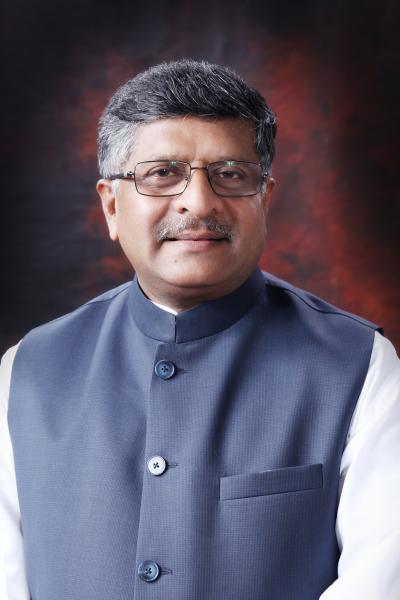
NEW DELHI: The Prime Minister Narendra Modi’s mandate of ‘Digital India’ will be a game changer for the country and will have a cascading effect on the entire system said Communications and Information Technology Minister Ravi Shankar Prasad.
Chairing the consultative committee meeting attached to his Ministry, he informed the members that about 700,000 kilometer of cable for broadband is proposed to be laid in the next three years as against one million kilometers already laid in the country, so far.

The Minister informed members that 50,000 gram panchayats will be provided broadband facility in the first tranche and 2.5 lakh in the next three years. Prasad also assured the members that the government is giving priority to the production of electronic goods as part of the ‘Make in India’ programme.
Reacting to the concern of some of the members about poor services of the BSNL network in the country, he said more funds are proposed to be provided to the public sector telephone service providers during the VII phase to improve their functioning and make them commercially active.
The Department of Electronics and Information Technology secretary RS Sharma, made a presentation on the ‘Digital India’ programme before the members of the consultative committee. Earlier at the FICCI, Prasad said Rs 18000 crore worth investments proposals have been received till now for the ‘Digital India’ programme, of which Rs 4000 crore worth have been approved and more are in the pipeline.
Speaking at the session on ‘The role of ICT and ‘Digital India’ initiative in India’s growth’ at the 87th AGM of FICCI, Prasad said that while there are issues of spectrum to provide high speed connectivity and regulatory control, India will become an exciting place as far as ‘Digital India’ is concerned. E-commerce, he said, was worth billions of dollars and will help increase India’s GDP in a big way.
Prasad said that the huge postal network can be used for various services like banking, insurance etc. The postal services earn Rs 280 crore from e-commerce, he said, and urged the private sector to take the initiative to develop India digitally.
Stating that digital connectivity is needed for good governance, Prasad said India had more than $100 billion turnover in IT industry. All fortune companies connect with India’s IT. India has the potential of becoming number two after China and surpass the United States.
Spelling out the initiatives that have already been taken under the Digital India Programme, the Minister said mygov.in portal has been launched to allow India to interact on various government programmes. Suggestions received on various programmes like ‘Clean Ganga’, ‘Swachh Bharat’ through the portal and designing, logo, slogan etc have been prepared. Under the ‘Jan Dhan Yojna’ – name for the programme was coined with the help of suggestions received through the portal, eight crore bank accounts have been opened till now with a total deposit amount of Rs 8000 crore. This is an ideal example of financial inclusion through digital technology.
Additionally, programmes such as ‘Jeevan Pramaan’, a biometric-enabled digital service for pensioners has been launched. Besides, through IT, two lakh schools were connected (two crore children) on the eve of Teacher’s Day.
Prasad said the digital divide between those who have and those who don’t needs to be plugged. For this the government has initiated the programme – National Optical Fibre Network (NOFN) – which proposes to connect seven lakh kilometers optical fiber to be laid to connect 250 gram panchayats in three years. Wi-fi spots will be provided around the clusters after that and all villages to be provided with internet connectivity.
He said that to promote ‘Digital India’ it is proposed to set up a broadband duct which is a pre-requisite for getting sewer, water and electricity connections.




I&B Ministry
Doordarshan, ICCR sign MoU to boost global reach of Indian culture
Pact taps TV, radio and digital platforms to take cultural content worldwide
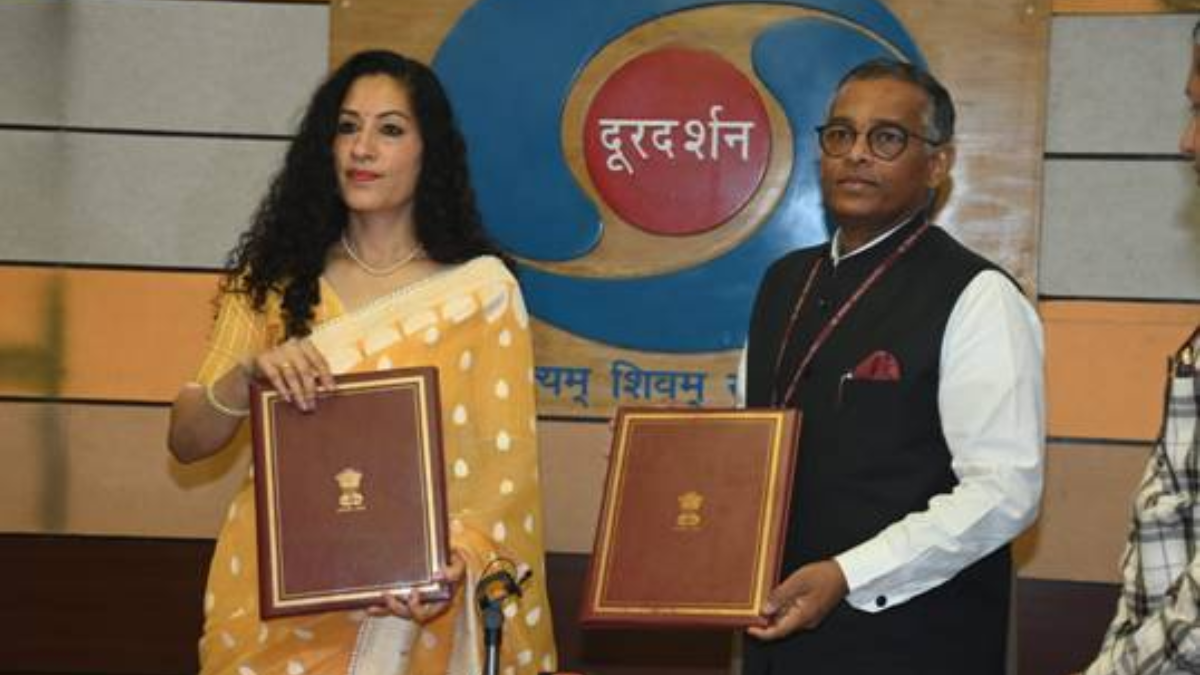
NEW DELHI: In a move aimed at taking India’s cultural story further across borders, Doordarshan under Prasar Bharati has signed a memorandum of understanding with the Indian Council for Cultural Relations to expand the global reach of Indian cultural content.
The agreement, signed on April 7 at Doordarshan Bhawan, brings together the content strength of ICCR and the wide broadcast network of Doordarshan, spanning television, radio and digital platforms.
Under the partnership, ICCR will provide a steady stream of cultural programming, including performances and events organised by Indian missions abroad such as embassies, consulates and cultural centres. Doordarshan will handle production, coverage and distribution, ensuring that these programmes find audiences not just in India but across the world.
The collaboration also opens the door for recorded cultural content from overseas missions to be aired across multiple platforms, including OTT and social media, making Indian art, music and heritage more accessible to global viewers.
A notable feature of the MoU is joint ownership of content rights in perpetuity, including digital rights. This allows both organisations to archive and reuse material over time, building a long-term cultural repository while maximising reach. Doordarshan will also support pre-event promotion and cross-platform visibility to drive engagement.
Speaking at the signing, Doordarshan director general K. Satish Nambudiripad and Indian Council for Cultural Relations director general K. Nandini Singla highlighted the potential of the partnership to strengthen India’s cultural diplomacy through modern media channels.
The agreement, initially valid for three years, also allows Doordarshan to explore monetisation opportunities from the content generated, adding a commercial layer to cultural broadcasting.
As India looks to blend tradition with technology, this partnership signals a clear intent to make its cultural voice not just heard, but seen and streamed across the globe.






