News Broadcasting
‘RGV rejected me for a gangster’s role – Actor Pankaj Tripathi tells Rajat Sharma in ‘Aap Ki Adalat’

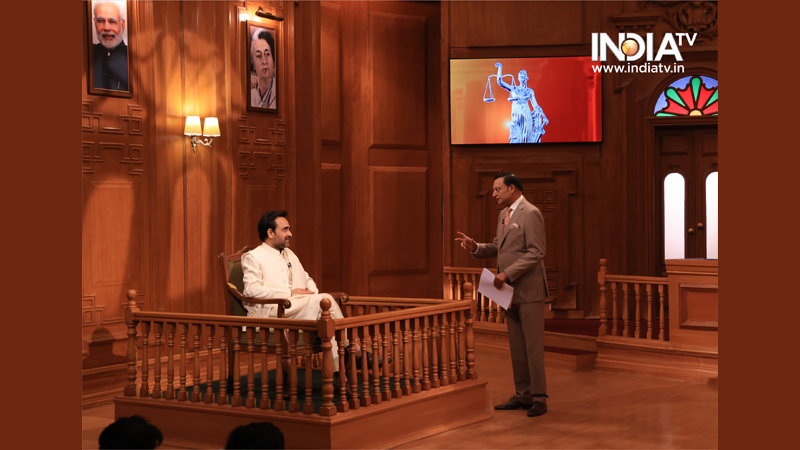
Mumbai: Bollywood and OTT star actor Pankaj Tripathi has revealed how director Ram Gopal Varma once rejected him for a gangster’s role after carrying out a test. “It was good otherwise both he and I would have suffered losses”, Tripathi said.
Appearing in Rajat Sharma’s iconic show ‘Aap Ki Adalat’, telecasted on Saturday 6 January 2024, Pankaj Tripathi was asked why a noted director like Ram Gopal Varma rejected him for a gangster’s role.
Pankaj Tripathi replied: “Yes, I once went to him and found several ferocious looking ‘gunday’ (gangsters) already waiting there. Some had deep scars on their faces. I asked one of them, are you really an actor? He replied, Ram Gopal Varma casts dangerous looking characters. Those days, aspiring actors used to deliberately cut their faces with blades, so that Ram Gopal Varma may spot and cast them.

Rajat Sharma: Did Ramu call you?
Pankaj Tripathi: Yes, he called me. It was an interesting incident. Ramu asked me to sit on a bench meant for four persons. I sat on the bench in a corner. He told me, ‘No No, come more close this side’. On a bench meant for four, I was sitting alone and he stared at me intently for 10 to 15 minutes. I felt very sheepish, when he continued to stare me for long. Then he told me, ‘Jao, Go’. He didn’t call me later….Of course, he is a good director. He met me once later and praised my acting, and said, “You are doing good, Pankaj”.
Rajat Sharma: He must have realized, if he had cast you then it could have been his gain?
Tripathi: It’s all a game of time (Samay Ka Khel Hota Hai). If he had cast me then, then it would have been his loss and my loss too. (Tripathi told the audience) So, if nothing big happens in your life, don’t be disappointed, it is an omen for something good that is going to happen.
‘I Never Check Monitor After Shoot’
Pankaj Tripathi revealed he never watched the camera monitor after completing his shoot. He said, “This is a rare thing which few people in the media know about. You (Rajat Sharma) have good spies in Mumbai. I never check the camera monitor after finishing my shoot. I think the director is the captain and it is his job to check the monitor. If he okays the scene, then it means he got what he wanted.”
‘Fukrey’ and Other Sequels
Asked whether he changed his dialogues and sometimes, even the climax in his films, Pankaj Tripathi admitted in the affirmative. He said, at this moment, five of his films have sequels because they were hits.
Rajat Sharma: Where did you get this idea of mixing Hindi with English in your dialogues?
Tripathi: In the first part of the movie Fukrey, it was my idea. I told the director (M S Lamba) I wanted to change my lines. He first refused. While I was rehearsing, lighting work was going on inside the security cabin of Delhi’s Miranda College. The director told me don’t mix English in your dialogue, I told him I am only rehearsing. The lighting men began to laugh when I mixed English in my dialogues. By that time, the director had seen my rehearsed dialogue, and he agreed. In ‘Fukrey Returns’, I got the written dialogues. Also in ‘Fukrey 3’ too.
Rajat Sharma: In Fukrey Part 1 and Part 2, your picture was not there in the posters, but in Part 3, your picture was there in the poster. Pankaj Tripathi has become a saleable star now?
Tripathi: Yahi Toh Jeevan Hai (This is Life)
Rajat Sharma: That’s why you are doing several sequels of your films?
Tripathi: Sequels are made when film becomes a hit. Unsuccessful films don’t have sequels. At this moment, five of my films have sequels – Stree, Mirzapur, Criminal Justice, Fukrey and also Gangs of Wasseypur.
Rajat Sharma: There was this ‘Super 30’ movie in which you were doing the role of a neta. You deliberately changed the dialogues?
Tripathi: Vikas Bahl was the director. There was the scene where a student’s gets admission to Oxford University and asks the neta for money. The neta started blubbering something else. The neta was saying: ‘Ja Rahe Ho? Kahan Ja Rahe Ho? Jao, Jao, London Jao, Paris Jao, Japan Jao, Vietnam Jao, China Jao, Beijing Jao, Dubai Jao, Bahrain Jao.’ It looked like a poetry. The lines were not written. The dialogue was delivered spontaneously. I was doing the role of a neta in Bihar (Minister Shriram Singh in the movie). I had seen a leader in my village who used to blubber meaninglessly. I told the director Vikas Bahl, I will speak in the same manner. So, the scene developed in that way. It looked different.
Rajat Sharma: Can you repeat the same dialogue here?
Tripathi: It was, “Dubai Jao, Bahrain Jao … Kya Baat Hai. The boy said, Sir, you had called me. I replied: Hum har us cheez ko bulate hain, jo desh ke liye baat karega. The boy said, I need money. I replied: Jao Jao Jahan Jaana, par paisa aur prem ke chakkar me mat padna. Humne achche achhe ko barbaad hote dekha hai. Bhagat Singh padhe they? Dekho, nahin pade they. Jao Jao.” So you see, the neta starts giving a sermon instead of giving money.







News Broadcasting
CNN-News18 to host Fury in the Gulf conclave on West Asia crisis
Three-hour summit to unpack geopolitical fallout and impact on India
MUMBAI: CNN-News18 is set to host a special three-hour broadcast, Fury in the Gulf – War Conclave, on April 7, aiming to decode the escalating West Asia crisis and its far-reaching implications for India.
Scheduled from 4:00 PM to 7:00 PM, the conclave comes at a time when tensions between Iran and the United States are reshaping global geopolitics and triggering economic uncertainty. With India’s deep energy ties, trade links and large diaspora in the Gulf, the developments carry significant domestic relevance.
Built around the theme ‘Conflict, Consequences, and The Future,’ the programme will feature six curated sessions combining one-on-one interviews and panel discussions. The focus is to cut through the clutter and offer viewers a clearer understanding of the fast-evolving situation.
Key sessions include ‘Diplomacy in Times of War’ featuring Shashi Tharoor, and ‘World After the Iran Conflict’ with voices such as Ram Madhav, Reuven Azar, representatives from the European Union and the Iranian Deputy Envoy. Another session titled ‘Another Dunkirk?’ will bring together K. J. S. Dhillon and Jitin Prasada among others.
CNN-News18 editorial affairs director Rahul Shivshankar said, “In times of war, clarity becomes the most powerful tool. Fury in the Gulf – War Conclave brings together credible voices to address the questions and confusion that arise amid an overwhelming influx of information.”
He added that the initiative is aimed at delivering “facts, perspective, and insight” at a time when misinformation can easily cloud public understanding.
Echoing the sentiment, CNN-News18 CEO– English and business news Smriti Mehra said the conflict marks a defining global moment, with consequences that extend well beyond the region. She noted that the conclave seeks to present the crisis with “depth, nuance and responsibility” so audiences can better grasp its real-world impact.
As geopolitical tensions continue to dominate headlines, the conclave positions itself as an attempt to bring order to the noise, offering viewers a structured, insight-led look at a complex and rapidly shifting global situation.






