Cable TV
Retransmission law contravened: Sidhu, Fastway refutes ‘monopoly’ charge

MUMBAI Punjab minister Navjot Singh Sidhu intends to bring an ordinance for auditing the tax the previous government collected from cable operators. Putting the chief minister Capt Amarinder Singh in a fix, Sidhu has asked him to decide on recovering the ‘tax evaded’ by the MSO — Fastway Cable Network.
The Punjab Government, he said, was committed to break the monopoly situation and to have a level playing field in cable TV industry.
In the Indian states where there is competition among MSOs, Sidhu said, rates being charged from LCOs (local cable operators) are Rs 75 in Rajasthan, Rs 60 in UP, and a whopping Rs 130 in Punjab. It was being done without any legal agreement and without raising any invoices, whereby LCOs had no option but deposit the same — which is in contravention of the law of retransmission of cable TV signals. By creating the monopoly, Sidhu said, MSOs have an unequal bargaining power with the broadcasters but extracting huge carriage/placement revenue from the broadcasters.

Sidhu said that he would procure a GPR (ground penetrating radar) to assess where cabled had been laid and whether the operator had paid due taxes. Since the subject related to excise and taxation is under the CM, he said, the matter would have to be taken to Singh and the cabinet.
In 1995, Sidhu said, the entertainment tax in Punjab was Rs 50 per television set. But, the Badal government amended the provisions to keep Fastway out of tax net and imposed a tiny tax of Rs 15,000 per annum. A Fastway release later stated that the Supreme Court lawyer Vineet Bhagat (Sidhu’s advisor) was defeated by Fastway in several cases, and hence he had twisted the facts and presented figures to show the MSO in a poor light.
Calculating the impact of the loss to the state exchequer by taking into account a conservative figure of 40 lakh Fastway connections (as stated in 2012 Competition Commission of India report, it would come to (40 lakh x 50 x 12 x 6) Rs 14.4 billion, the minister alleged. Sidhu said the actual figure could go up to Rs 200 billion. Despite having over 80 lakh connections today, Sidhu said, Fastway had grossly under-declared its connections at around 24 lakh to TRAI, continuing to short-change the regulator and the government.
Refuting, Fastway CEO Peeush Mahajan said his company had no monopoly as Godfather Cable, Hinduja and MC Transmissions were operating in the state. Punjab had six DTH companies as well, he said. Fastway, he said, had a tamper-proof system and it has been audited by broadcasters and the central government agency BECL (Broadcasting Engineering Corporation of India Limited).
ALSO READ :
Probe Punjab ‘cable mafia,’ demands minister, Fastway refutes charges
Punjab Govt falters in first leg of breaking cable monopoly
Punjab govt. vows to break cable monopoly, rules out blocking MSO Fastway
Hinduja’s NXT Digital enters Fastway-dominated Punjab






Cable TV
Hathway Cable appoints Gurjeev Singh Kapoor as CEO
Leadership change comes as cable TV faces shrinking subscriber base and modest earnings pressure
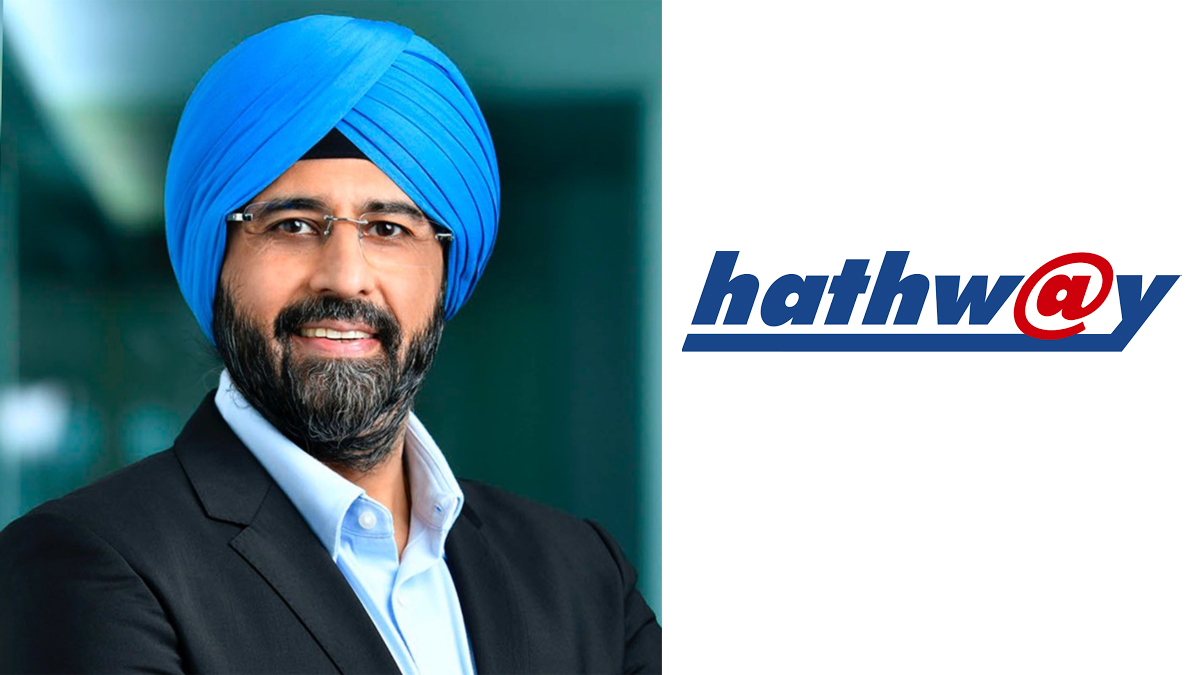
MUMBAI: Hathway Cable and Datacom has tapped industry veteran Gurjeev Singh Kapoor as chief executive officer, marking a leadership pivot at a time when India’s cable television business is under mounting strain.
Kapoor will take over from Tavinderjit Singh Panesar, who is set to retire in August after a long innings with the company. Panesar, chief executive since 2023, has held multiple leadership roles at Hathway, including his latest stint beginning in 2022.
Kapoor brings more than three decades of experience in media and entertainment. He most recently led distribution at The Walt Disney Company’s Star India business, now part of JioStar. His career spans television distribution and affiliate partnerships, with stints at Sony Pictures Networks India, Discovery Communications and Zee Entertainment.
Panesar, with over three decades in the industry, has worked across strategic planning, distribution and business development in media, broadcasting and manufacturing. His past associations include ESPN Star Sports, Star India, Apollo Tyres and JK Industries.
The transition lands as the cable sector grapples with structural disruption. Traditional operators are losing ground to streaming platforms, while telecom and broadband players tighten the squeeze with bundled offerings.
An EY report estimates India’s pay-TV base could shrink by a further 30 to 40 million households by 2030, taking the total down to 71 to 81 million. The slide follows a loss of nearly 40 million homes between 2018 and 2024, a contraction that has already wiped out more than 37,000 jobs in the local cable operator ecosystem.
Hathway’s numbers reflect the strain. The company reported a consolidated net profit of Rs 93 crore for FY25, down from Rs 99 crore a year earlier. Revenue inched up to Rs 2,040 crore from Rs 1,981 crore. As of December 2025, it had about 4.7 million cable TV subscribers and roughly 1.02 million broadband users.
Kapoor steps in with a familiar brief but a shrinking playbook. In a market where viewers are cutting cords faster than companies can reinvent them, the new chief executive inherits a business fighting to stay plugged in.







