News Broadcasting
Republic TV rejigs top leadership, names Darius Maneckji as business head


Mumbai: Republic Media Network has bolstered its business team with the elevation of Hersh Bhandari as group chief operating officer – broadcasting division and appointment of Darius Maneckji as business head for Republic TV and senior executive vice president.
In his new role, Bhandari will oversee the entire national operations for all existing broadcast channels of the network. Maneckji will now lead the entire expansive national operations for Republic TV, including the channel’s offices in Bengaluru, Noida, Gurgaon, Kolkata and Mumbai. He will report to Hersh Bhandari, announced the network in a statement on Wednesday.
With 24 years of experience, Bhandari is a well-established industry veteran with hefty achievements. With his impeccable record, he will also lead and strategise all future growth of the network’s broadcasting business into languages and regions. “Bhandari will manage the entire broadcast business operations from the network’s offices in Noida and Mumbai,” the media company said.

“At Republic Media Network, we continue to consolidate and strengthen ourselves with speed for the growth that beckons us,” said Hersh Bhandari. “I am energised by the trust reposed in me by the board, management, and my colleagues, to help shape and deliver the next phase of growth. We think and move as one, shoulder-to-shoulder.”
With over 20 years of experience, dominantly in leadership positions, Maneckji has a well-respected and robust record in the media. He has been the national sales head in the past for Times Now and also the national sales head for the English movie cluster at Turner International India. Before onboarding with Republic TV, his last assignment was with TV Today. “I am excited to join India’s fastest-growing news network. I look forward to working with one of the best teams in the business to ensure we continue to command and establish our leadership role in the English news genre,” said Darius Maneckji.
“I am excited about the new roles for both Hersh and Darius,” said Republic Media Network founder and editor-in-chief Arnab Goswami. “The broadcasting division under Hersh will see rapid growth, like never before. Our digital business is being expanded by 100 percent and together with our Strategic Business partnerships, will be hived off into separate business divisions, each with their own leadership and goals. At a consolidated level, this should place us in a fantastic position to be the number one TV plus digital news company across the board in two years.”
Republic Media Network is expanding its broadcasting operations and will be making more announcements in the coming weeks. “The induction of strong business talent is part of the expansion of the network and creation of a strong organizational base to take the plans forward,” added Goswami.







News Broadcasting
Network18 channels lead YouTube news viewership in March 2026
CNN-News18, News18 India and CNBC channels top categories with record views
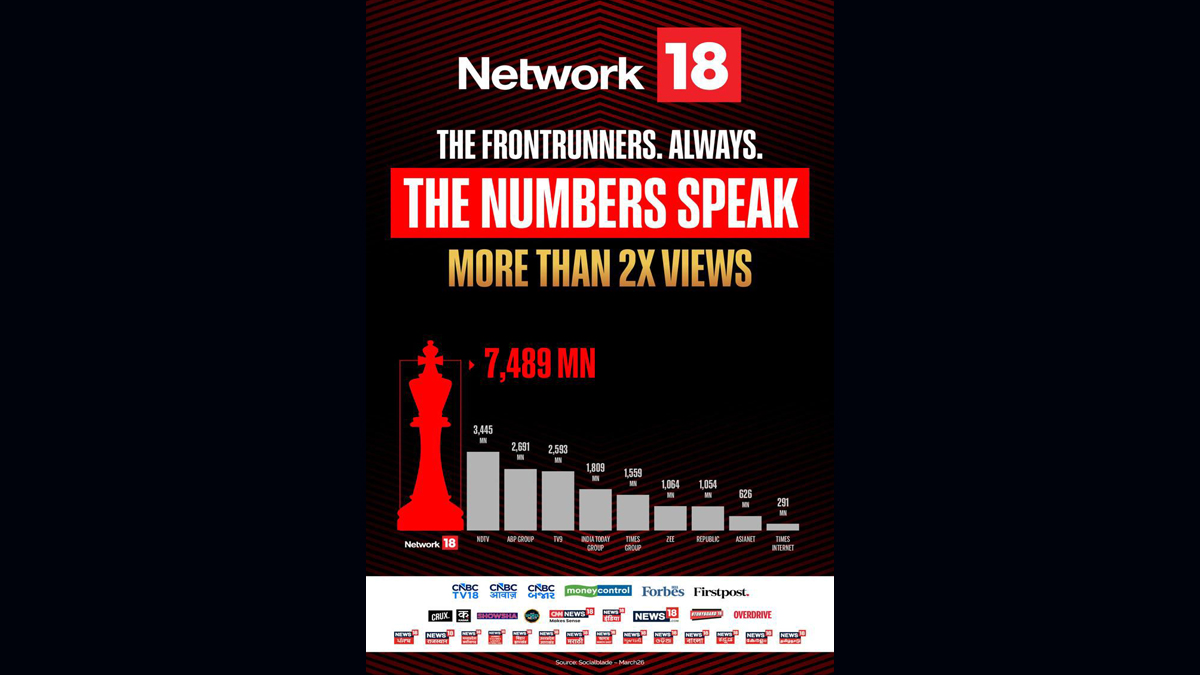
MUMBAI: When the world hit refresh on breaking news, Network18’s channels were already streaming ahead. As geopolitical tensions and war-driven headlines fuelled a surge in global news consumption, the network’s digital playbook delivered big clocking record Youtube viewership across English, Hindi and business news categories in March 2026.
At the forefront was CNN-News18, which emerged as the clear leader in the English news segment with 130 million live and video-on-demand views. The channel edged past competitors such as Times of India (126.5 million), Times Now (101.1 million), India Today (88.2 million) and NDTV (77.5 million), according to Databeings data for March.
In the Hindi news arena, News18 India delivered a commanding performance, racking up a staggering 3,297 million views on YouTube. The channel comfortably outpaced NDTV India, which recorded 3,119 million views, underlining its deep reach and consistent engagement with mass audiences, as per Playboard data.
The network’s dominance wasn’t confined to general news. In the Hindi business segment, CNBC Awaaz topped the charts with 92 million views, narrowly ahead of Zee Business (90 million) and well ahead of ET Now Swadesh (57 million). Meanwhile, its English counterpart CNBC-TV18 posted a strong 58 million views, reinforcing the network’s cross-category strength.
The spike in viewership reflects a broader shift in audience behaviour, with viewers increasingly turning to digital platforms particularly Youtube for real-time updates and in-depth coverage during high-intensity news cycles. For Network18, the numbers signal more than just scale; they underline the effectiveness of a multi-platform strategy that blends speed, credibility and continuous coverage.
In a month where the news never paused, it seems viewers chose to stay tuned where the stream never stopped.






