News Broadcasting
Reporting from the frontline: Journalists battle with Covid second wave

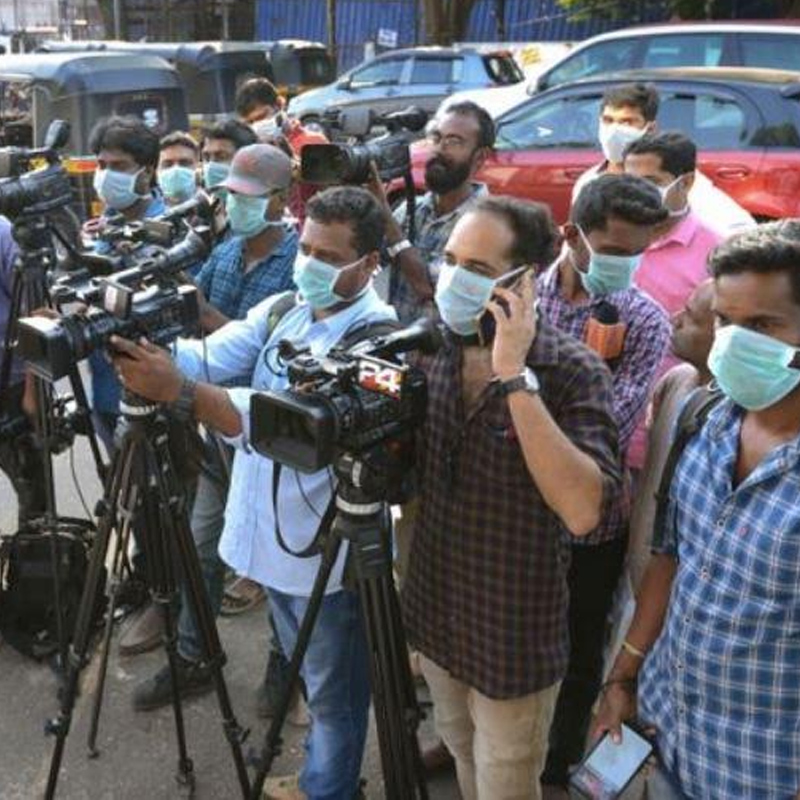
NEW DELHI: With India engulfed in the firestorm that is the second wave of Covid2019, journalists in the country are putting their lives on the line to keep the public informed and abreast of the latest developments regarding the fatal pathogen, and the measures that should be taken to curb its spread. But in spite of these noble efforts from the news media community, the government has not classified scribes as frontline workers who are entitled to priority Covid vaccination. It’s a fact that while working round the clock to provide Covid updates from the frontlines, several journalists have lost their lives.
According to data released by the Press Emblem Campaign (PEC), a non-profit organisation focused on press freedom and journalist safety, 51 Indian journalists have died due to coronavirus. The data released by PEC was dated 29 December, and the current death toll among the news media community could be much higher, especially at this time where the resurgent virus is on a killing spree through India.
Request from Editors Guild of India

Recently, the Editors Guild of India urged the government to declare journalists as frontline workers and be allowed priority Covid vaccination.
“News organisations have been relentlessly covering the pandemic, elections, and other current affairs in an effort to ensure that the flow of news and information to readers continues unabated. News media is included in essential services. Therefore it will only be fair that journalists be given this cover of protection, especially in the face of the number of infected rising to astronomical levels,” the Editors Guild of India said in a statement.
Extending support to newspersons in the country, Delhi chief minister Arvind Kejriwal also urged the central government to classify media personals as frontline workers.
“Journalists are reporting from most adverse situations. They should be treated as frontline workers and should be allowed vaccination on priority. Delhi government is writing to the Centre in this regard,” tweeted the AAP supremo.
Journalists are reporting from most adverse situations. They shud be treated as frontline workers and shud be allowed vaccination on priority. Delhi govt is writing to centre in this regard
— Arvind Kejriwal (@ArvindKejriwal) April 14, 2021
Tamil Nadu MP B Manickam Tagore also appealed to prime minister Narendra Modi to declare all journalists as frontline workers. In a memorandum, Tagore shockingly revealed that India has the highest fatalities among journalists dying due to Covid infection across Asia and the second-highest across the world.
Industry experts react
Calling journalists ”frontline warriors”, Asianet News editor-in-chief MG Radhakrishnan stated that several journalists contracted the novel Coronavirus at his channel.
“At least 25 journalists working in Asianet News have been infected with the coronavirus. Like any other frontline workers, journalists are also risking their lives to keep people informed about the pandemic and our role in this war against the invisible enemy should not be ignored,” said Radhakrishnan.
Talking about the challenges during news reporting, he added, “Unlike other instances of calamity, we are putting families too at risk.”
Mathrubhumi Group managing director MV Shreyams Kumar shared that his company has been trying hard to give all protection measures for journalists since the pandemic outbreak.
“We have an effective operational standard maintained, the reporters are given shifts on a rotational basis and they are regularly examined and tested. The office space is well sanitised, and safety factors are taken into consideration. The government has been quite supportive to the media industry, they have well adhered to the fact that newspapers are playing a very important role in delivering credible news to its readers and the general public at large,” he noted.
Senior media consultant and veteran journalist Mohan Nair echoed the sentiment, going on to add that reporters who are on the field are more prone to occupational hazards despite taking precautionary measures, and urged the government to give prioritised vaccines to journalists irrespective of their age.
Senior photojournalist Vivek Bendre succumbed to Covid-19 early on Sunday after over a week-long battle with the infection. Vivek, aged 58, was associated with The Hindu for the last three and half decades. We have lost an excellent human being. May his soul rest in peace. pic.twitter.com/w2drhSMkCG
— Mumbai Press Club (@mumbaipressclub) April 25, 2021
Senior journalist Sadanand Shinde passed away of Covid-19 infection on Sunday evening. Known to call a spade and spade, he always waxed eloquent and with a great sense of humour put across his point. He was associated with Navakal. We stand behind the bereaved family. RIP. pic.twitter.com/kJRP97UKUn
— Mumbai Press Club (@mumbaipressclub) April 25, 2021
PIB’s relief efforts and Uttarakhand government’s empathetical step
In a major relief, the Uttarakhand government has decided to classify journalists as frontline workers. Uttarakhand chief minister Tirath Singh Rawat has also ordered the vaccination of all journalists and representatives of media organisations. The Telangana government has also decided to give financial assistance of Rs 2 lakh each to the families of journalists who have succumbed to Covid.
To help the families of journalists who have passed away due to Covid infection under the Journalist Welfare Scheme (JWS), the PIB is collecting information of newspersons who lost their lives during the pandemic time. The central government has also approved the proposal of the Press Information Bureau’s journalist welfare committee to provide financial relief of Rs 5 lakh to deceased journalists’ family. As a part of this plan, the families of 39 journalists will receive this financial relief.
As hundreds of journalists have succumbed to Coronavirus in India, the Network of Women in Media India (NWMI) recently paid tribute to newspersons who lost their lives during the pandemic.
“Media houses need to actively ensure the safety and health of journalists who work for them and those who, as independent stringers or freelancers, supply vital information, photographs and videos to them. Media houses must stop forcing journalists to travel in dangerously unsafe conditions to work in offices instead of encouraging them to work from home,” said NWMI in a statement.
On 26 April, India witnessed more than 3,23,000 Covid positive cases and 2,771 Covid-related deaths. Medical experts believe that the double and triple mutant variants of the deadly virus are responsible for the sudden surge in cases in India.





News Broadcasting
Network18 channels lead YouTube news viewership in March 2026
CNN-News18, News18 India and CNBC channels top categories with record views

MUMBAI: When the world hit refresh on breaking news, Network18’s channels were already streaming ahead. As geopolitical tensions and war-driven headlines fuelled a surge in global news consumption, the network’s digital playbook delivered big clocking record Youtube viewership across English, Hindi and business news categories in March 2026.
At the forefront was CNN-News18, which emerged as the clear leader in the English news segment with 130 million live and video-on-demand views. The channel edged past competitors such as Times of India (126.5 million), Times Now (101.1 million), India Today (88.2 million) and NDTV (77.5 million), according to Databeings data for March.
In the Hindi news arena, News18 India delivered a commanding performance, racking up a staggering 3,297 million views on YouTube. The channel comfortably outpaced NDTV India, which recorded 3,119 million views, underlining its deep reach and consistent engagement with mass audiences, as per Playboard data.
The network’s dominance wasn’t confined to general news. In the Hindi business segment, CNBC Awaaz topped the charts with 92 million views, narrowly ahead of Zee Business (90 million) and well ahead of ET Now Swadesh (57 million). Meanwhile, its English counterpart CNBC-TV18 posted a strong 58 million views, reinforcing the network’s cross-category strength.
The spike in viewership reflects a broader shift in audience behaviour, with viewers increasingly turning to digital platforms particularly Youtube for real-time updates and in-depth coverage during high-intensity news cycles. For Network18, the numbers signal more than just scale; they underline the effectiveness of a multi-platform strategy that blends speed, credibility and continuous coverage.
In a month where the news never paused, it seems viewers chose to stay tuned where the stream never stopped.






