News Broadcasting
Reliance Media Works reports lower net loss for April-June 2013 quarter


BENGALURU: Reliance Media Works (RMW), formerly Adlabs Films and a part of the Reliance ADA group, reported lower consolidated net loss in the April-June 2013 quarter as compared to the preceding quarter (January-March 2013) and the corresponding quarter (April-June 2012) of 2012.
RMW’s net worth has eroded, however, having regard to revenue visibility of new businesses in film and media services, improved operational performance of exhibition business, financial support from its promoters, further restructuring exercise being implemented etc, the financial statements have been prepared on the basis that the company is a going concern and that no adjustments are required to the carrying value of assets and liabilities.

Important Notes:
(1) Since the previous financial year of the company was extended till 30 September 2012, the result for the April-June 2013 quarter will be referred to as Q3-2013, January-March 2013 quarter as Q2-2013 and April-June 2012 quarter as Q3-2012 in this report/analysis.
(2) Notes of the attached financial statement must be read along with this analysis.
For the current quarter (Q3-2013) RMW reported a consolidated net loss of Rs 123.60 crore which was 5.9 per cent lower than the Rs 131.30 crore (y-o-y) for Q3-2012 and substantially lower by 44.4 per cent as compared to the Rs 222.12 crore for Q2-2013 (q-o-q).
Details of RMW’s standalone financial information are: Turnover Rs 126.40 crore for Q3-2013 as compared to Rs 122.61crore for Q3-2012. RMW’s loss before tax for Q3-2013 was Rs 83.73 crore as compared to the Rs 91 crore loss for Q3-2012. Loss after tax stood at the same figure for Q3-2013 and the previous year’s corresponding quarter (Q3-2012).
Let us look at the other figures reported by RMW for the April-June 2013 (Q3-2013) quarter
RMW reported a total income from operations of Rs 180.16 crore for Q3-2013, 10.91 per cent lower than the Rs 202.15 crore in Q3-2012, but 24.6 per cent higher than the Rs 144.63 crore for Q2-2013.
Its total expense for Q3-2013 was Rs 238.97 crore, 6.5 per cent lower than the Rs 255.56 crore for Q3-2012 and 2.2 per cent lower than the Rs 244.38 crore for Q2-2013.
RMW’s net loss from operations at Rs 58.80 crore was 10.1 per cent higher than the Rs 53.41 crore of Q3-2012, but substantially lower than the Rs 99.75 crore in Q2-2013.
Let us look at RMW’s segment results
Film Production Services, Theatrical Exhibition, and Television, Film Production & Distribution are the three segments. Pursuant to the business restructuring exercise of Film Production Services, with effect from 1 October 2011, animation business is no longer considered to be a part of this segment.
Film Production Services reported income of Rs 41.62 crore for Q3-2013, 2.4 per cent lower than the Rs 47.88 crore for Q3-2012, but 14.33 per cent more than the Rs 36.40 crore for Q2-2013.
Loss before interest and tax by this segment was Rs 33.55 crore, almost double (more by 93.9 per cent) the Rs17.31 crore in Q3-2012, but 10.14 per cent lower than the Rs 37.53 crore loss incurred in Q2-2013.
RMW’s Theatrical Exhibition segment reported income of Rs 127.56 crore for Q3-2013 (Includes exceptional items of Rs 60 crore) which was 39.56 per cent lower than Rs 204.29 crore for Q3-2012 and 11.86 per cent lower than the Rs 144.71 crore in Q2-2013.
Loss before interest and tax by RMW’s Theatrical Exhibition was Rs 24.25 crore for Q3-2013 was however 10.46 per cent lower than the Rs 29.09 crore for Q3-2012 and less than a quarter (4.42 times less or 21.74 per cent) of the Rs 111.56 crore loss incurred in Q2-2013.
RMW’s Television/Film Production and Distribution income of Rs 13.25 crore which contributed to just 7.4 per cent to its consolidated revenues in Q3-2013 was the only one that reported a profit before interest and tax of Rs 4.34 crore in Q3-2013 which was 60 per cent higher than the profit before interest and tax of Rs 2.73 crore in Q3-2012. This segment had reported a loss of Rs 3.50 crore for Q2-2013. Revenue from this segment in Q3-2013 was higher by 13.3 per cent as compared to the Rs 11.7 crore for Q2-2012 and 25.7 per cent higher than the Rs10.54 crore for Q2-2013.







News Broadcasting
News18 India launches Command Centre war explainer with Arya
New show shifts from debates to decoding global conflicts and impacts
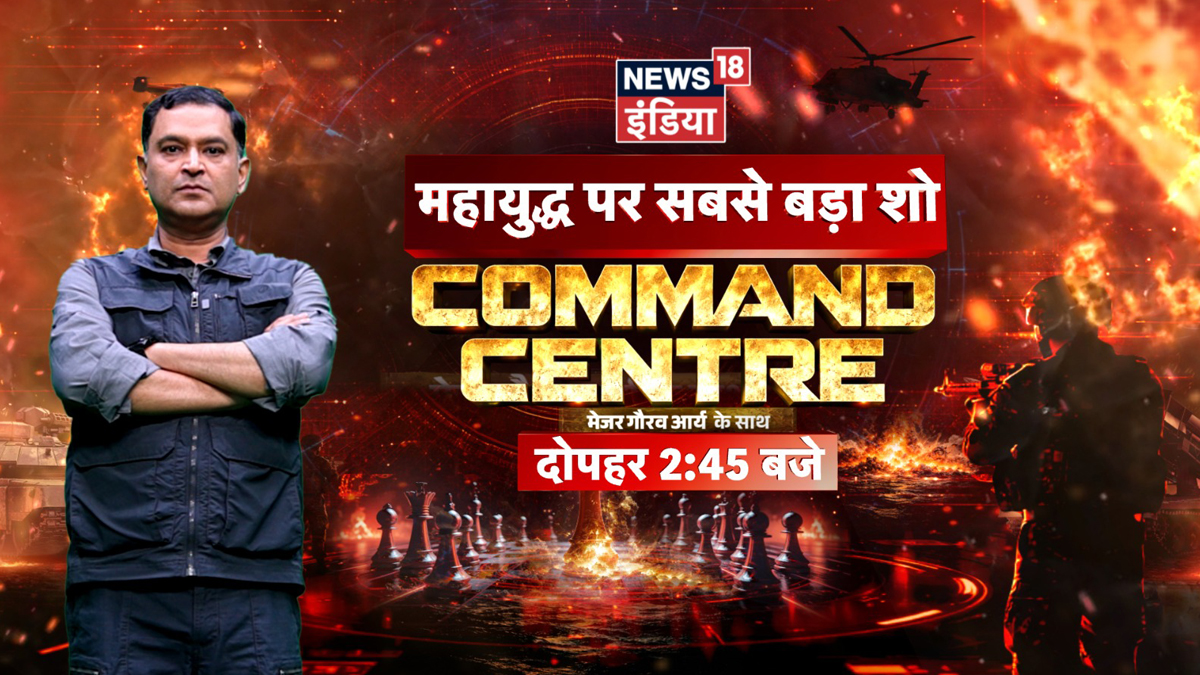
MUMBAI: News18 India has rolled out a new war-focused programme, Command Centre, featuring Gaurav Arya, as it looks to offer viewers a sharper, more grounded take on global conflicts amid rising tensions in West Asia.
Positioned as an “insider war room”, the show moves away from conventional panel debates and instead focuses on explaining military developments, decoding strategy and connecting global events to their everyday impact, from fuel prices to economic shifts.
The format leans heavily on visuals and data. The studio has been designed like a command hub, complete with large LED war maps, real-time graphics and an alert system to track developments as they unfold.
At the centre of it all is Arya, who brings his military background to simplify complex war strategies for viewers. His signature line, “Seedhi baat samjhiye”, anchors the show’s promise of clarity over noise.
News18 India managing editor Jyoti Kamal said, “Command Centre, featuring Major Gaurav Arya is designed to deliver accurate insights and a clear perspective on how evolving conflicts impact everyday life, from household budgets to national security. With expert voices analysing every development in real time, the show goes beyond headlines to decode what’s happening now, what it means, and what could come next.”
Echoing the intent, Gaurav Arya added, “In times of war, confusion is the biggest threat. With News18 India’s Command Centre, we are bringing viewers inside the war room, decoding strategies, tracking every escalation, and explaining, in the simplest terms, what it means for India and for every household. Seedhi baat samjhiye, this is where you understand not just what is happening, but what happens next.”
The weekday show will air in the afternoon slot and will also feature Gaurav Shukla, adding to its editorial depth.
With its mix of analysis, visuals and a clear focus on impact, the show reflects a broader shift in news consumption. Viewers are no longer just watching events unfold, they are looking to understand what those events mean for them.






