iWorld
Regional content consumption overtakes Eng on digital: report

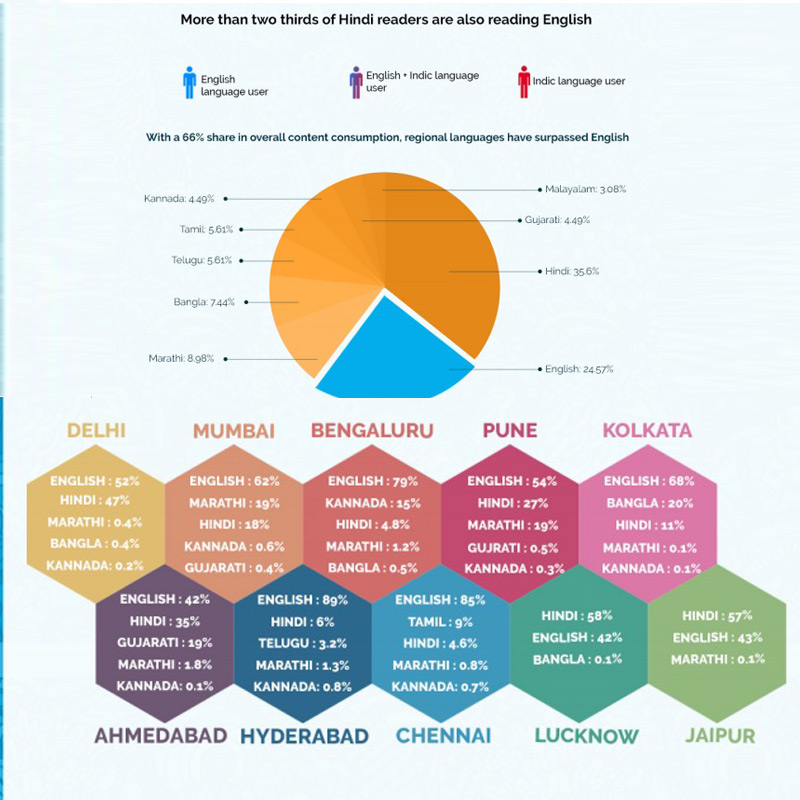
MUMBAI: Times Internet has released a study titled ‘The Changing Lingual Face of Digital India’ highlighting the rapid shift of digital users towards regional content consumption. With this study, Times Internet has validated the rising trend of online content consumption across the eight most widely consumed regional languages in the country. To map the magnitude of this trend, online content consumption patterns of over 90 million netizens were evaluated, unveiling many future possibilities and the impact of content in regional languages.
According to the study, out of the 90 million plus surveyed digital users, more than half of the Indian internet user base is non-English. More than two thirds of Hindi readers are also reading English. Regional languages have surpassed English with a 66 per cent share in overall content consumption.
Across all regional languages, news as a genre sees the highest content consumption at 67 per cent, followed by Sports at 17 per cent and Entertainment at 16 per cent. Whereas, News in Bangla language tops the chart with 72 per cent.

Out of the 66 per cent, the ratio of specific regional language consumption is that 4.49 per cent user base consumes Kannada, 5.61 per cent Tamil, 5.61 per cent Telugu, 7.44 per cent Bangla, 8.98 per cent Marathi, 3.08 per cent Malayalam, 4.49 per cent Gujarati, 35.6 per cent Hindi and 24.57 per cent in English.
The regional language user base in India has grown at a CAGR of 41 per cent between 2011 and 2016 to reach the current 234 million. This is expected to grow by 18 per cent CAGR to reach 536 million by 2021 versus English, which is expected to grow at 3 per cent CAGR to reach 199 million by 2021. By 2012, regional language users will account for 75 per cent of India’s internet user base.
Regional language content consumption is not limited to native state/cities anymore but it is a countrywide trend now. Delhi consumes 52 per cent in English, 47 per cent in Hindi, 0.4 per cent in Marathi, 0.4 per cent in Bangla and 0.2 per cent in Kannada. Mumbai consumes 62 per cent in English, 18 per cent in Hindi, 19 per cent in Marathi, 0.4 per cent in Gujarati and 0.6 per cent in Kannada.
The study highlights that content consumption in regional languages among younger audiences is fast growing, with consumption among Indians in the 25-34 age group being the highest.
Currently, women are consuming regional language content highest than ever before. Among female users, Gujarati language sees the highest online content consumption at 44.78 per cent. Whereas, 22.02 per cent of Hindi content, 29.22 per cent of Marathi content, 29.75 per cent of Kannada content, 30.61 per cent of Bangla content, 22.37 per cent of Tamil content, 23.95 per cent of Telugu content and 38.83 per cent of Malayalam content is consumed by women.
Mobile is fast becoming the primary screen for regional language content consumption with Hindi consumed for 69.7 per cent, Marathi consumed for 40.3 per cent, Kannada consumed for 61.8 per cent, Bangla consumed for 66.3 per cent, Telugu consumed for 65.6 per cent and Malayalam consumed for 72.7 per cent.
The report states that India is inching closer to becoming a digital-first nation as affordable smartphones and low priced 3G and 4G connections are driving internet penetration and digital literacy in the country. Access to high-speed Internet connectivity is no longer restricted to metro cities, which is causing a massive shift in online content consumption patterns, across the country.
Also Read :
Chanpreet Arora appointed CEO of Vice Media India
Times Internet buys MX Player for $200 million







iWorld
Bill Ackman’s Pershing Square makes $64 billion bid to acquire Universal Music Group
Ackman pitches NYSE relisting plan as UMG board weighs unsolicited offer

The hedge fund has proposed a business combination that values UMG at €30.40 per share, representing a hefty 78 per cent premium to its current trading price. The offer includes €9.4 billion in cash alongside stock in a newly formed entity, with shareholders set to receive €5.05 per share in cash and 0.77 shares in the new company for each UMG share they hold.
Under the proposal, UMG would merge with Pershing Square SPARC Holdings Ltd and re-emerge as a Nevada-based entity listed on the New York Stock Exchange. The move is designed to boost investor visibility and potentially secure inclusion in major indices such as the S&P 500.
Pershing Square Capital Management ceo Bill Ackman argued that while UMG’s operational performance remains strong, its market valuation has lagged due to external factors. “UMG’s stock price has languished due to a combination of issues that are unrelated to the performance of its music business,” Ackman said, pointing to concerns ranging from shareholder overhang to delayed US listing plans.
Ackman also flagged what he sees as untapped potential in UMG’s balance sheet and a lack of clear capital allocation strategy. He added that the market has not fully recognised the value of UMG’s €2.7 billion stake in Spotify, alongside gaps in investor communication.
The proposed transaction would also result in the cancellation of around 17 per cent of UMG’s outstanding shares, while maintaining its investment-grade balance sheet. Pershing Square has said it will fully backstop the equity financing, with debt commitments secured at signing. The deal is targeted for completion by the end of the year.
UMG, however, has struck a measured tone. The company confirmed that its board has received the non-binding proposal and will review it with advisers. It reiterated confidence in its current strategy and leadership under Lucian Grainge, signalling no immediate shift in stance.
The proposal comes at a time when global music companies are navigating evolving investor expectations, streaming economics and capital allocation pressures. For Pershing Square, the bet is clear: sharpen the financial story, relist in the US, and let the music play louder in the markets.
Whether UMG’s board is ready to change the tune remains to be seen, but the spotlight on its valuation just got a lot brighter.






