Hindi
Reel women power as IFFI panel flips the script on cinema’s old narratives

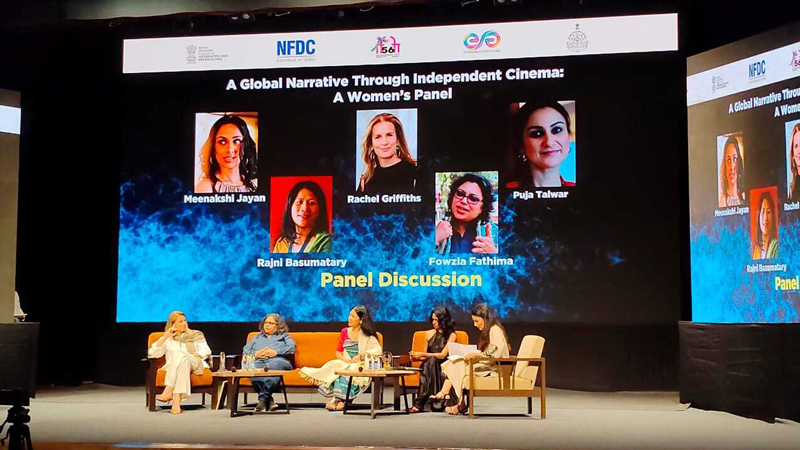
MUMBAI: Cinema may run on lights, camera and action but at IFFI 2025, it was honesty, humour and hard-earned wisdom that took centre stage. In a masterclass that played out like a director’s commentary on gender, power and perspective, four women from across continents unpacked how female creators are reshaping storytelling from the inside out.
Moderated by journalist Puja Talwar, the panel brought together Australian actor Rachel Griffiths, Malayalam actor Meenakshi Jayan, cinematographer Fowzia Fathima, and Assamese actor-filmmaker Rajni Basumatary each speaking with a mix of candour, frustration, wit and fierce optimism.
And the big question that set the mood? Where does cinema begin to bridge the intimate and the universal?

Griffiths wasted no time diving in. She argued that women instinctively understand one another across languages, borders and cultures. “I could watch a woman’s story in any language and never feel othered,” she said, describing the “molecular connection” that binds women’s experiences as daughters, mothers and creators. Her point landed with a laugh and a punch: “Women are actually the answer.”
Meenakshi Jayan agreed, adding that women’s films often begin from a deeply personal place and that intimacy, when handled with honesty, almost always translates into something universal.
Cinematographer Fowzia Fathima expanded the idea further, calling empathy the quiet force that shapes not only stories but the filmmaking process itself. “When empathy informs the work, the local becomes global,” she said, a simple statement that neatly captured why nuanced, smaller stories often resonate far beyond their origin.
Assamese actor Rajni Basumatary observed that women are naturally attuned to the “smallest of things”, which is why their films often hold exceptional nuance making the seemingly small feel monumental to the communities represented.
She also reminded the audience that women have long been underrepresented, and their increased visibility today is essential in completing the circle of on-screen and off-screen representation.
Rachel Griffiths brought the conversation back to the numbers, the kind that often contradict the rosy perceptions built on a few high-profile success stories.
From her work on Australia’s Gender Matters Committee, Griffiths explained how decades of celebrated female directors and cinematographers created a false image of parity, even as the data revealed how few women actually directed television episodes or feature films.
“It’s so easy to look at a couple of successful people and think, ‘Oh, it’s solved.’ Until you look at the numbers. And anyone who doesn’t want to show the data is hiding a shame,” she said.
Offering a homegrown counterpoint, Fowzia traced the evolution of the Indian Women Cinematographers Collective (IWCC). A network she once thought had “eight people” now numbers 200, spanning juniors to seniors, united in craft and camaraderie.
Their website highlights each cinematographer’s work equally “because unless people see how many of us there are, they will keep calling one of us ‘the only woman’.”
She also walked the audience through Kerala’s groundbreaking Women Cinema Project, which annually funds a woman director with a grant of Rs 1.45 crore, pushing both representation and skill-building.
Rajni added a heartwarming anecdote: when she approached one cinematographer from the collective, date clashes led to a chain of referrals, each woman recommending another.
“That sorority, that sisterhood, I was very touched,” she said.
Rachel Griffiths highlighted an oft-ignored truth: the film industry’s brutal 16–17-hour days force many women to step back during motherhood, a stage where careers and caregiving clash most violently.
Her solution?
Job-sharing for crew roles such as continuity and direction, allowing women to stay in the industry instead of disappearing for a decade and attempting an impossible comeback.
“It’s not a lack of talent. It’s a lack of support,” she said plainly.
The panel didn’t shy away from the stubborn double standards that still plague the industry.
A “superstar” who requested an eight-hour shift after childbirth became a national debate while male stars routinely avoid weekends without headlines. Women taking hiatuses for family obligations often return to find their relevance questioned.
As Rajni pointed out, “If a woman comes back, suddenly everyone wants to know why she disappeared in the first place.”
Fowzia shared her own journey balancing academia, parenting and filmmaking before stepping back into the industry with a major Tamil feature film, Train, starring Vijay Sethupathi.
“It took time, but I’m on track again,” she said with a relieved smile, prompting applause.
From American television’s powerful women-led writers’ rooms to British cinema’s habit of scripting women as “forever disappointed”, Griffiths argued that representation in writers’ rooms is the true game-changer.
“Once the right people sit in the room where stories begin, everything changes,” she said.
The panel closed with a big question, How can actors influence change beyond the screen?
Choosing scripts more deliberately. Asking for inclusive crews. Insisting on representation not just in front of the camera, but behind it. The consensus was unanimous, actors today hold more power than ever and wielding it thoughtfully can transform the ecosystem.
What began as a discussion on intimacy and universality grew into a sweeping conversation on data, empathy, sisterhood, structural barriers, and the future of global cinema.
If one theme defined the afternoon, it was this, Women aren’t just telling stories, they are reclaiming the system that shapes them.
And judging by the energy in that IFFI hall, the next chapter of global cinema is not just going to be female. It’s going to be fearless.



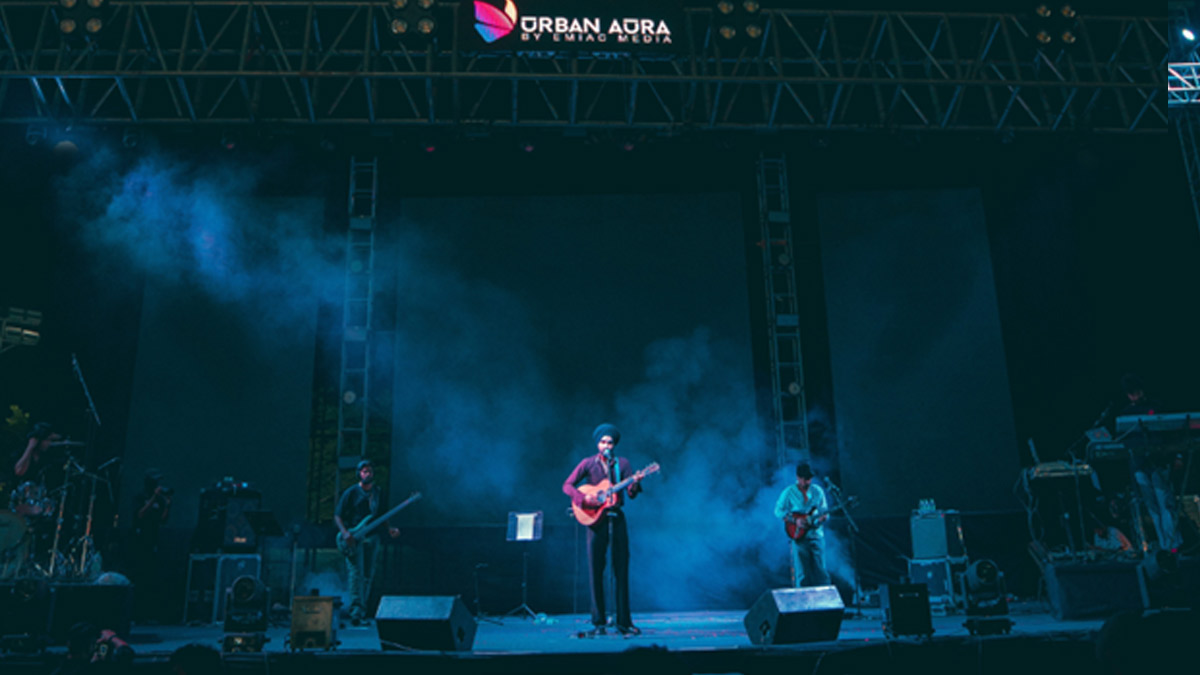
In a music industry that often rewards speed, spectacle, and instant recall, Navjot Ahuja’s journey feels refreshingly different. His story is not built on noise. It is built on patience, discipline, emotional honesty, and a quiet commitment to becoming better with every passing year. After 14 years of struggle, learning, performing, and writing, Navjot stands today as an artist whose success has not changed his centre. If anything, it has only made his purpose clearer.
For Navjot, music has never been about chasing fame alone. It has always been about expression. It is about writing more truthfully, singing more skillfully, understanding himself more deeply, and becoming a kinder human being in the process. That rare clarity is what gives his journey its beauty.
Where It All Began: A Writer Before a Singer
Indian singer and songwriter Navjot Ahuja’s musical journey began in the most familiar of places: school assemblies. But even then, what was growing inside him was not only the desire to sing. It was the need to write.
Long before he saw himself as a performer, he had already discovered the emotional release that writing offered him. For Navjot, words became the first true channel for feeling. Songwriting came before singing because writing was the only way he could let emotions flow through him fully. That inner pull shaped his artistic identity early on.
Like many young musicians, he sharpened his craft by creating renditions of popular songs.
Those experiments became his training ground. But the turning point came in 2012, when he wrote his first original song. That moment did not just mark the beginning of songwriting. It marked the beginning of self-definition.
A Calling He Did Not Chase, But Accepted
What makes the latest Indian singer-songwriter Navjot’s story especially compelling is the way he describes his relationship with music. He does not frame it as a career he aggressively pursued. In his own understanding, music was not something he chose. It was something that chose him.
There was a time when he imagined a very different future for himself. He wanted to become a successful engineer, like many young people shaped by ambition and conventional expectations. But life had a different script waiting for him. During his college years, around 2021, music entered his life professionally and began taking a firmer shape.
That shift was not driven by image-building or industry ambition. It came from acceptance. Navjot embraced the fact that music had claimed him in a way no other path could. That sense of surrender continues to define the artist he is today.
An Artist Guided by Instinct, Not Influence
Unlike many singers who speak openly about idols, icons, and musical role models, Navjot’s creative world is built differently. He does not believe his music comes from imitation or inherited influence. He listens inward.
He has never considered himself shaped by ideals in the traditional sense. In fact, he admits that he does not particularly enjoy listening to songs, especially his own. His decisions as a songwriter and singer come from instinct. He writes what feels right. He trusts what his inner voice tells him. He positions his music according to what he honestly believes in, not what trends demand.
That creative independence gives his work a distinct emotional sincerity. His songs do not feel calculated. They feel alive.
The Long Years of Invisible Struggle

Every artist carries a chapter of struggle, and Navjot’s was long, demanding, and deeply formative. One of the biggest challenges he faced was building continuity as the best new indian singer songwriter in an era where musical collaboration is increasingly fluid.
For emerging singers, especially those trying to build with a band, consistency can be difficult. Instrumentalists today have more opportunities than ever to freelance and perform with multiple artists. While that growth is positive and well deserved, it can make things harder for singers who are still trying to establish a steady team and sound around their work.
For Navjot, one of the most difficult phases came during 2021 and 2022, when he was doing club shows almost every day. It was a period of relentless performance, but not always personal fulfillment. He was largely singing covers because clubs were not open to original songs that audiences did not yet know.
For a new Indian singer and songwriter, that can be a painful compromise. To perform constantly and still not have the freedom to share your own voice requires not just resilience, but restraint.
“Khat” and the Grace of Staying Unchanged
After 14 years of effort, Navjot’s new love song Khat became a defining milestone. Professionally, he acknowledges that the song changed how society viewed him as a musician. It strengthened his place in the public eye and altered his standing in meaningful ways.
Yet personally, he remains unchanged.
That is perhaps the most striking part of his story. Navjot says his routine is still the same. His calm is still the same. His writing process is still the same. He does not want success or failure to interfere with the purity of his art. For him, emotional detachment from public outcomes is essential because the moment an artist becomes too attached to validation, the writing begins to shift.
His joy comes not from numbers, but from the attempt. If he has tried to improve his skill today, if he has written his heart out more honestly than before, then he is at peace.
Growth, Not Glory, Remains the Real Goal
Even now, Navjot is not consumed by labels such as singles artist, performer, or digital success story. His focus remains deeply personal. He wants to sing better. He wants to play instruments better. He wants to understand himself more. And he wants to become a kinder person.
That is what makes Navjot Ahuja’s journey so moving. It is not simply the story of a musician finding recognition. It is the story of an artist who continues to grow inward, even as the world begins to look outward at him. In an age obsessed with applause, Navjot reminds us that the most meaningful success often begins in silence, honesty, and the courage to remain true to oneself.






