Hindi
Red Lorry Film Festival returns with a cinematic extravaganza

MUMBAI: Dust off your cinephile credentials and brace yourself—the Red Lorry Film Festival is roaring back, bringing with it a truckload of nostalgia, storytelling genius, and enough cinematic gold to keep film buffs grinning for weeks! Curated by BookMyShow and presented by BookAChange, this festival is the ultimate paradise for cinephiles, bringing together over 120 legendary films spanning decades, genres, and unforgettable moments on the big screen.
This year, the festival pays tribute to Indian cinema’s finest through two special segments: “Legacy Rewind” and “Timeless Tales”. From the magnetic charm of Brad Pitt and Julia Roberts to the masterful storytelling of Subhash Ghai, Vijay Anand, and Michael Mann, Red Lorry Film Festival is set to bring these cinematic gems back to the big screen.
Legacy Rewind

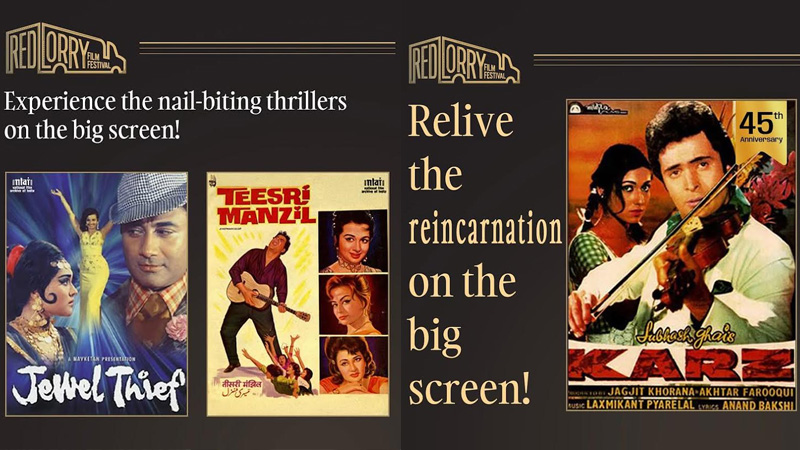
Celebrating 45 years of Subhash Ghai’s Karz (1980), the festival pays tribute to Indian cinema’s ‘Showman’ and his unforgettable musical thriller. “The magic of Karz still resonates today, and I am thrilled to share this milestone with fans,” said Ghai.
Adding to the nostalgia, Mansoor Khan takes the audience back in time with Qayamat Se Qayamat Tak (1988) and Jo Jeeta Wohi Sikandar (1992). “These films hold a special place in my heart, and I’m honoured to see them celebrated again,” he shared.
The legacy continues with Nasir Hussain’s iconic classics Yaadon Ki Baaraat (1973) and Hum Kisise Kum Nahin (1977), marking 65 years of his unparalleled storytelling. Rajiv Rai, son of visionary Gulshan Rai, will present Johny Mera Naam (1970) and Deewaar (1975), celebrating 55 years of Trimurti Films. “My father’s films were ahead of their time, and their impact continues to inspire generations,” said Rai.
The segment also honours Vijay Anand’s cinematic masterpieces like Teesri Manzil (1966), Jewel Thief (1967), and Johny Mera Naam (1970), bringing Indian cinema’s golden era back to the screen.
Timeless Tales
This festival isn’t just about Indian cinema—it’s a global celebration of cinema! Honouring the centennial birth anniversary of Guru Dutt, the festival presents one of his rare comedies, Mr. & Mrs. ‘55 (1955).
Marking 70 years of Smita Patil’s legacy, her iconic performance in Mirch Masala (1987) will once again grace the silver screen. Hollywood royalty takes center stage too, with a 35 Anniversary screening of Julia Roberts’ Pretty Woman and a 30 Anniversary Imax edition of Brad Pitt’s psychological thriller Se7en.
Adding to the international flavour, cinephiles can revisit French classics like Z (1969) and The Wages of Fear (1953), alongside Paul Verhoeven’s Showgirls (1995) in a 30 anniversary showcase.
Curated by acclaimed filmmaker Atul Sabharwal, the festival will present Michael Mann’s Heat (1995) and The Last of the Mohicans (1992). “These films are benchmarks in cinematic storytelling,” noted Sabharwal.
Fans of contemporary cinema can rejoice as Vikramaditya Motwane’s Udaan (2010) marks its 15 anniversary at the festival. “Udaan was a deeply personal project, and seeing it celebrated at this festival is a surreal experience,” shared Motwane.
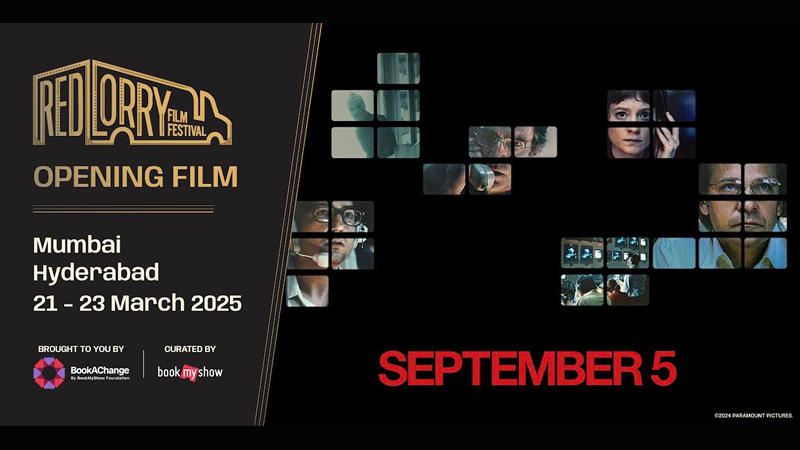
Following a phenomenal debut in 2024, the Red Lorry Film Festival returns from 21-23 March 2025, in Mumbai as ‘Red Lorry Film Festival: Take 2’, and expands to Hyderabad with ‘Red Lorry Film Festival: Parallel Verse’.
With over 120 meticulously curated films, interactive masterclasses, and discussions with industry greats, the festival promises an immersive experience for film lovers.
Don’t miss out on this cinematic adventure! Grab your tickets and be part of history.
Instagram: @bookmyshowin and @redlorryfilmfestival
X (Twitter): @bookmyshow and @RLFilmFestival
Facebook: @bookmyshow
YouTube: @bookmyshow



Hindi
India’s telecom subscribers cross 1.32 billion in February 2026
Broadband base swells past 1.06 billion as Jio and Airtel tighten grip on the market.
MUMBAI: India’s telecom sector is ringing in steady growth once again adding millions of new connections every month while the race for broadband supremacy continues to heat up like a fiercely contested cricket match. According to the latest data released by the Telecom Regulatory Authority of India (TRAI) on 1 April 2026, the total telephone subscriber base in the country reached 1,321.31 million at the end of February 2026. This marked a net addition of 7.31 million subscribers during the month, translating into a monthly growth rate of 0.56 per cent.
Wireless subscribers (including mobile and Fixed Wireless Access) stood at 1,273.31 million, registering a net addition of 6.97 million and a growth rate of 0.55 per cent. Within this, urban wireless connections grew to 730.75 million (growth 0.70 per cent), while rural wireless subscribers reached 542.56 million (growth 0.35 per cent).
Wireline subscribers, though much smaller in scale, showed slightly faster growth. The total wireline base increased to 47.99 million, with a net addition of 0.34 million and a monthly growth rate of 0.70 per cent. Urban areas continued to dominate wireline connections with a share of 89.41 per cent.
Overall tele-density in India improved to 92.66 per cent. Urban tele-density stood at 150.68 per cent, while rural tele-density edged up to 60.02 per cent.
The broadband subscriber base crossed a significant milestone, reaching 1,059.05 million at the end of February 2026. This reflected a healthy net addition of 6.33 million subscribers and a monthly growth rate of 0.60 per cent from January’s figure of 1,052.72 million.
Segment-wise, mobile wireless access continued to drive the majority of growth with 996.52 million subscribers. Fixed Wireless Access (including 5G FWA) added 16.51 million, while wired broadband stood at 46.02 million.
Reliance Jio Infocomm Ltd. maintained its commanding lead with 519.64 million broadband subscribers. Bharti Airtel Ltd. followed with 364.14 million, Vodafone Idea Ltd. with 129.36 million, Bharat Sanchar Nigam Ltd. with 28.70 million, and Atria Convergence Technologies Ltd. with 2.38 million.
Together, these top five players command a massive 98.60 per cent share of the total broadband market.
In the wireless (mobile) segment, private operators continued to dominate with 92.59 per cent market share, leaving public sector undertakings (BSNL and MTNL) with just 7.41 per cent.
Out of the total 1,257.29 million wireless (mobile) subscribers, 1,177.60 million were active on the peak Visitor Location Register (VLR) date, representing an impressive 93.66 per cent activity rate. Bharti Airtel led in this metric with 99.42 per cent of its subscribers active.
Meanwhile, 14.47 million subscribers submitted requests for Mobile Number Portability (MNP) in February, indicating healthy competition and customer churn across zones.
While urban areas still lead in absolute numbers, rural connectivity is slowly catching up. Rural wireless tele-density stood at 59.46 per cent, compared with the much higher urban figure of 142.32 per cent.
Fixed Wireless Access using 5G technology also showed promising traction, growing to 11.93 million subscribers. Reliance Jio and Bharti Airtel are the primary players driving this segment.
The data paints a picture of a maturing yet still rapidly expanding telecom ecosystem. With total telephone subscribers now well past the 1.32 billion mark and broadband users comfortably above 1.06 billion, India continues to solidify its position as one of the world’s largest and most dynamic digital markets.
From bustling city streets to remote villages, more Indians are staying connected than ever before proving that when it comes to telecom, the country’s appetite for growth shows no signs of hanging up anytime soon.






