News Broadcasting
Ravina Raj Kohli: On the prowl for professionals for Star News


Ravina Raj Kohli is stepping into high gear. Back from a month-long tour of News Corp’s news operations in the US, the UK, east Asia, she is charged up and raring to go all out in hiring professionals – both editorial and management – for her most challenging job yet. Setting up Star News India afresh from ground up in Hindi. News head Sanjay Pugalia – a steal from Zee News – is expected in Mumbai to begin a round of interviews in the coming week.
“I’m looking for a new kind of broadcasting professional who comes without any baggage,” says Kohli. “We would like people who think out of the box. Innovation is going to be the key word. I want new people, I want the best of talent because I believe if you want to be the preferred channel to watch, you have to be the preferred channel to work in as well.
According to her, she has hired a single professional agency to rope in the best of talent. She reveals that Star News India will have two major streams: the news side and operations. Pugalia, as stated earlier heads editorial and news, and the operations head has already been appointed from within the Star India network in Vynsley Fernandes. Operations will handle broadcasting and technology matters that make for a quality service, she says.

Kohli states that the news operations will be peopled by seasoned blood mixed with raw, young, and dynamic news gathering talent. “I’m looking for people who have fire in their bellies,” she says. “Who are willing to go the distance for the story.”
“News as a genre is no longer going to be the same,” says the tough-as-nails lady. “What we are looking at is relaunching the brand to broaden its horizons and perspective. We are the most fertile news market in the world. We can generate more news per square foot than anywhere else because of the sheer diversity and population that this country offers. And that is what Star News aims to tap.”
Central to Kohli’s vision is Mumbai, India’s commercial and entertainment capital. According to her, the very act of centralising news operations in Mumbai is a huge paradigm shift of perceptions because Delhi is India’s political capital and all national television news organisations are hqed there.
Why Mumbai? “Because the city encapsulates the cosmopolitan Indian sensibility,” says Kohli.







News Broadcasting
Network18 channels lead YouTube news viewership in March 2026
CNN-News18, News18 India and CNBC channels top categories with record views
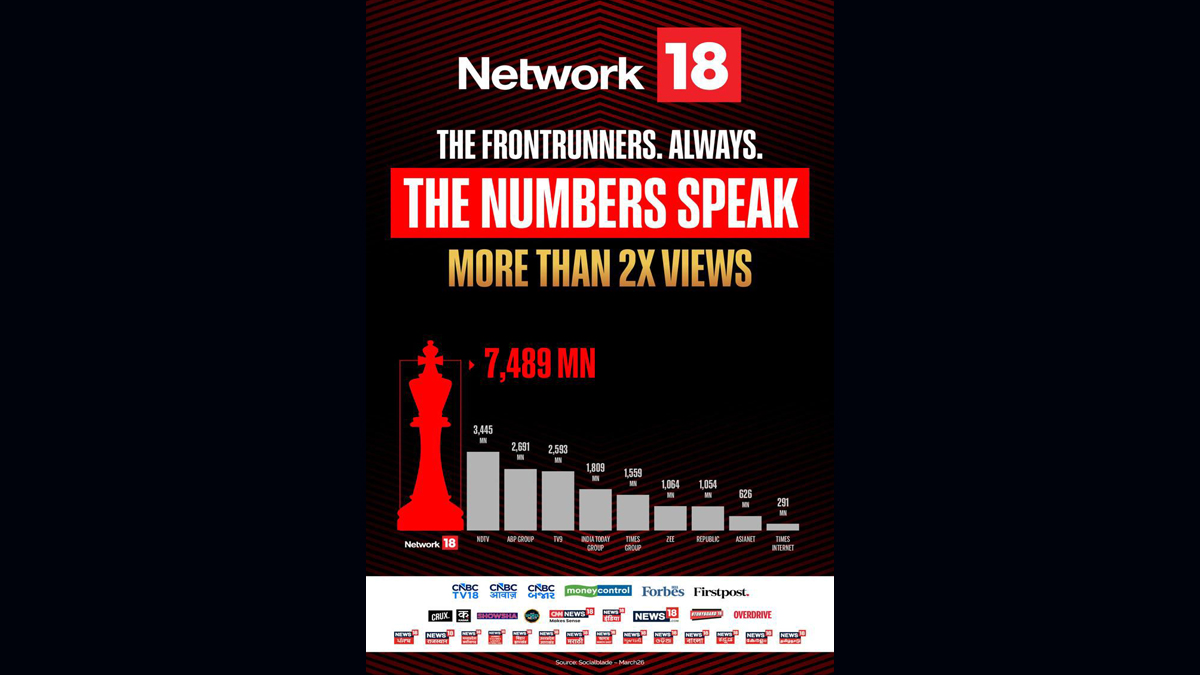
MUMBAI: When the world hit refresh on breaking news, Network18’s channels were already streaming ahead. As geopolitical tensions and war-driven headlines fuelled a surge in global news consumption, the network’s digital playbook delivered big clocking record Youtube viewership across English, Hindi and business news categories in March 2026.
At the forefront was CNN-News18, which emerged as the clear leader in the English news segment with 130 million live and video-on-demand views. The channel edged past competitors such as Times of India (126.5 million), Times Now (101.1 million), India Today (88.2 million) and NDTV (77.5 million), according to Databeings data for March.
In the Hindi news arena, News18 India delivered a commanding performance, racking up a staggering 3,297 million views on YouTube. The channel comfortably outpaced NDTV India, which recorded 3,119 million views, underlining its deep reach and consistent engagement with mass audiences, as per Playboard data.
The network’s dominance wasn’t confined to general news. In the Hindi business segment, CNBC Awaaz topped the charts with 92 million views, narrowly ahead of Zee Business (90 million) and well ahead of ET Now Swadesh (57 million). Meanwhile, its English counterpart CNBC-TV18 posted a strong 58 million views, reinforcing the network’s cross-category strength.
The spike in viewership reflects a broader shift in audience behaviour, with viewers increasingly turning to digital platforms particularly Youtube for real-time updates and in-depth coverage during high-intensity news cycles. For Network18, the numbers signal more than just scale; they underline the effectiveness of a multi-platform strategy that blends speed, credibility and continuous coverage.
In a month where the news never paused, it seems viewers chose to stay tuned where the stream never stopped.






