News Broadcasting
#RaceTo272 with Twitter and NDTV’s Graphity


MUMBAI: When it first created Graphity on the occasion of Republic Day, little did NDTV know that its service of sending personalized photographs and messages would create such a flutter on social media, especially Twitter.
On the counting day, 16 May, NDTV has decided to engage its propriety service Graphity on Twitter to tweet real-time results to people who use the hashtag #RaceTo272 from @NDTVElections. The tweet will have an info-graphic representing the latest party/alliance position at that moment.

How does it work?
A little over three months since its launch and NDTV’s platform already boasts a client list that reads: Rajinikanth, Jai Ho, the BJP, Hero and Star Vijay among others. Indeed, when Rajini finally decided to be a part of Twitter, his first few followers received autographed photographs of the southern legend, courtesy Graphity.
While the popular trend has been for people and companies to turn to Graphity to attract users, more prominently on Twitter, the service is not restricted only to Twitter, and can operate for web and SMS as well. According to NDTV Convergence CTO Kawaljit Singh Bedi, “The technology is such that we can monitor any social media. But Twitter is the best medium to do it.”
On Twitter, Graphity works on keywords and hash tags; it listens to them and sends out the desired outcome, as requested by the client or NDTV itself. A case in point is Star Vijay, which utilized the service for its show Super Singer where hash tags were tracked and personalized messages from finalists were sent for a week before the finale. “We wanted to be a brand that people follow. Super Singer is synonymous with Star Vijay so the conversation would revolve round us. This helped us deepen the bond and make it stronger,” says Star Vijay digital media strategist Paul Samji.
NDTV first used Graphity for one of its own activities in January, post which, Twitter sat up and took notice and started routing people who required similar services to NDTV. It took four months to come up with the service and if anything, all that hard work is now bearing fruit. It takes one or at the most two days to form an idea of what the client wants. Using the content management system (CMS), users give controls to the software. Firstly, the ‘listener’ service listens to hash tags by connecting to Twitter and secondly, the listener application connects to the ‘pusher’ application. The response page then sends out the desired outcome that is modified to fit a web page as well as various operating systems.
According to sources, rates for Graphity have ranged from Rs 3 lakh to Rs 18 lakh.
The inspiration for Graphity came from BCCI’s photographs of Sachin Tendulkar bidding farewell to the cricketing world and his fans. After speaking to various companies, including some in the US, NDTV decided to do it alone. A team of four engineers helped set up Graphity. “We have built it like a platform. It suggests an inpoint and outpoint for sending commands to execute outcome. These can be text, image, video, information or a combination of any of these,” says Bedi. “There are two more brands we are working with. The requests are only increasing because brands see the value in Graphity.”
Given Graphity’s growing popularity, it’s quite possible that in the near future, the service may evolve into more than just a branding exercise used by brands to get maximum exposure.





News Broadcasting
Network18 channels lead YouTube news viewership in March 2026
CNN-News18, News18 India and CNBC channels top categories with record views
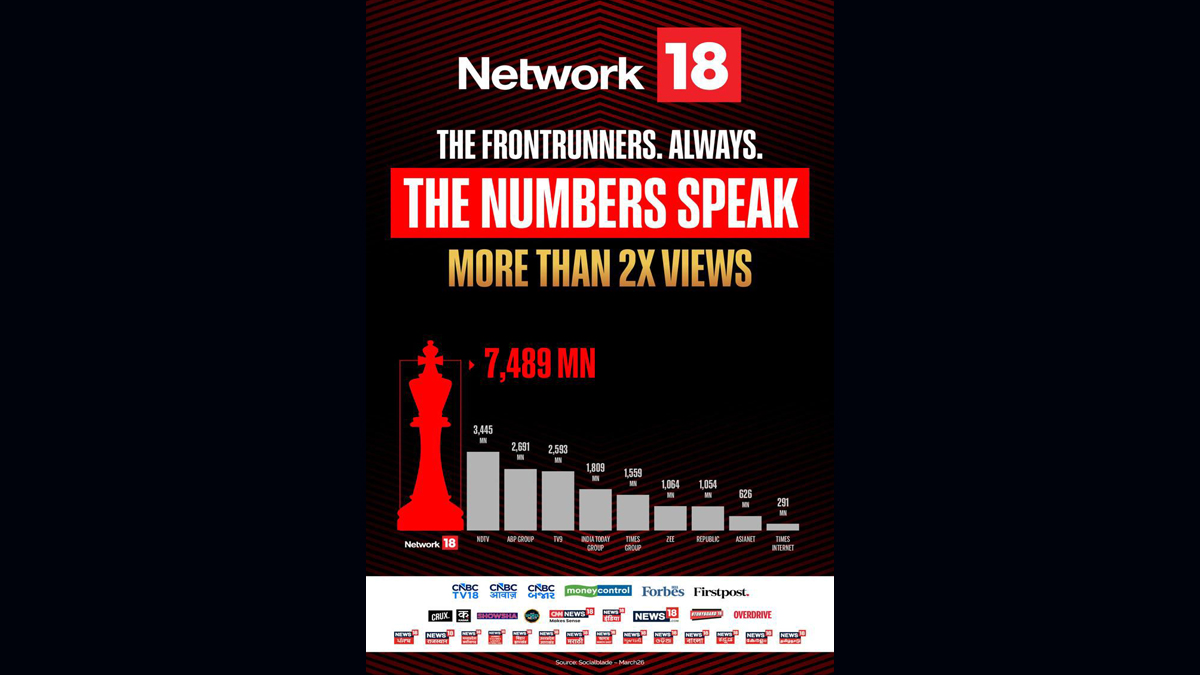
MUMBAI: When the world hit refresh on breaking news, Network18’s channels were already streaming ahead. As geopolitical tensions and war-driven headlines fuelled a surge in global news consumption, the network’s digital playbook delivered big clocking record Youtube viewership across English, Hindi and business news categories in March 2026.
At the forefront was CNN-News18, which emerged as the clear leader in the English news segment with 130 million live and video-on-demand views. The channel edged past competitors such as Times of India (126.5 million), Times Now (101.1 million), India Today (88.2 million) and NDTV (77.5 million), according to Databeings data for March.
In the Hindi news arena, News18 India delivered a commanding performance, racking up a staggering 3,297 million views on YouTube. The channel comfortably outpaced NDTV India, which recorded 3,119 million views, underlining its deep reach and consistent engagement with mass audiences, as per Playboard data.
The network’s dominance wasn’t confined to general news. In the Hindi business segment, CNBC Awaaz topped the charts with 92 million views, narrowly ahead of Zee Business (90 million) and well ahead of ET Now Swadesh (57 million). Meanwhile, its English counterpart CNBC-TV18 posted a strong 58 million views, reinforcing the network’s cross-category strength.
The spike in viewership reflects a broader shift in audience behaviour, with viewers increasingly turning to digital platforms particularly Youtube for real-time updates and in-depth coverage during high-intensity news cycles. For Network18, the numbers signal more than just scale; they underline the effectiveness of a multi-platform strategy that blends speed, credibility and continuous coverage.
In a month where the news never paused, it seems viewers chose to stay tuned where the stream never stopped.






